

3.4 Electromagnetic Separation of Isotopes
131
We first deal with electromagnetic separation of isotopes. Barrier diffusion is
taken up in Sect. 3.5.
The electromagnetic separation facility at Oak Ridge was code-named Y-12, and
utilized “calutron” separators designed by Ernest Lawrence; the name is a contraction
of “California University Cyclotron.” The design of these separators was predicated
on the phenomenon that an ion, when directed into a magnetic field oriented perpendicularly to the its initial velocity, will subsequently travel in a circular orbit whose
radius is dictated by the strength of the field, the magnitude of the initial velocity,
the degree of ionization, and the ion’s mass. Isotopes of different masses will consequently travel in different orbits, and can be separated. As with any isotope separation technique, this method depends on the very slight mass difference between the
isotopes involved. In the case of
235 U and
238 U, the mass difference is very small, so
this technique is extremely difficult to realize in practice.
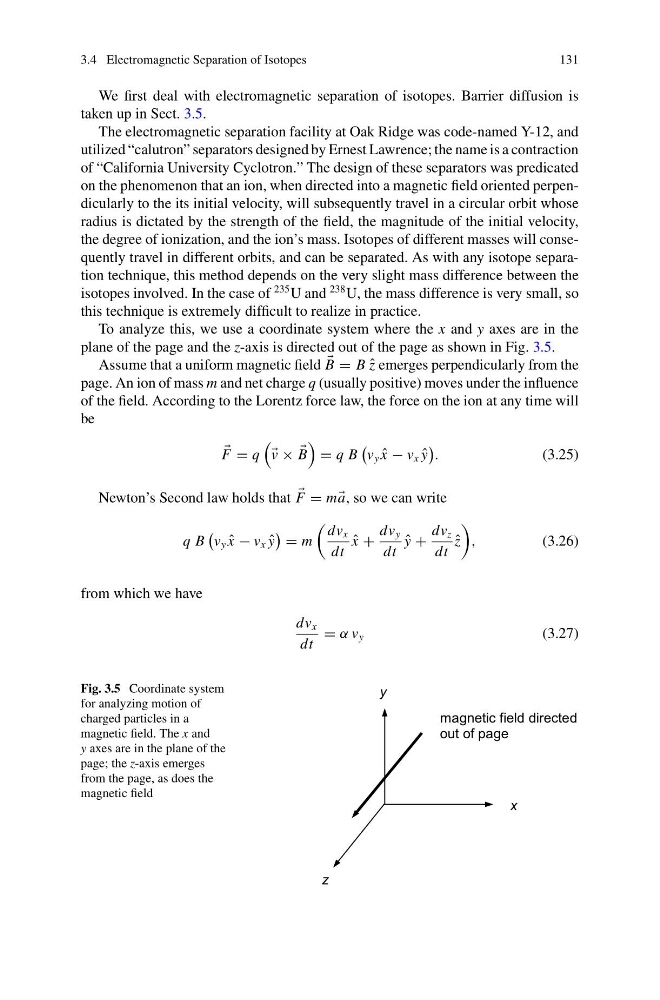
To analyze this, we use a coordinate system where the x and y axes are in the
plane of the page and the z-axis is directed out of the page as shown in Fig. 3.5.
Assume that a uniform magnetic field
B = B ˆ
z emerges perpendicularly from the
page. An ion of mass m and net charge q (usually positive) moves under the influence
of the field. According to the Lorentz force law, the force on the ion at any time will
be
F = q
v ×
B
= q B
v y ˆ
x − v x ˆ
y
.
(3.25)
Newton’s Second law holds that
F = m
a, so we can write
q B
v y ˆ
x − v x ˆ
y
= m
dv x
dt
ˆ
x +
dv y
dt
ˆ
y +
dv z
dt
ˆ
z
,
(3.26)
from which we have
dv x
dt
= α v y
(3.27)
Fig. 3.5 Coordinate system
for analyzing motion of
charged particles in a
magnetic field. The x and
y axes are in the plane of the
page; the z-axis emerges
from the page, as does the
magnetic field
x
y
z
magnetic field directed
out of page
131
We first deal with electromagnetic separation of isotopes. Barrier diffusion is
taken up in Sect. 3.5.
The electromagnetic separation facility at Oak Ridge was code-named Y-12, and
utilized “calutron” separators designed by Ernest Lawrence; the name is a contraction
of “California University Cyclotron.” The design of these separators was predicated
on the phenomenon that an ion, when directed into a magnetic field oriented perpendicularly to the its initial velocity, will subsequently travel in a circular orbit whose
radius is dictated by the strength of the field, the magnitude of the initial velocity,
the degree of ionization, and the ion’s mass. Isotopes of different masses will consequently travel in different orbits, and can be separated. As with any isotope separation technique, this method depends on the very slight mass difference between the
isotopes involved. In the case of
235 U and
238 U, the mass difference is very small, so
this technique is extremely difficult to realize in practice.
To analyze this, we use a coordinate system where the x and y axes are in the
plane of the page and the z-axis is directed out of the page as shown in Fig. 3.5.
Assume that a uniform magnetic field
B = B ˆ
z emerges perpendicularly from the
page. An ion of mass m and net charge q (usually positive) moves under the influence
of the field. According to the Lorentz force law, the force on the ion at any time will
be
F = q
v ×
B
= q B
v y ˆ
x − v x ˆ
y
.
(3.25)
Newton’s Second law holds that
F = m
a, so we can write
q B
v y ˆ
x − v x ˆ
y
= m
dv x
dt
ˆ
x +
dv y
dt
ˆ
y +
dv z
dt
ˆ
z
,
(3.26)
from which we have
dv x
dt
= α v y
(3.27)
Fig. 3.5 Coordinate system
for analyzing motion of
charged particles in a
magnetic field. The x and
y axes are in the plane of the
page; the z-axis emerges
from the page, as does the
magnetic field
x
y
z
magnetic field directed
out of page