

3.2 Neutron Thermalization
127
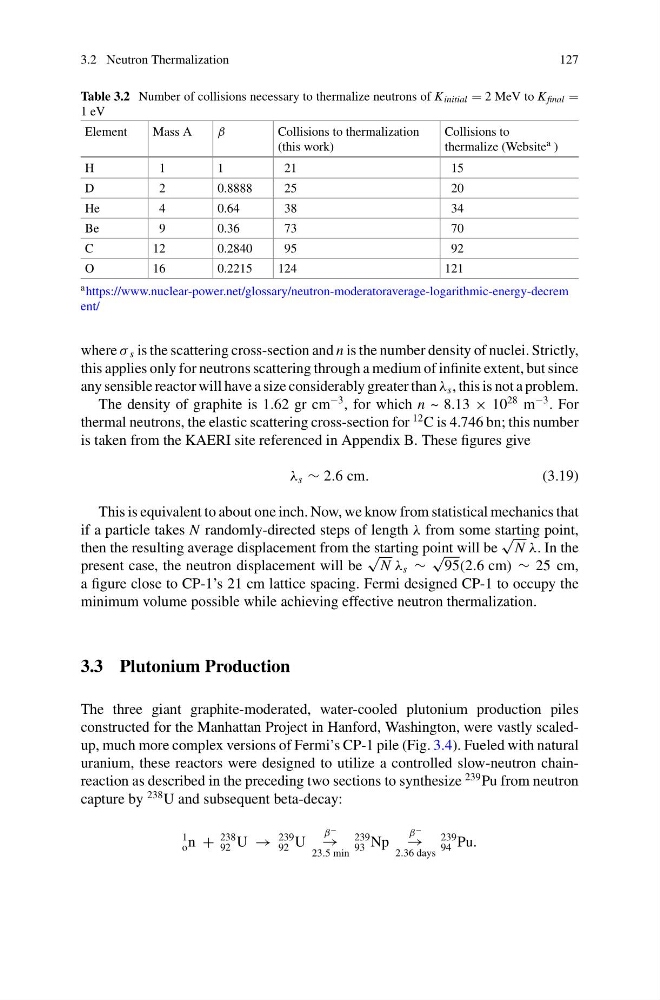
Table 3.2 Number of collisions necessary to thermalize neutrons of K initial = 2 MeV to K final =
1 eV
Element
Mass A
β
Collisions to thermalization
(this work)
Collisions to
thermalize (Website a )
H
1
1
21
15
D
2
0.8888
25
20
He
4
0.64
38
34
Be
9
0.36
73
70
C
12
0.2840
95
92
O
16
0.2215
124
121
a https://www.nuclear-power.net/glossary/neutron-moderatoraverage-logarithmic-energy-decrem
ent/
where σ s is the scattering cross-section and n is the number density of nuclei. Strictly,
this applies only for neutrons scattering through a medium of infinite extent, but since
any sensible reactor will have a size considerably greater than λ s , this is not a problem.
The density of graphite is 1.62 gr cm
−3 , for which n ~ 8.13 × 10
28 m
−3 . For
thermal neutrons, the elastic scattering cross-section for
12 C is 4.746 bn; this number
is taken from the KAERI site referenced in Appendix B. These figures give
λ s ∼ 2.6 cm.
(3.19)
This is equivalent to about one inch. Now, we know from statistical mechanics that
if a particle takes N randomly-directed steps of length λ from some starting point,
then the resulting average displacement from the starting point will be
√
N λ. In the
present case, the neutron displacement will be
√
N λ s ∼
√
95(2.6 cm) ∼ 25 cm,
a figure close to CP-1’s 21 cm lattice spacing. Fermi designed CP-1 to occupy the
minimum volume possible while achieving effective neutron thermalization.
3.3 Plutonium Production
The three giant graphite-moderated, water-cooled plutonium production piles
constructed for the Manhattan Project in Hanford, Washington, were vastly scaledup, much more complex versions of Fermi’s CP-1 pile (Fig. 3.4). Fueled with natural
uranium, these reactors were designed to utilize a controlled slow-neutron chainreaction as described in the preceding two sections to synthesize
239 Pu from neutron
capture by
238 U and subsequent beta-decay:
1
o n +
238
92 U →
239
92 U
β
−
→
23.5 min
239
93 Np
β
−
→
2.36 days
239
94 Pu.
127
Table 3.2 Number of collisions necessary to thermalize neutrons of K initial = 2 MeV to K final =
1 eV
Element
Mass A
β
Collisions to thermalization
(this work)
Collisions to
thermalize (Website a )
H
1
1
21
15
D
2
0.8888
25
20
He
4
0.64
38
34
Be
9
0.36
73
70
C
12
0.2840
95
92
O
16
0.2215
124
121
a https://www.nuclear-power.net/glossary/neutron-moderatoraverage-logarithmic-energy-decrem
ent/
where σ s is the scattering cross-section and n is the number density of nuclei. Strictly,
this applies only for neutrons scattering through a medium of infinite extent, but since
any sensible reactor will have a size considerably greater than λ s , this is not a problem.
The density of graphite is 1.62 gr cm
−3 , for which n ~ 8.13 × 10
28 m
−3 . For
thermal neutrons, the elastic scattering cross-section for
12 C is 4.746 bn; this number
is taken from the KAERI site referenced in Appendix B. These figures give
λ s ∼ 2.6 cm.
(3.19)
This is equivalent to about one inch. Now, we know from statistical mechanics that
if a particle takes N randomly-directed steps of length λ from some starting point,
then the resulting average displacement from the starting point will be
√
N λ. In the
present case, the neutron displacement will be
√
N λ s ∼
√
95(2.6 cm) ∼ 25 cm,
a figure close to CP-1’s 21 cm lattice spacing. Fermi designed CP-1 to occupy the
minimum volume possible while achieving effective neutron thermalization.
3.3 Plutonium Production
The three giant graphite-moderated, water-cooled plutonium production piles
constructed for the Manhattan Project in Hanford, Washington, were vastly scaledup, much more complex versions of Fermi’s CP-1 pile (Fig. 3.4). Fueled with natural
uranium, these reactors were designed to utilize a controlled slow-neutron chainreaction as described in the preceding two sections to synthesize
239 Pu from neutron
capture by
238 U and subsequent beta-decay:
1
o n +
238
92 U →
239
92 U
β
−
→
23.5 min
239
93 Np
β
−
→
2.36 days
239
94 Pu.