

126
3 Producing Fissile Material
p = −
2M
m + M
p initial cos ψ.
(3.14)
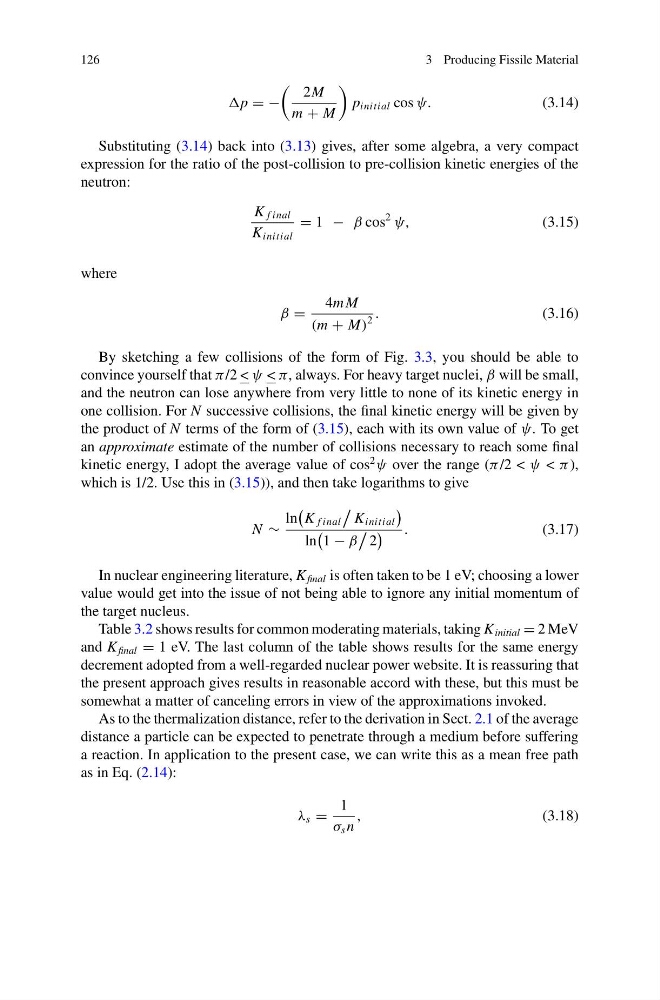
Substituting (3.14) back into (3.13) gives, after some algebra, a very compact
expression for the ratio of the post-collision to pre-collision kinetic energies of the
neutron:
K f inal
K initial
= 1 − β cos
2
ψ,
(3.15)
where
β =
4m M
(m + M)
2
.
(3.16)
By sketching a few collisions of the form of Fig. 3.3, you should be able to
convince yourself that π /2 < ψ < π, always. For heavy target nuclei, β will be small,
and the neutron can lose anywhere from very little to none of its kinetic energy in
one collision. For N successive collisions, the final kinetic energy will be given by
the product of N terms of the form of (3.15), each with its own value of ψ. To get
an approximate estimate of the number of collisions necessary to reach some final
kinetic energy, I adopt the average value of cos
2
ψ over the range (π /2 < ψ < π ),
which is 1/2. Use this in (3.15)), and then take logarithms to give
N ∼
ln
K f inal
K initial
ln
1 − β
2
.
(3.17)
In nuclear engineering literature, K final is often taken to be 1 eV; choosing a lower
value would get into the issue of not being able to ignore any initial momentum of
the target nucleus.
Table 3.2 shows results for common moderating materials, taking K initial = 2 MeV
and K final = 1 eV. The last column of the table shows results for the same energy
decrement adopted from a well-regarded nuclear power website. It is reassuring that
the present approach gives results in reasonable accord with these, but this must be
somewhat a matter of canceling errors in view of the approximations invoked.
As to the thermalization distance, refer to the derivation in Sect. 2.1 of the average
distance a particle can be expected to penetrate through a medium before suffering
a reaction. In application to the present case, we can write this as a mean free path
as in Eq. (2.14):
λ s =
1
σ s n
,
(3.18)
3 Producing Fissile Material
p = −
2M
m + M
p initial cos ψ.
(3.14)
Substituting (3.14) back into (3.13) gives, after some algebra, a very compact
expression for the ratio of the post-collision to pre-collision kinetic energies of the
neutron:
K f inal
K initial
= 1 − β cos
2
ψ,
(3.15)
where
β =
4m M
(m + M)
2
.
(3.16)
By sketching a few collisions of the form of Fig. 3.3, you should be able to
convince yourself that π /2 < ψ < π, always. For heavy target nuclei, β will be small,
and the neutron can lose anywhere from very little to none of its kinetic energy in
one collision. For N successive collisions, the final kinetic energy will be given by
the product of N terms of the form of (3.15), each with its own value of ψ. To get
an approximate estimate of the number of collisions necessary to reach some final
kinetic energy, I adopt the average value of cos
2
ψ over the range (π /2 < ψ < π ),
which is 1/2. Use this in (3.15)), and then take logarithms to give
N ∼
ln
K f inal
K initial
ln
1 − β
2
.
(3.17)
In nuclear engineering literature, K final is often taken to be 1 eV; choosing a lower
value would get into the issue of not being able to ignore any initial momentum of
the target nucleus.
Table 3.2 shows results for common moderating materials, taking K initial = 2 MeV
and K final = 1 eV. The last column of the table shows results for the same energy
decrement adopted from a well-regarded nuclear power website. It is reassuring that
the present approach gives results in reasonable accord with these, but this must be
somewhat a matter of canceling errors in view of the approximations invoked.
As to the thermalization distance, refer to the derivation in Sect. 2.1 of the average
distance a particle can be expected to penetrate through a medium before suffering
a reaction. In application to the present case, we can write this as a mean free path
as in Eq. (2.14):
λ s =
1
σ s n
,
(3.18)