

3.2 Neutron Thermalization
125
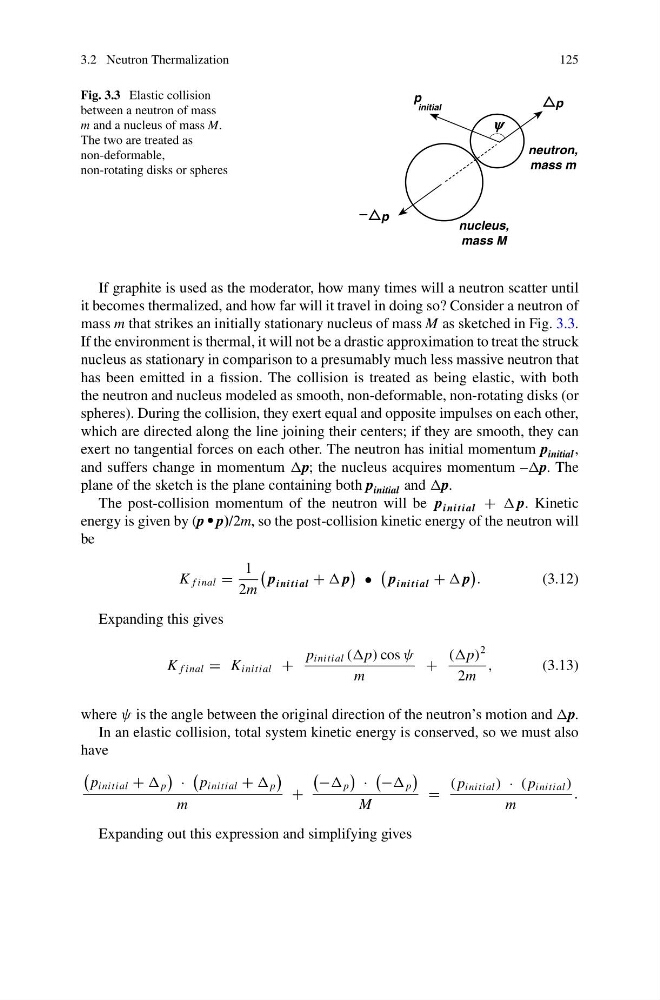
Fig. 3.3 Elastic collision
between a neutron of mass
m and a nucleus of mass M.
The two are treated as
non-deformable,
non-rotating disks or spheres
p
p
p
neutron,
mass m
nucleus,
mass M
initial
If graphite is used as the moderator, how many times will a neutron scatter until
it becomes thermalized, and how far will it travel in doing so? Consider a neutron of
mass m that strikes an initially stationary nucleus of mass M as sketched in Fig. 3.3.
If the environment is thermal, it will not be a drastic approximation to treat the struck
nucleus as stationary in comparison to a presumably much less massive neutron that
has been emitted in a fission. The collision is treated as being elastic, with both
the neutron and nucleus modeled as smooth, non-deformable, non-rotating disks (or
spheres). During the collision, they exert equal and opposite impulses on each other,
which are directed along the line joining their centers; if they are smooth, they can
exert no tangential forces on each other. The neutron has initial momentum p initial ,
and suffers change in momentum the nucleus acquires momentum – The
plane of the sketch is the plane containing both p initial and
The post-collision momentum of the neutron will be p ini t i al + p. Kinetic
energy is given by (p • p)/2m, so the post-collision kinetic energy of the neutron will
be
K f inal =
1
2m
p ini t i al + p
•
p ini t i al + p
.
(3.12)
Expanding this gives
K f inal = K initial +
p initial ( cos ψ
m
+
(
2
2m
,
(3.13)
where ψ is the angle between the original direction of the neutron’s motion and
In an elastic collision, total system kinetic energy is conserved, so we must also
have
p initial + p
·
p initial + p
m
+
− p
·
− p
M
=
( p initial ) · ( p initial )
m
.
Expanding out this expression and simplifying gives
125
Fig. 3.3 Elastic collision
between a neutron of mass
m and a nucleus of mass M.
The two are treated as
non-deformable,
non-rotating disks or spheres
p
p
p
neutron,
mass m
nucleus,
mass M
initial
If graphite is used as the moderator, how many times will a neutron scatter until
it becomes thermalized, and how far will it travel in doing so? Consider a neutron of
mass m that strikes an initially stationary nucleus of mass M as sketched in Fig. 3.3.
If the environment is thermal, it will not be a drastic approximation to treat the struck
nucleus as stationary in comparison to a presumably much less massive neutron that
has been emitted in a fission. The collision is treated as being elastic, with both
the neutron and nucleus modeled as smooth, non-deformable, non-rotating disks (or
spheres). During the collision, they exert equal and opposite impulses on each other,
which are directed along the line joining their centers; if they are smooth, they can
exert no tangential forces on each other. The neutron has initial momentum p initial ,
and suffers change in momentum the nucleus acquires momentum – The
plane of the sketch is the plane containing both p initial and
The post-collision momentum of the neutron will be p ini t i al + p. Kinetic
energy is given by (p • p)/2m, so the post-collision kinetic energy of the neutron will
be
K f inal =
1
2m
p ini t i al + p
•
p ini t i al + p
.
(3.12)
Expanding this gives
K f inal = K initial +
p initial ( cos ψ
m
+
(
2
2m
,
(3.13)
where ψ is the angle between the original direction of the neutron’s motion and
In an elastic collision, total system kinetic energy is conserved, so we must also
have
p initial + p
·
p initial + p
m
+
− p
·
− p
M
=
( p initial ) · ( p initial )
m
.
Expanding out this expression and simplifying gives