

124
3 Producing Fissile Material
3.2 Neutron Thermalization
Fermi’s CP-1 reactor used graphite (crystallized carbon) as a moderator to slow
neutrons emitted by fissioning
235 U nuclei to so-called “thermal” speeds to take
advantage of the large fission cross-section of that isotope for neutrons of such
energy. Graphite was used as it has a small capture cross-section for neutrons. In this
section we quantify the meaning of “thermal,” and estimate the typical distance a
neutron will travel during the thermalization process; this will give us insight as to
why the lumps of uranium in CP-1 were distributed as a cubical lattice with a spacing
of 8.25 in. (21 cm). A detailed description of CP-1 was published in Fermi (1952).
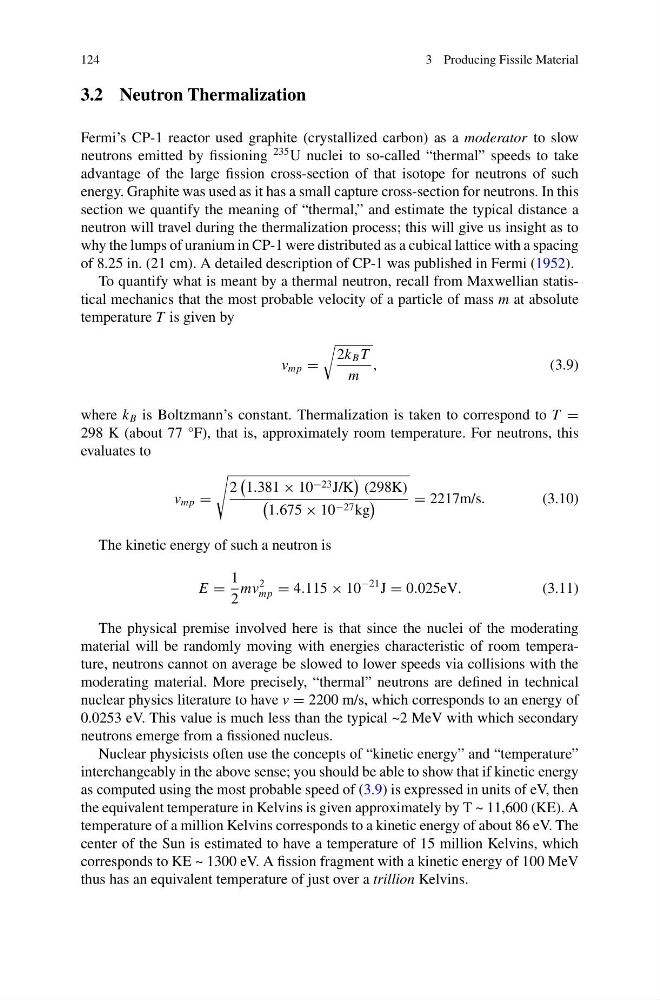
To quantify what is meant by a thermal neutron, recall from Maxwellian statistical mechanics that the most probable velocity of a particle of mass m at absolute
temperature T is given by
v mp =
2k B T
m
,
(3.9)
where k B is Boltzmann’s constant. Thermalization is taken to correspond to T =
298 K (about 77 °F), that is, approximately room temperature. For neutrons, this
evaluates to
v mp =
2
1.381 × 10 −23 J/K
(298K)
1.675 × 10 −27 kg
= 2217m/s.
(3.10)
The kinetic energy of such a neutron is
E =
1
2
mv
2
mp = 4.115 × 10
−21 J = 0.025eV.
(3.11)
The physical premise involved here is that since the nuclei of the moderating
material will be randomly moving with energies characteristic of room temperature, neutrons cannot on average be slowed to lower speeds via collisions with the
moderating material. More precisely, “thermal” neutrons are defined in technical
nuclear physics literature to have v = 2200 m/s, which corresponds to an energy of
0.0253 eV. This value is much less than the typical ~2 MeV with which secondary
neutrons emerge from a fissioned nucleus.
Nuclear physicists often use the concepts of “kinetic energy” and “temperature”
interchangeably in the above sense; you should be able to show that if kinetic energy
as computed using the most probable speed of (3.9) is expressed in units of eV, then
the equivalent temperature in Kelvins is given approximately by T ~ 11,600 (KE). A
temperature of a million Kelvins corresponds to a kinetic energy of about 86 eV. The
center of the Sun is estimated to have a temperature of 15 million Kelvins, which
corresponds to KE ~ 1300 eV. A fission fragment with a kinetic energy of 100 MeV
thus has an equivalent temperature of just over a trillion Kelvins.
3 Producing Fissile Material
3.2 Neutron Thermalization
Fermi’s CP-1 reactor used graphite (crystallized carbon) as a moderator to slow
neutrons emitted by fissioning
235 U nuclei to so-called “thermal” speeds to take
advantage of the large fission cross-section of that isotope for neutrons of such
energy. Graphite was used as it has a small capture cross-section for neutrons. In this
section we quantify the meaning of “thermal,” and estimate the typical distance a
neutron will travel during the thermalization process; this will give us insight as to
why the lumps of uranium in CP-1 were distributed as a cubical lattice with a spacing
of 8.25 in. (21 cm). A detailed description of CP-1 was published in Fermi (1952).
To quantify what is meant by a thermal neutron, recall from Maxwellian statistical mechanics that the most probable velocity of a particle of mass m at absolute
temperature T is given by
v mp =
2k B T
m
,
(3.9)
where k B is Boltzmann’s constant. Thermalization is taken to correspond to T =
298 K (about 77 °F), that is, approximately room temperature. For neutrons, this
evaluates to
v mp =
2
1.381 × 10 −23 J/K
(298K)
1.675 × 10 −27 kg
= 2217m/s.
(3.10)
The kinetic energy of such a neutron is
E =
1
2
mv
2
mp = 4.115 × 10
−21 J = 0.025eV.
(3.11)
The physical premise involved here is that since the nuclei of the moderating
material will be randomly moving with energies characteristic of room temperature, neutrons cannot on average be slowed to lower speeds via collisions with the
moderating material. More precisely, “thermal” neutrons are defined in technical
nuclear physics literature to have v = 2200 m/s, which corresponds to an energy of
0.0253 eV. This value is much less than the typical ~2 MeV with which secondary
neutrons emerge from a fissioned nucleus.
Nuclear physicists often use the concepts of “kinetic energy” and “temperature”
interchangeably in the above sense; you should be able to show that if kinetic energy
as computed using the most probable speed of (3.9) is expressed in units of eV, then
the equivalent temperature in Kelvins is given approximately by T ~ 11,600 (KE). A
temperature of a million Kelvins corresponds to a kinetic energy of about 86 eV. The
center of the Sun is estimated to have a temperature of 15 million Kelvins, which
corresponds to KE ~ 1300 eV. A fission fragment with a kinetic energy of 100 MeV
thus has an equivalent temperature of just over a trillion Kelvins.