

3.1 Reactor Criticality
123
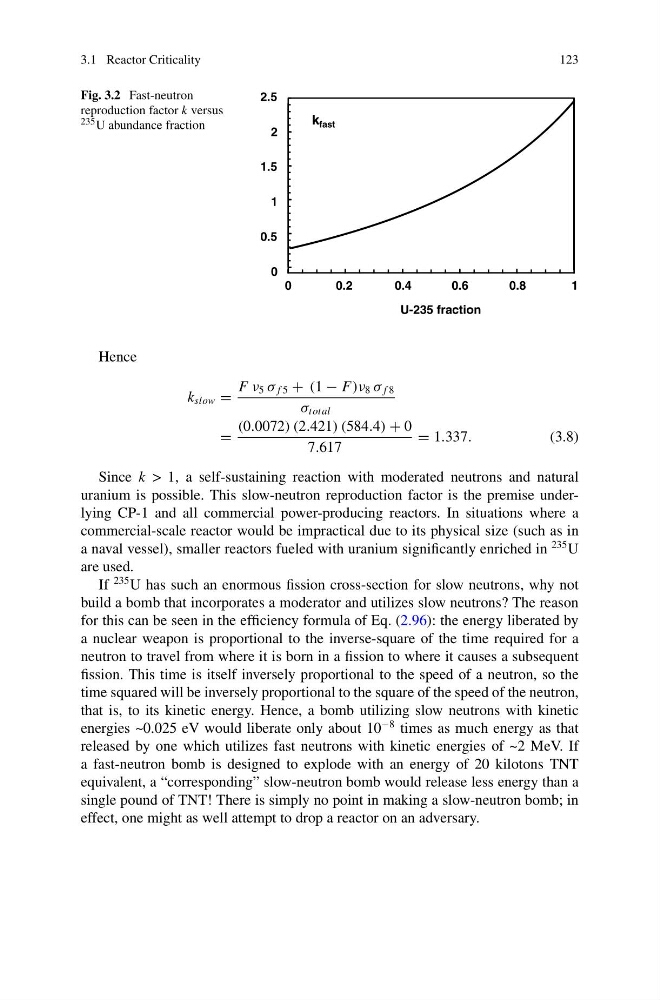
Fig. 3.2 Fast-neutron
reproduction factor k versus
235 U abundance fraction
0
0.5
1
1.5
2
2.5
0
0.2
0.4
0.6
0.8
1
k fast
U-235 fraction
Hence
k slow =
F ν 5 σ f 5 + (1 − F)ν 8 σ f 8
σ total
=
(0.0072) (2.421) (584.4) + 0
7.617
= 1.337.
(3.8)
Since k > 1, a self-sustaining reaction with moderated neutrons and natural
uranium is possible. This slow-neutron reproduction factor is the premise underlying CP-1 and all commercial power-producing reactors. In situations where a
commercial-scale reactor would be impractical due to its physical size (such as in
a naval vessel), smaller reactors fueled with uranium significantly enriched in
235 U
are used.
If
235 U has such an enormous fission cross-section for slow neutrons, why not
build a bomb that incorporates a moderator and utilizes slow neutrons? The reason
for this can be seen in the efficiency formula of Eq. (2.96): the energy liberated by
a nuclear weapon is proportional to the inverse-square of the time required for a
neutron to travel from where it is born in a fission to where it causes a subsequent
fission. This time is itself inversely proportional to the speed of a neutron, so the
time squared will be inversely proportional to the square of the speed of the neutron,
that is, to its kinetic energy. Hence, a bomb utilizing slow neutrons with kinetic
energies ~0.025 eV would liberate only about 10
−8 times as much energy as that
released by one which utilizes fast neutrons with kinetic energies of ~2 MeV. If
a fast-neutron bomb is designed to explode with an energy of 20 kilotons TNT
equivalent, a “corresponding” slow-neutron bomb would release less energy than a
single pound of TNT! There is simply no point in making a slow-neutron bomb; in
effect, one might as well attempt to drop a reactor on an adversary.
123
Fig. 3.2 Fast-neutron
reproduction factor k versus
235 U abundance fraction
0
0.5
1
1.5
2
2.5
0
0.2
0.4
0.6
0.8
1
k fast
U-235 fraction
Hence
k slow =
F ν 5 σ f 5 + (1 − F)ν 8 σ f 8
σ total
=
(0.0072) (2.421) (584.4) + 0
7.617
= 1.337.
(3.8)
Since k > 1, a self-sustaining reaction with moderated neutrons and natural
uranium is possible. This slow-neutron reproduction factor is the premise underlying CP-1 and all commercial power-producing reactors. In situations where a
commercial-scale reactor would be impractical due to its physical size (such as in
a naval vessel), smaller reactors fueled with uranium significantly enriched in
235 U
are used.
If
235 U has such an enormous fission cross-section for slow neutrons, why not
build a bomb that incorporates a moderator and utilizes slow neutrons? The reason
for this can be seen in the efficiency formula of Eq. (2.96): the energy liberated by
a nuclear weapon is proportional to the inverse-square of the time required for a
neutron to travel from where it is born in a fission to where it causes a subsequent
fission. This time is itself inversely proportional to the speed of a neutron, so the
time squared will be inversely proportional to the square of the speed of the neutron,
that is, to its kinetic energy. Hence, a bomb utilizing slow neutrons with kinetic
energies ~0.025 eV would liberate only about 10
−8 times as much energy as that
released by one which utilizes fast neutrons with kinetic energies of ~2 MeV. If
a fast-neutron bomb is designed to explode with an energy of 20 kilotons TNT
equivalent, a “corresponding” slow-neutron bomb would release less energy than a
single pound of TNT! There is simply no point in making a slow-neutron bomb; in
effect, one might as well attempt to drop a reactor on an adversary.