

128
3 Producing Fissile Material
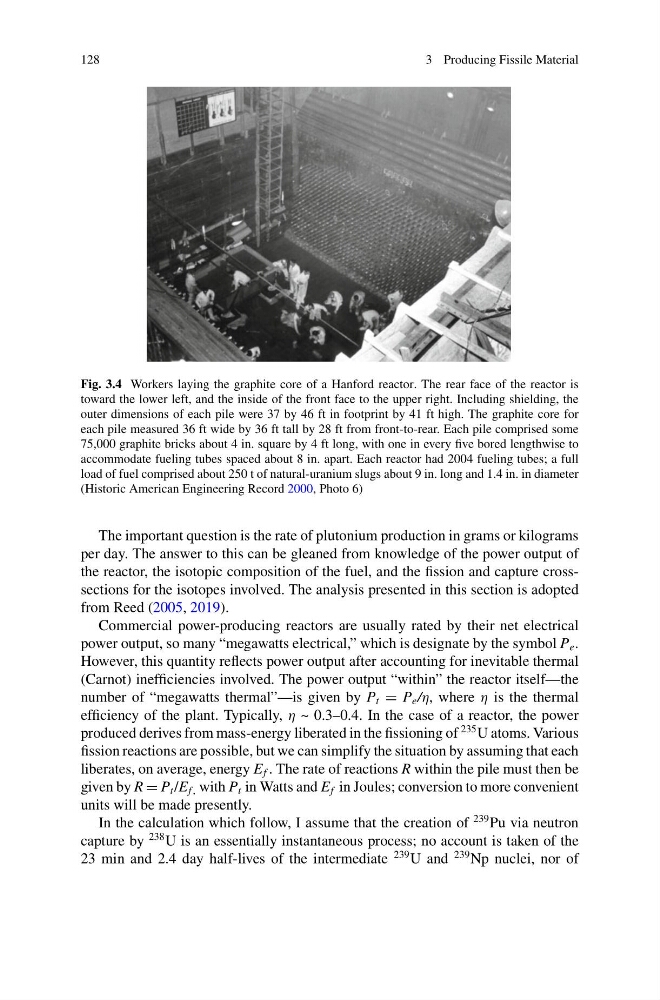
Fig. 3.4 Workers laying the graphite core of a Hanford reactor. The rear face of the reactor is
toward the lower left, and the inside of the front face to the upper right. Including shielding, the
outer dimensions of each pile were 37 by 46 ft in footprint by 41 ft high. The graphite core for
each pile measured 36 ft wide by 36 ft tall by 28 ft from front-to-rear. Each pile comprised some
75,000 graphite bricks about 4 in. square by 4 ft long, with one in every five bored lengthwise to
accommodate fueling tubes spaced about 8 in. apart. Each reactor had 2004 fueling tubes; a full
load of fuel comprised about 250 t of natural-uranium slugs about 9 in. long and 1.4 in. in diameter
(Historic American Engineering Record 2000, Photo 6)
The important question is the rate of plutonium production in grams or kilograms
per day. The answer to this can be gleaned from knowledge of the power output of
the reactor, the isotopic composition of the fuel, and the fission and capture crosssections for the isotopes involved. The analysis presented in this section is adopted
from Reed (2005, 2019).
Commercial power-producing reactors are usually rated by their net electrical
power output, so many “megawatts electrical,” which is designate by the symbol P e .
However, this quantity reflects power output after accounting for inevitable thermal
(Carnot) inefficiencies involved. The power output “within” the reactor itself—the
number of “megawatts thermal”—is given by P t = P e /η, where η is the thermal
efficiency of the plant. Typically, η ~ 0.3–0.4. In the case of a reactor, the power
produced derives from mass-energy liberated in the fissioning of
235 U atoms. Various
fission reactions are possible, but we can simplify the situation by assuming that each
liberates, on average, energy E f . The rate of reactions R within the pile must then be
given by R = P t /E f , with P t in Watts and E f in Joules; conversion to more convenient
units will be made presently.
In the calculation which follow, I assume that the creation of
239 Pu via neutron
capture by
238 U is an essentially instantaneous process; no account is taken of the
23 min and 2.4 day half-lives of the intermediate
239 U and
239 Np nuclei, nor of
3 Producing Fissile Material
Fig. 3.4 Workers laying the graphite core of a Hanford reactor. The rear face of the reactor is
toward the lower left, and the inside of the front face to the upper right. Including shielding, the
outer dimensions of each pile were 37 by 46 ft in footprint by 41 ft high. The graphite core for
each pile measured 36 ft wide by 36 ft tall by 28 ft from front-to-rear. Each pile comprised some
75,000 graphite bricks about 4 in. square by 4 ft long, with one in every five bored lengthwise to
accommodate fueling tubes spaced about 8 in. apart. Each reactor had 2004 fueling tubes; a full
load of fuel comprised about 250 t of natural-uranium slugs about 9 in. long and 1.4 in. in diameter
(Historic American Engineering Record 2000, Photo 6)
The important question is the rate of plutonium production in grams or kilograms
per day. The answer to this can be gleaned from knowledge of the power output of
the reactor, the isotopic composition of the fuel, and the fission and capture crosssections for the isotopes involved. The analysis presented in this section is adopted
from Reed (2005, 2019).
Commercial power-producing reactors are usually rated by their net electrical
power output, so many “megawatts electrical,” which is designate by the symbol P e .
However, this quantity reflects power output after accounting for inevitable thermal
(Carnot) inefficiencies involved. The power output “within” the reactor itself—the
number of “megawatts thermal”—is given by P t = P e /η, where η is the thermal
efficiency of the plant. Typically, η ~ 0.3–0.4. In the case of a reactor, the power
produced derives from mass-energy liberated in the fissioning of
235 U atoms. Various
fission reactions are possible, but we can simplify the situation by assuming that each
liberates, on average, energy E f . The rate of reactions R within the pile must then be
given by R = P t /E f , with P t in Watts and E f in Joules; conversion to more convenient
units will be made presently.
In the calculation which follow, I assume that the creation of
239 Pu via neutron
capture by
238 U is an essentially instantaneous process; no account is taken of the
23 min and 2.4 day half-lives of the intermediate
239 U and
239 Np nuclei, nor of