

114
2 Critical Mass, Efficiency, and Yield
this by demanding that
N φ (φ) = N φ (φ + 2π ),
(2.165)
or, more explicitly,
Ce
ιk φ φ
+ De
−ιk φ φ
= Ce
ιk φ (φ+2π )
+ De
−ιk φ (φ+2π )
.
(2.166)
This can be rewritten as
Ce
ιk φ φ
+ De
−ιk φ φ
= Ce
ιk φ φ
e
2πιk φ
+ De
−ιk φ φ
e
−2πιk φ
.
(2.167)
This can only be satisfied if e
±2π ιk φ = 1, that is, if
cos
2π k φ
± ι sin
2π k φ
= 1.
(2.168)
This expression will only be satisfied if
k φ = 0, 1, 2, 3, . . . .
(2.169)
That φ is cyclic has led to the restriction that the order of our Bessel equation
must be an integer.
With k φ now established (at least to some extent), we can begin to get to the issue
of the length and radius of a threshold-critical core. Return to the radial equation,
(2.160):
x
2 ∂
2 N x
∂ x 2 + x
∂ N x
∂ x
+
x
2
− k
2
φ
N x = 0.
(2.170)
The length L of the core appears explicitly in k z , which is incorporated into this
expression through κ and x.
To determine when criticality is achieved, we need to know what value(s) of x
will just render (2.170) satisfied for a given value of the order k φ ; this will dictate
the critical radius ρ through (2.159). For a given choice of k φ , there prove to be an
infinitude of values of x that make this so; these values are known as the zeros of
Bessel’s equation for order k φ , and are extensively tabulated in many sources. In
general, the values of the zeros increase monotonically within a given order, and the
value of the m’th zero (m = 1, 2, 3, …) also increases monotonically as a function of
order number. The m’th zero for some order k is commonly designated as J km ; order
numbers start at k = 0. In general, then, we will have criticality when x is equal to
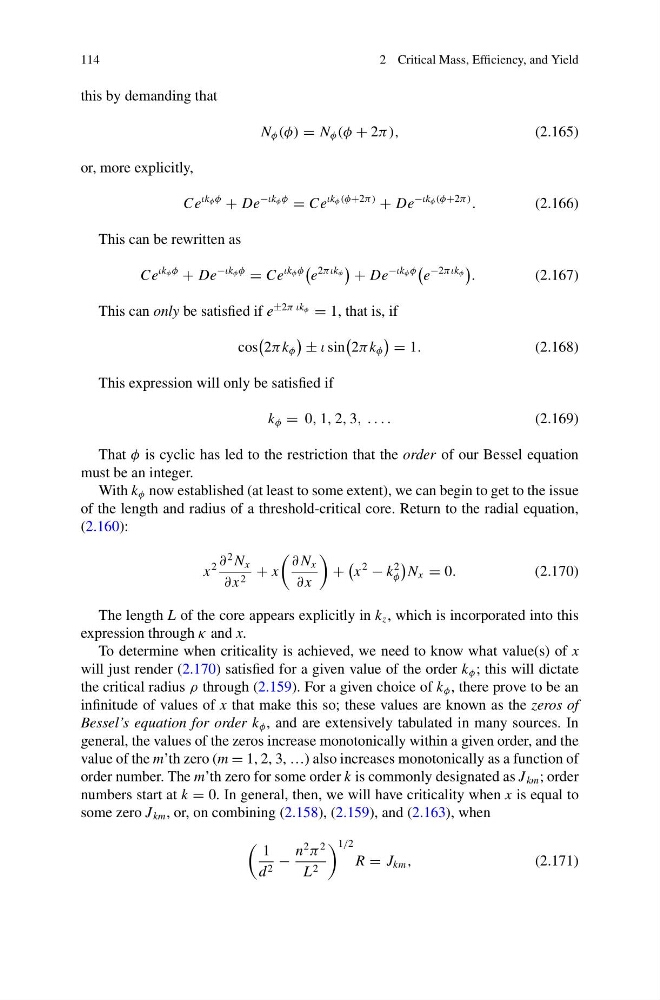
some zero J km , or, on combining (2.158), (2.159), and (2.163), when
1
d 2 −
n
2
π
2
L 2
1/2
R = J km ,
(2.171)
2 Critical Mass, Efficiency, and Yield
this by demanding that
N φ (φ) = N φ (φ + 2π ),
(2.165)
or, more explicitly,
Ce
ιk φ φ
+ De
−ιk φ φ
= Ce
ιk φ (φ+2π )
+ De
−ιk φ (φ+2π )
.
(2.166)
This can be rewritten as
Ce
ιk φ φ
+ De
−ιk φ φ
= Ce
ιk φ φ
e
2πιk φ
+ De
−ιk φ φ
e
−2πιk φ
.
(2.167)
This can only be satisfied if e
±2π ιk φ = 1, that is, if
cos
2π k φ
± ι sin
2π k φ
= 1.
(2.168)
This expression will only be satisfied if
k φ = 0, 1, 2, 3, . . . .
(2.169)
That φ is cyclic has led to the restriction that the order of our Bessel equation
must be an integer.
With k φ now established (at least to some extent), we can begin to get to the issue
of the length and radius of a threshold-critical core. Return to the radial equation,
(2.160):
x
2 ∂
2 N x
∂ x 2 + x
∂ N x
∂ x
+
x
2
− k
2
φ
N x = 0.
(2.170)
The length L of the core appears explicitly in k z , which is incorporated into this
expression through κ and x.
To determine when criticality is achieved, we need to know what value(s) of x
will just render (2.170) satisfied for a given value of the order k φ ; this will dictate
the critical radius ρ through (2.159). For a given choice of k φ , there prove to be an
infinitude of values of x that make this so; these values are known as the zeros of
Bessel’s equation for order k φ , and are extensively tabulated in many sources. In
general, the values of the zeros increase monotonically within a given order, and the
value of the m’th zero (m = 1, 2, 3, …) also increases monotonically as a function of
order number. The m’th zero for some order k is commonly designated as J km ; order
numbers start at k = 0. In general, then, we will have criticality when x is equal to
some zero J km , or, on combining (2.158), (2.159), and (2.163), when
1
d 2 −
n
2
π
2
L 2
1/2
R = J km ,
(2.171)