

2.9 Critical Mass of a Cylindrical Core (Optional)
113
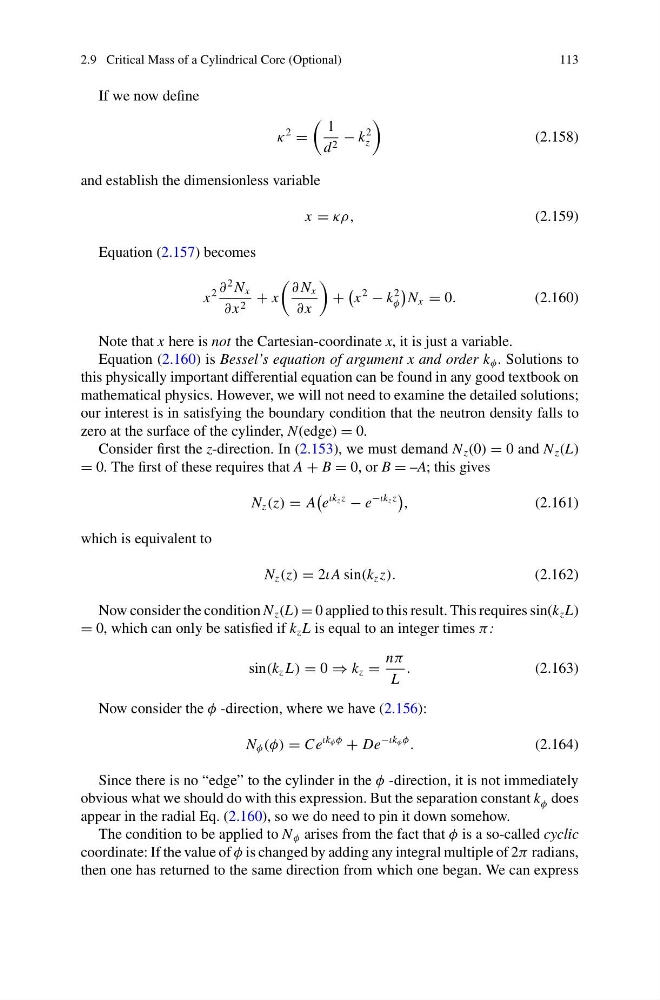
If we now define
κ
2
=
1
d 2 − k
2
z
(2.158)
and establish the dimensionless variable
x = κρ,
(2.159)
Equation (2.157) becomes
x
2 ∂
2 N x
∂ x 2 + x
∂ N x
∂ x
+
x
2
− k
2
φ
N x = 0.
(2.160)
Note that x here is not the Cartesian-coordinate x, it is just a variable.
Equation (2.160) is Bessel’s equation of argument x and order k φ . Solutions to
this physically important differential equation can be found in any good textbook on
mathematical physics. However, we will not need to examine the detailed solutions;
our interest is in satisfying the boundary condition that the neutron density falls to
zero at the surface of the cylinder, N(edge) = 0.
Consider first the z-direction. In (2.153), we must demand N z (0) = 0 and N z (L)
= 0. The first of these requires that A + B = 0, or B = –A; this gives
N z (z) = A
e
ιk z z
− e
−ιk z z
,
(2.161)
which is equivalent to
N z (z) = 2ιA sin(k z z).
(2.162)
Now consider the condition N z (L) = 0 applied to this result. This requires sin(k z L)
= 0, which can only be satisfied if k z L is equal to an integer times π :
sin(k z L) = 0 ⇒ k z =
nπ
L
.
(2.163)
Now consider the φ -direction, where we have (2.156):
N φ (φ) = Ce
ιk φ φ
+ De
−ιk φ φ
.
(2.164)
Since there is no “edge” to the cylinder in the φ -direction, it is not immediately
obvious what we should do with this expression. But the separation constant k φ does
appear in the radial Eq. (2.160), so we do need to pin it down somehow.
The condition to be applied to N φ arises from the fact that φ is a so-called cyclic
coordinate: If the value of φ is changed by adding any integral multiple of 2π radians,
then one has returned to the same direction from which one began. We can express
113
If we now define
κ
2
=
1
d 2 − k
2
z
(2.158)
and establish the dimensionless variable
x = κρ,
(2.159)
Equation (2.157) becomes
x
2 ∂
2 N x
∂ x 2 + x
∂ N x
∂ x
+
x
2
− k
2
φ
N x = 0.
(2.160)
Note that x here is not the Cartesian-coordinate x, it is just a variable.
Equation (2.160) is Bessel’s equation of argument x and order k φ . Solutions to
this physically important differential equation can be found in any good textbook on
mathematical physics. However, we will not need to examine the detailed solutions;
our interest is in satisfying the boundary condition that the neutron density falls to
zero at the surface of the cylinder, N(edge) = 0.
Consider first the z-direction. In (2.153), we must demand N z (0) = 0 and N z (L)
= 0. The first of these requires that A + B = 0, or B = –A; this gives
N z (z) = A
e
ιk z z
− e
−ιk z z
,
(2.161)
which is equivalent to
N z (z) = 2ιA sin(k z z).
(2.162)
Now consider the condition N z (L) = 0 applied to this result. This requires sin(k z L)
= 0, which can only be satisfied if k z L is equal to an integer times π :
sin(k z L) = 0 ⇒ k z =
nπ
L
.
(2.163)
Now consider the φ -direction, where we have (2.156):
N φ (φ) = Ce
ιk φ φ
+ De
−ιk φ φ
.
(2.164)
Since there is no “edge” to the cylinder in the φ -direction, it is not immediately
obvious what we should do with this expression. But the separation constant k φ does
appear in the radial Eq. (2.160), so we do need to pin it down somehow.
The condition to be applied to N φ arises from the fact that φ is a so-called cyclic
coordinate: If the value of φ is changed by adding any integral multiple of 2π radians,
then one has returned to the same direction from which one began. We can express