

112
2 Critical Mass, Efficiency, and Yield
1
d 2 +
1
N ρ ρ
∂
∂ρ
ρ
∂ N ρ
∂ρ
+
1
ρ 2 N φ
∂
2 N φ
∂φ 2 +
1
N z
∂
2 N z
∂z 2 = 0.
(2.150)
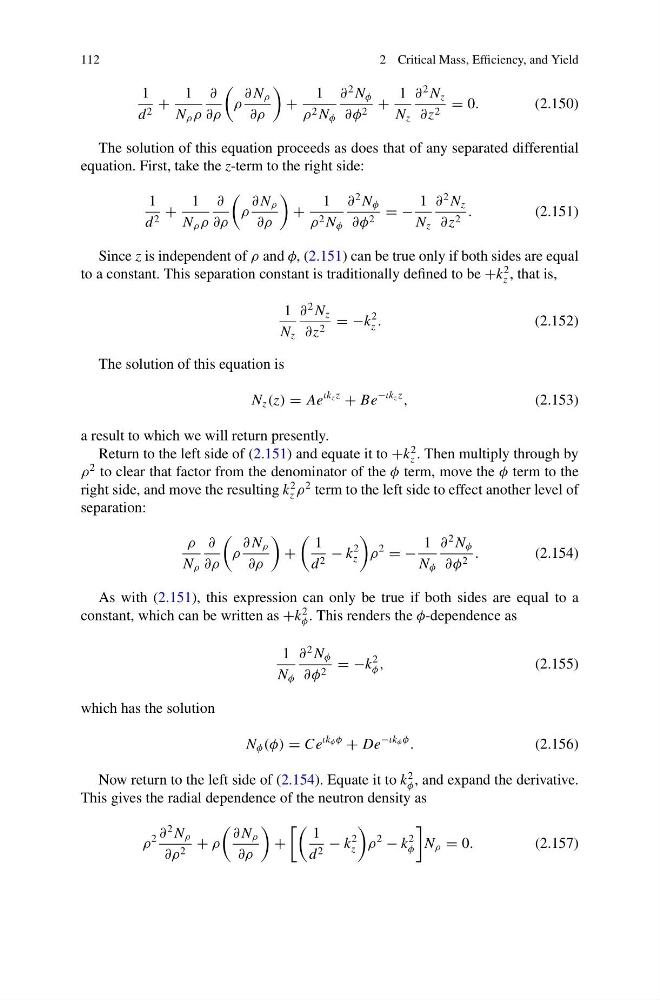
The solution of this equation proceeds as does that of any separated differential
equation. First, take the z-term to the right side:
1
d 2 +
1
N ρ ρ
∂
∂ρ
ρ
∂ N ρ
∂ρ
+
1
ρ 2 N φ
∂
2 N φ
∂φ 2 = −
1
N z
∂
2 N z
∂z 2 .
(2.151)
Since z is independent of ρ and φ, (2.151) can be true only if both sides are equal
to a constant. This separation constant is traditionally defined to be +k
2
z , that is,
1
N z
∂
2 N z
∂z 2 = −k
2
z .
(2.152)
The solution of this equation is
N z (z) = Ae
ιk z z
+ Be
−ιk z z
,
(2.153)
a result to which we will return presently.
Return to the left side of (2.151) and equate it to +k
2
z . Then multiply through by
ρ
2 to clear that factor from the denominator of the φ term, move the φ term to the
right side, and move the resulting k
2
z ρ
2 term to the left side to effect another level of
separation:
ρ
N ρ
∂
∂ρ
ρ
∂ N ρ
∂ρ
+
1
d 2 − k
2
z
ρ
2
= −
1
N φ
∂
2 N φ
∂φ 2 .
(2.154)
As with (2.151), this expression can only be true if both sides are equal to a
constant, which can be written as +k
2
φ . This renders the φ-dependence as
1
N φ
∂
2 N φ
∂φ 2 = −k
2
φ ,
(2.155)
which has the solution
N φ (φ) = Ce
ιk φ φ
+ De
−ιk φ φ
.
(2.156)
Now return to the left side of (2.154). Equate it to k
2
φ , and expand the derivative.
This gives the radial dependence of the neutron density as
ρ
2 ∂
2 N ρ
∂ρ 2 + ρ
∂ N ρ
∂ρ
+
1
d 2 − k
2
z
ρ
2
− k
2
φ
N ρ = 0.
(2.157)
2 Critical Mass, Efficiency, and Yield
1
d 2 +
1
N ρ ρ
∂
∂ρ
ρ
∂ N ρ
∂ρ
+
1
ρ 2 N φ
∂
2 N φ
∂φ 2 +
1
N z
∂
2 N z
∂z 2 = 0.
(2.150)
The solution of this equation proceeds as does that of any separated differential
equation. First, take the z-term to the right side:
1
d 2 +
1
N ρ ρ
∂
∂ρ
ρ
∂ N ρ
∂ρ
+
1
ρ 2 N φ
∂
2 N φ
∂φ 2 = −
1
N z
∂
2 N z
∂z 2 .
(2.151)
Since z is independent of ρ and φ, (2.151) can be true only if both sides are equal
to a constant. This separation constant is traditionally defined to be +k
2
z , that is,
1
N z
∂
2 N z
∂z 2 = −k
2
z .
(2.152)
The solution of this equation is
N z (z) = Ae
ιk z z
+ Be
−ιk z z
,
(2.153)
a result to which we will return presently.
Return to the left side of (2.151) and equate it to +k
2
z . Then multiply through by
ρ
2 to clear that factor from the denominator of the φ term, move the φ term to the
right side, and move the resulting k
2
z ρ
2 term to the left side to effect another level of
separation:
ρ
N ρ
∂
∂ρ
ρ
∂ N ρ
∂ρ
+
1
d 2 − k
2
z
ρ
2
= −
1
N φ
∂
2 N φ
∂φ 2 .
(2.154)
As with (2.151), this expression can only be true if both sides are equal to a
constant, which can be written as +k
2
φ . This renders the φ-dependence as
1
N φ
∂
2 N φ
∂φ 2 = −k
2
φ ,
(2.155)
which has the solution
N φ (φ) = Ce
ιk φ φ
+ De
−ιk φ φ
.
(2.156)
Now return to the left side of (2.154). Equate it to k
2
φ , and expand the derivative.
This gives the radial dependence of the neutron density as
ρ
2 ∂
2 N ρ
∂ρ 2 + ρ
∂ N ρ
∂ρ
+
1
d 2 − k
2
z
ρ
2
− k
2
φ
N ρ = 0.
(2.157)