

2.9 Critical Mass of a Cylindrical Core (Optional)
115
where the radius ρ is now written as R. The volume of the core is π R
2 L. We can
solve (2.171) for R and then express the volume entirely in terms of L:
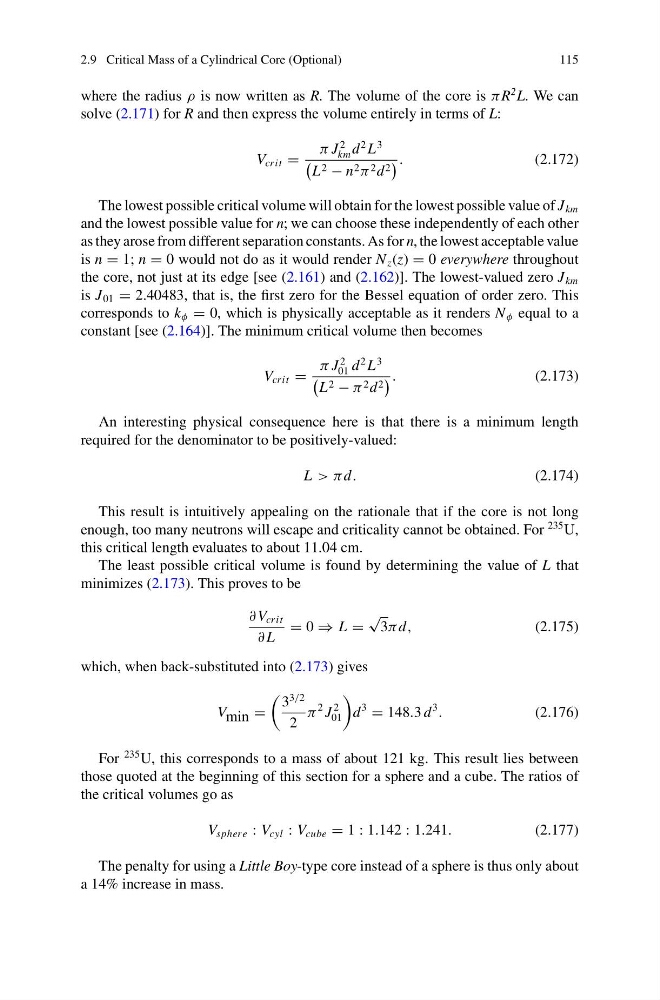
V crit =
π J
2
km d
2 L
3
L 2 − n 2 π 2 d 2
.
(2.172)
The lowest possible critical volume will obtain for the lowest possible value of J km
and the lowest possible value for n; we can choose these independently of each other
as they arose from different separation constants. As for n, the lowest acceptable value
is n = 1; n = 0 would not do as it would render N z (z) = 0 everywhere throughout
the core, not just at its edge [see (2.161) and (2.162)]. The lowest-valued zero J km
is J 01 = 2.40483, that is, the first zero for the Bessel equation of order zero. This
corresponds to k φ = 0, which is physically acceptable as it renders N φ equal to a
constant [see (2.164)]. The minimum critical volume then becomes
V crit =
π J
2
01 d
2 L
3
L 2 − π 2 d 2
.
(2.173)
An interesting physical consequence here is that there is a minimum length
required for the denominator to be positively-valued:
L > πd.
(2.174)
This result is intuitively appealing on the rationale that if the core is not long
enough, too many neutrons will escape and criticality cannot be obtained. For
235 U,
this critical length evaluates to about 11.04 cm.
The least possible critical volume is found by determining the value of L that
minimizes (2.173). This proves to be
∂ V crit
∂ L
= 0 ⇒ L =
√
3π d,
(2.175)
which, when back-substituted into (2.173) gives
V min =
3
3/2
2
π
2 J
2
01
d
3
= 148.3 d
3
.
(2.176)
For
235 U, this corresponds to a mass of about 121 kg. This result lies between
those quoted at the beginning of this section for a sphere and a cube. The ratios of
the critical volumes go as
V sphere : V cyl : V cube = 1 : 1.142 : 1.241.
(2.177)
The penalty for using a Little Boy-type core instead of a sphere is thus only about
a 14% increase in mass.
115
where the radius ρ is now written as R. The volume of the core is π R
2 L. We can
solve (2.171) for R and then express the volume entirely in terms of L:
V crit =
π J
2
km d
2 L
3
L 2 − n 2 π 2 d 2
.
(2.172)
The lowest possible critical volume will obtain for the lowest possible value of J km
and the lowest possible value for n; we can choose these independently of each other
as they arose from different separation constants. As for n, the lowest acceptable value
is n = 1; n = 0 would not do as it would render N z (z) = 0 everywhere throughout
the core, not just at its edge [see (2.161) and (2.162)]. The lowest-valued zero J km
is J 01 = 2.40483, that is, the first zero for the Bessel equation of order zero. This
corresponds to k φ = 0, which is physically acceptable as it renders N φ equal to a
constant [see (2.164)]. The minimum critical volume then becomes
V crit =
π J
2
01 d
2 L
3
L 2 − π 2 d 2
.
(2.173)
An interesting physical consequence here is that there is a minimum length
required for the denominator to be positively-valued:
L > πd.
(2.174)
This result is intuitively appealing on the rationale that if the core is not long
enough, too many neutrons will escape and criticality cannot be obtained. For
235 U,
this critical length evaluates to about 11.04 cm.
The least possible critical volume is found by determining the value of L that
minimizes (2.173). This proves to be
∂ V crit
∂ L
= 0 ⇒ L =
√
3π d,
(2.175)
which, when back-substituted into (2.173) gives
V min =
3
3/2
2
π
2 J
2
01
d
3
= 148.3 d
3
.
(2.176)
For
235 U, this corresponds to a mass of about 121 kg. This result lies between
those quoted at the beginning of this section for a sphere and a cube. The ratios of
the critical volumes go as
V sphere : V cyl : V cube = 1 : 1.142 : 1.241.
(2.177)
The penalty for using a Little Boy-type core instead of a sphere is thus only about
a 14% increase in mass.