

106
2 Critical Mass, Efficiency, and Yield
the enclosed air as an ideal gas; this would help drive home the phenomenal orders
of magnitude of physical quantities involved in such explosions.
2.8.4 A Simplified Model of Tamped-Core Yield
The numerical simulation described in Sect. 2.6 tracks conditions within an exploding
bomb core, as least as far as its underlying assumptions and the diffusion theory on
which it is based are valid. Its disadvantage, however, is that it requires writing
a program likely to run to a few hundred lines, which may make it impractical
for a classroom setting. In this section, an approximate approach to estimating the
yield of a tamped-core bomb is developed. What is lost in this approach is any
detailed time-dependent tracking of various conditions, but it can be programmed
into a single spreadsheet. Like the numerical simulation, this method is formulated
so that the core and tamper experience the same radial expansion in order to model
a uniform expansion velocity. Input densities can easily be altered to simulate any
initial compression. This method is adopted from Reed (2018b).
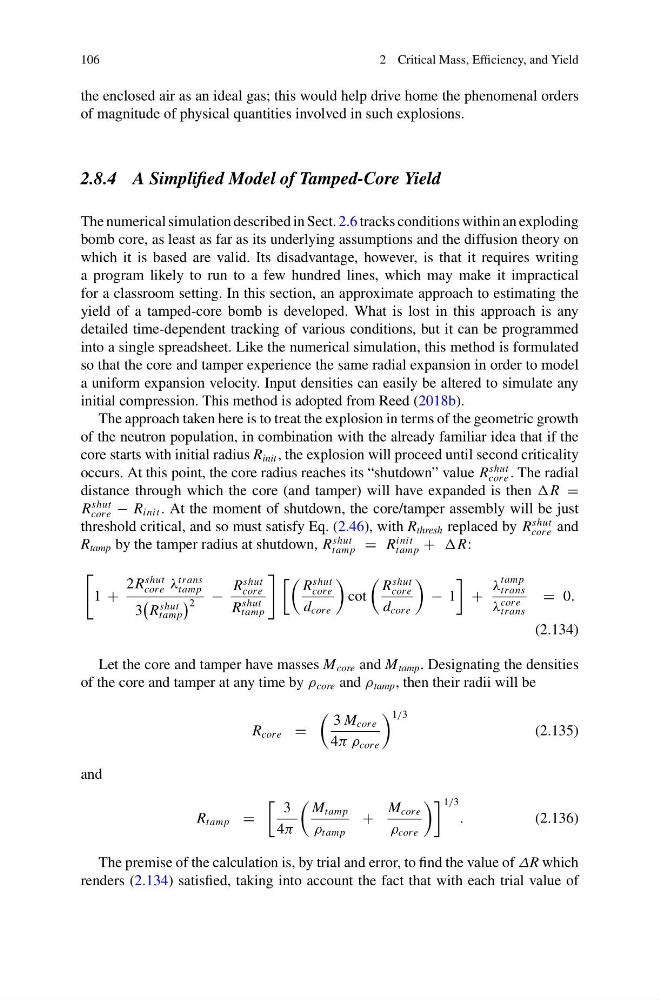
The approach taken here is to treat the explosion in terms of the geometric growth
of the neutron population, in combination with the already familiar idea that if the
core starts with initial radius R init , the explosion will proceed until second criticality
occurs. At this point, the core radius reaches its “shutdown” value R
shut
core . The radial
distance through which the core (and tamper) will have expanded is then R =
R
shut
core − R init . At the moment of shutdown, the core/tamper assembly will be just
threshold critical, and so must satisfy Eq. (2.46), with R thresh replaced by R
shut
core and
R tamp by the tamper radius at shutdown, R
shut
tamp = R
init
tamp + R:
1 +
2R
shut
core λ
trans
tamp
3
R
shut
tamp
2 −
R
shut
core
R
shut
tamp
R
shut
core
d core
cot
R
shut
core
d core
− 1
+
λ
tamp
trans
λ
core
trans
= 0.
(2.134)
Let the core and tamper have masses M core and M tamp . Designating the densities
of the core and tamper at any time by ρ core and ρ tamp , then their radii will be
R core =
3 M core
4π ρ core
1/3
(2.135)
and
R tamp =
3
4π
M tamp
ρ tamp
+
M core
ρ core
1/3
.
(2.136)
The premise of the calculation is, by trial and error, to find the value of ΔR which
renders (2.134) satisfied, taking into account the fact that with each trial value of
2 Critical Mass, Efficiency, and Yield
the enclosed air as an ideal gas; this would help drive home the phenomenal orders
of magnitude of physical quantities involved in such explosions.
2.8.4 A Simplified Model of Tamped-Core Yield
The numerical simulation described in Sect. 2.6 tracks conditions within an exploding
bomb core, as least as far as its underlying assumptions and the diffusion theory on
which it is based are valid. Its disadvantage, however, is that it requires writing
a program likely to run to a few hundred lines, which may make it impractical
for a classroom setting. In this section, an approximate approach to estimating the
yield of a tamped-core bomb is developed. What is lost in this approach is any
detailed time-dependent tracking of various conditions, but it can be programmed
into a single spreadsheet. Like the numerical simulation, this method is formulated
so that the core and tamper experience the same radial expansion in order to model
a uniform expansion velocity. Input densities can easily be altered to simulate any
initial compression. This method is adopted from Reed (2018b).
The approach taken here is to treat the explosion in terms of the geometric growth
of the neutron population, in combination with the already familiar idea that if the
core starts with initial radius R init , the explosion will proceed until second criticality
occurs. At this point, the core radius reaches its “shutdown” value R
shut
core . The radial
distance through which the core (and tamper) will have expanded is then R =
R
shut
core − R init . At the moment of shutdown, the core/tamper assembly will be just
threshold critical, and so must satisfy Eq. (2.46), with R thresh replaced by R
shut
core and
R tamp by the tamper radius at shutdown, R
shut
tamp = R
init
tamp + R:
1 +
2R
shut
core λ
trans
tamp
3
R
shut
tamp
2 −
R
shut
core
R
shut
tamp
R
shut
core
d core
cot
R
shut
core
d core
− 1
+
λ
tamp
trans
λ
core
trans
= 0.
(2.134)
Let the core and tamper have masses M core and M tamp . Designating the densities
of the core and tamper at any time by ρ core and ρ tamp , then their radii will be
R core =
3 M core
4π ρ core
1/3
(2.135)
and
R tamp =
3
4π
M tamp
ρ tamp
+
M core
ρ core
1/3
.
(2.136)
The premise of the calculation is, by trial and error, to find the value of ΔR which
renders (2.134) satisfied, taking into account the fact that with each trial value of