

2.8 Criticality and Yield: Approximate Methods
107
ΔR, the densities of the core and tamper will change, and hence the values of d core
and the λ’s in (2.134) must be modified accordingly. Otherwise, d core and the λ’s are
as in Sects. 2.2 and 2.3. But for some notational differences, this is essentially the
method that was followed in setting up Figs. 2.9 and 2.10. What is new here is the
yield calculation that is about to be described. A significant player in this part of the
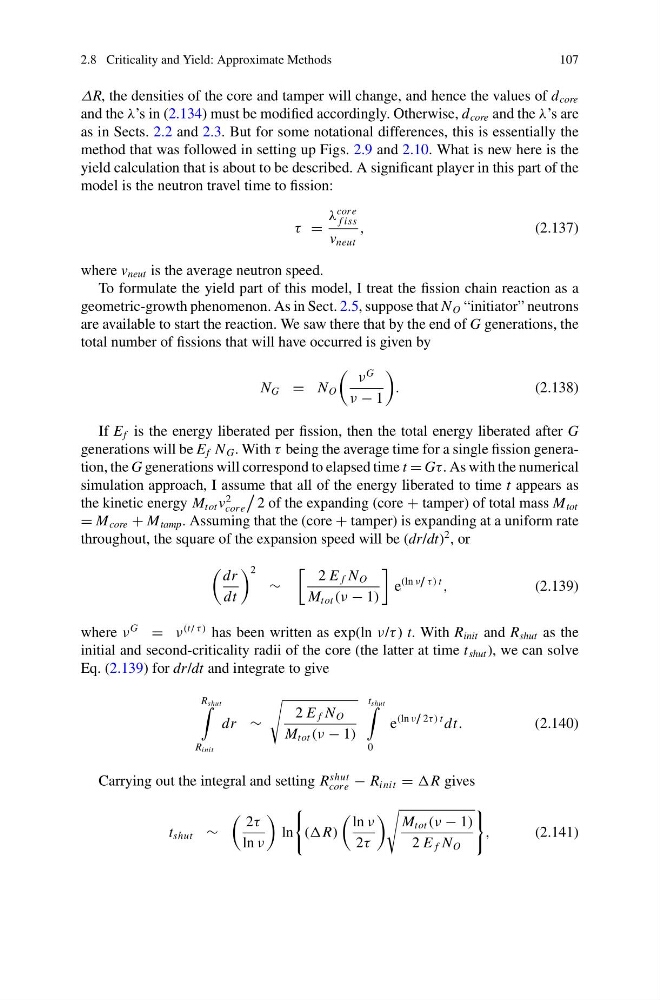
model is the neutron travel time to fission:
τ =
λ
core
f iss
v neut
,
(2.137)
where v neut is the average neutron speed.
To formulate the yield part of this model, I treat the fission chain reaction as a
geometric-growth phenomenon. As in Sect. 2.5, suppose that N O “initiator” neutrons
are available to start the reaction. We saw there that by the end of G generations, the
total number of fissions that will have occurred is given by
N G = N O
ν
G
ν − 1
.
(2.138)
If E f is the energy liberated per fission, then the total energy liberated after G
generations will be E f N G . With τ being the average time for a single fission generation, the G generations will correspond to elapsed time t = Gτ. As with the numerical
simulation approach, I assume that all of the energy liberated to time t appears as
the kinetic energy M tot v
2
core
2 of the expanding (core + tamper) of total mass M tot
= M core + M tamp . Assuming that the (core + tamper) is expanding at a uniform rate
throughout, the square of the expansion speed will be (dr/dt)
2 , or
dr
dt
2
∼
2 E f N O
M tot (ν − 1)
e
(ln ν / τ ) t ,
(2.139)
where ν
G
= ν
(t/ τ ) has been written as exp(ln ν/τ ) t. With R init and R shut as the
initial and second-criticality radii of the core (the latter at time t shut ), we can solve
Eq. (2.139) for dr/dt and integrate to give
R shut
R init
dr ∼
2 E f N O
M tot (ν − 1)
t shut
0
e
(ln ν / 2τ ) t dt.
(2.140)
Carrying out the integral and setting R
shut
core − R init = R gives
t shut ∼
2τ
ln ν
ln
(R)
ln ν
2τ
M tot (ν − 1)
2 E f N O
,
(2.141)
107
ΔR, the densities of the core and tamper will change, and hence the values of d core
and the λ’s in (2.134) must be modified accordingly. Otherwise, d core and the λ’s are
as in Sects. 2.2 and 2.3. But for some notational differences, this is essentially the
method that was followed in setting up Figs. 2.9 and 2.10. What is new here is the
yield calculation that is about to be described. A significant player in this part of the
model is the neutron travel time to fission:
τ =
λ
core
f iss
v neut
,
(2.137)
where v neut is the average neutron speed.
To formulate the yield part of this model, I treat the fission chain reaction as a
geometric-growth phenomenon. As in Sect. 2.5, suppose that N O “initiator” neutrons
are available to start the reaction. We saw there that by the end of G generations, the
total number of fissions that will have occurred is given by
N G = N O
ν
G
ν − 1
.
(2.138)
If E f is the energy liberated per fission, then the total energy liberated after G
generations will be E f N G . With τ being the average time for a single fission generation, the G generations will correspond to elapsed time t = Gτ. As with the numerical
simulation approach, I assume that all of the energy liberated to time t appears as
the kinetic energy M tot v
2
core
2 of the expanding (core + tamper) of total mass M tot
= M core + M tamp . Assuming that the (core + tamper) is expanding at a uniform rate
throughout, the square of the expansion speed will be (dr/dt)
2 , or
dr
dt
2
∼
2 E f N O
M tot (ν − 1)
e
(ln ν / τ ) t ,
(2.139)
where ν
G
= ν
(t/ τ ) has been written as exp(ln ν/τ ) t. With R init and R shut as the
initial and second-criticality radii of the core (the latter at time t shut ), we can solve
Eq. (2.139) for dr/dt and integrate to give
R shut
R init
dr ∼
2 E f N O
M tot (ν − 1)
t shut
0
e
(ln ν / 2τ ) t dt.
(2.140)
Carrying out the integral and setting R
shut
core − R init = R gives
t shut ∼
2τ
ln ν
ln
(R)
ln ν
2τ
M tot (ν − 1)
2 E f N O
,
(2.141)