

2.8 Criticality and Yield: Approximate Methods
105
radiation (~35%), prompt ionizing radiation (~5%), and longer-term residual fallout
radiation (10%); these authors also give a detailed description of fireball formation
and evolution. Since the nuclear explosion itself takes only about one microsecond,
all of the energy released in the Trinity explosion was emitted well before the 0.1 ms
initial time of Taylor’s analysis; we can assume that no further energy is generated
during the span of his data. For the present purpose, I will assume that an amount
of energy K goes into the kinetic energy of a bubble of air which expands outward,
accumulating more air as it does so. After securing an estimate of K, the overall yield
of the bomb can be estimated by multiplying by a factor of two to account for the
shock-wave share of the total energy as indicated above.
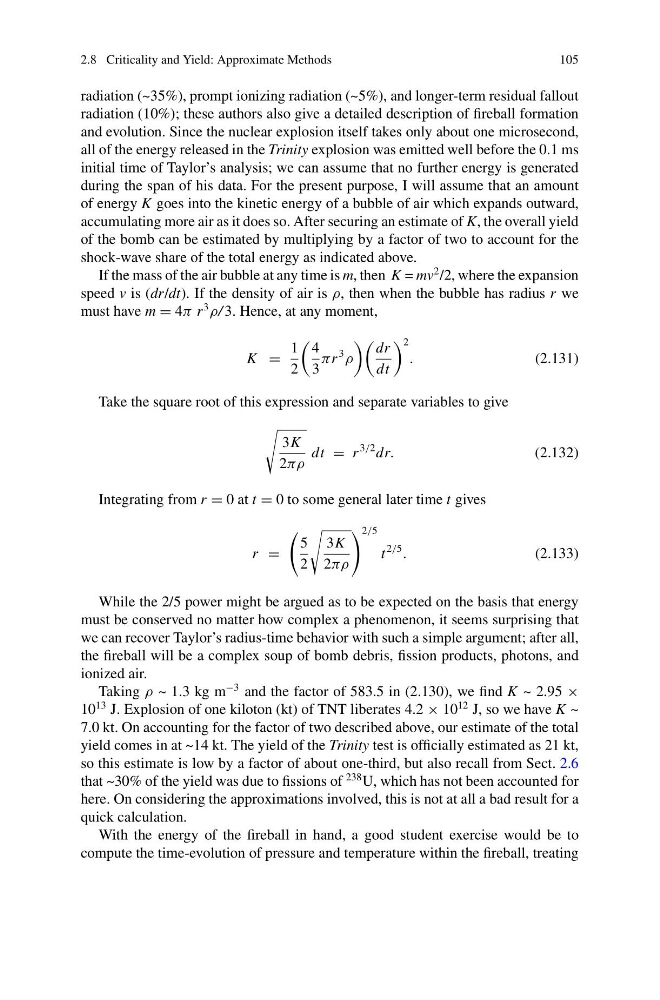
If the mass of the air bubble at any time is m, then K = mv
2 /2, where the expansion
speed v is (dr/dt). If the density of air is ρ, then when the bubble has radius r we
must have m = 4π r
3
ρ/ 3. Hence, at any moment,
K =
1
2
4
3
πr
3
ρ
dr
dt
2
.
(2.131)
Take the square root of this expression and separate variables to give
3K
2πρ
dt = r
3/2 dr.
(2.132)
Integrating from r = 0 at t = 0 to some general later time t gives
r =
5
2
3K
2πρ
2/5
t
2/5
.
(2.133)
While the 2/5 power might be argued as to be expected on the basis that energy
must be conserved no matter how complex a phenomenon, it seems surprising that
we can recover Taylor’s radius-time behavior with such a simple argument; after all,
the fireball will be a complex soup of bomb debris, fission products, photons, and
ionized air.
Taking ρ ~ 1.3 kg m
−3 and the factor of 583.5 in (2.130), we find K ~ 2.95 ×
10
13 J. Explosion of one kiloton (kt) of TNT liberates 4.2 × 10
12 J, so we have K ~
7.0 kt. On accounting for the factor of two described above, our estimate of the total
yield comes in at ~14 kt. The yield of the Trinity test is officially estimated as 21 kt,
so this estimate is low by a factor of about one-third, but also recall from Sect. 2.6
that ~30% of the yield was due to fissions of
238 U, which has not been accounted for
here. On considering the approximations involved, this is not at all a bad result for a
quick calculation.
With the energy of the fireball in hand, a good student exercise would be to
compute the time-evolution of pressure and temperature within the fireball, treating
105
radiation (~35%), prompt ionizing radiation (~5%), and longer-term residual fallout
radiation (10%); these authors also give a detailed description of fireball formation
and evolution. Since the nuclear explosion itself takes only about one microsecond,
all of the energy released in the Trinity explosion was emitted well before the 0.1 ms
initial time of Taylor’s analysis; we can assume that no further energy is generated
during the span of his data. For the present purpose, I will assume that an amount
of energy K goes into the kinetic energy of a bubble of air which expands outward,
accumulating more air as it does so. After securing an estimate of K, the overall yield
of the bomb can be estimated by multiplying by a factor of two to account for the
shock-wave share of the total energy as indicated above.
If the mass of the air bubble at any time is m, then K = mv
2 /2, where the expansion
speed v is (dr/dt). If the density of air is ρ, then when the bubble has radius r we
must have m = 4π r
3
ρ/ 3. Hence, at any moment,
K =
1
2
4
3
πr
3
ρ
dr
dt
2
.
(2.131)
Take the square root of this expression and separate variables to give
3K
2πρ
dt = r
3/2 dr.
(2.132)
Integrating from r = 0 at t = 0 to some general later time t gives
r =
5
2
3K
2πρ
2/5
t
2/5
.
(2.133)
While the 2/5 power might be argued as to be expected on the basis that energy
must be conserved no matter how complex a phenomenon, it seems surprising that
we can recover Taylor’s radius-time behavior with such a simple argument; after all,
the fireball will be a complex soup of bomb debris, fission products, photons, and
ionized air.
Taking ρ ~ 1.3 kg m
−3 and the factor of 583.5 in (2.130), we find K ~ 2.95 ×
10
13 J. Explosion of one kiloton (kt) of TNT liberates 4.2 × 10
12 J, so we have K ~
7.0 kt. On accounting for the factor of two described above, our estimate of the total
yield comes in at ~14 kt. The yield of the Trinity test is officially estimated as 21 kt,
so this estimate is low by a factor of about one-third, but also recall from Sect. 2.6
that ~30% of the yield was due to fissions of
238 U, which has not been accounted for
here. On considering the approximations involved, this is not at all a bad result for a
quick calculation.
With the energy of the fireball in hand, a good student exercise would be to
compute the time-evolution of pressure and temperature within the fireball, treating