

104
2 Critical Mass, Efficiency, and Yield
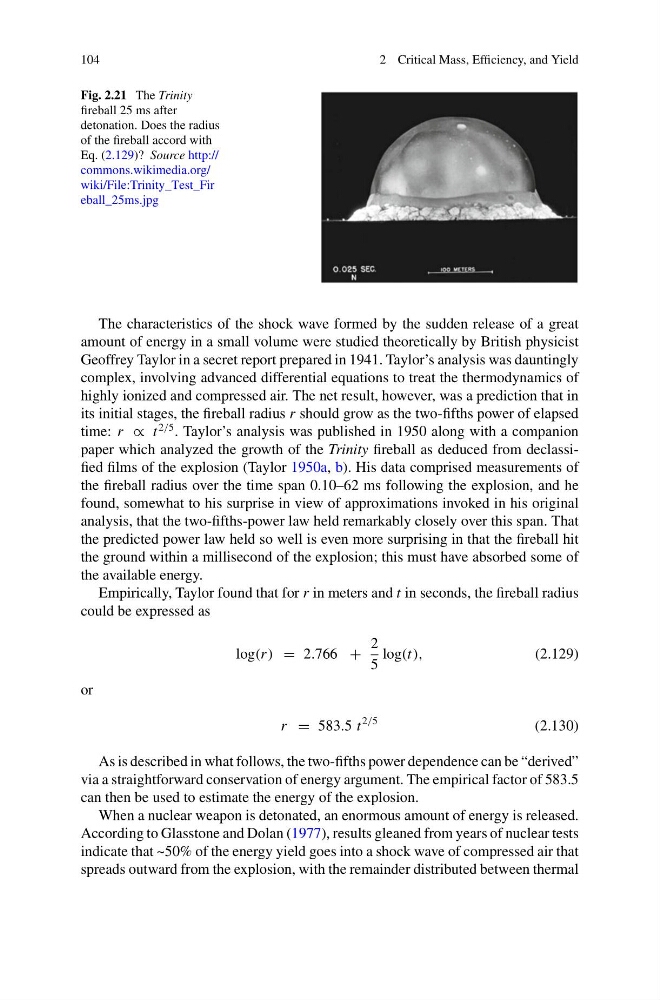
Fig. 2.21 The Trinity
fireball 25 ms after
detonation. Does the radius
of the fireball accord with
Eq. (2.129)? Source http://
commons.wikimedia.org/
wiki/File:Trinity_Test_Fir
eball_25ms.jpg
The characteristics of the shock wave formed by the sudden release of a great
amount of energy in a small volume were studied theoretically by British physicist
Geoffrey Taylor in a secret report prepared in 1941. Taylor’s analysis was dauntingly
complex, involving advanced differential equations to treat the thermodynamics of
highly ionized and compressed air. The net result, however, was a prediction that in
its initial stages, the fireball radius r should grow as the two-fifths power of elapsed
time: r ∝ t
2/5 . Taylor’s analysis was published in 1950 along with a companion
paper which analyzed the growth of the Trinity fireball as deduced from declassified films of the explosion (Taylor 1950a, b). His data comprised measurements of
the fireball radius over the time span 0.10–62 ms following the explosion, and he
found, somewhat to his surprise in view of approximations invoked in his original
analysis, that the two-fifths-power law held remarkably closely over this span. That
the predicted power law held so well is even more surprising in that the fireball hit
the ground within a millisecond of the explosion; this must have absorbed some of
the available energy.
Empirically, Taylor found that for r in meters and t in seconds, the fireball radius
could be expressed as
log(r ) = 2.766 +
2
5
log(t),
(2.129)
or
r = 583.5 t
2/5
(2.130)
As is described in what follows, the two-fifths power dependence can be “derived”
via a straightforward conservation of energy argument. The empirical factor of 583.5
can then be used to estimate the energy of the explosion.
When a nuclear weapon is detonated, an enormous amount of energy is released.
According to Glasstone and Dolan (1977), results gleaned from years of nuclear tests
indicate that ~50% of the energy yield goes into a shock wave of compressed air that
spreads outward from the explosion, with the remainder distributed between thermal
2 Critical Mass, Efficiency, and Yield
Fig. 2.21 The Trinity
fireball 25 ms after
detonation. Does the radius
of the fireball accord with
Eq. (2.129)? Source http://
commons.wikimedia.org/
wiki/File:Trinity_Test_Fir
eball_25ms.jpg
The characteristics of the shock wave formed by the sudden release of a great
amount of energy in a small volume were studied theoretically by British physicist
Geoffrey Taylor in a secret report prepared in 1941. Taylor’s analysis was dauntingly
complex, involving advanced differential equations to treat the thermodynamics of
highly ionized and compressed air. The net result, however, was a prediction that in
its initial stages, the fireball radius r should grow as the two-fifths power of elapsed
time: r ∝ t
2/5 . Taylor’s analysis was published in 1950 along with a companion
paper which analyzed the growth of the Trinity fireball as deduced from declassified films of the explosion (Taylor 1950a, b). His data comprised measurements of
the fireball radius over the time span 0.10–62 ms following the explosion, and he
found, somewhat to his surprise in view of approximations invoked in his original
analysis, that the two-fifths-power law held remarkably closely over this span. That
the predicted power law held so well is even more surprising in that the fireball hit
the ground within a millisecond of the explosion; this must have absorbed some of
the available energy.
Empirically, Taylor found that for r in meters and t in seconds, the fireball radius
could be expressed as
log(r ) = 2.766 +
2
5
log(t),
(2.129)
or
r = 583.5 t
2/5
(2.130)
As is described in what follows, the two-fifths power dependence can be “derived”
via a straightforward conservation of energy argument. The empirical factor of 583.5
can then be used to estimate the energy of the explosion.
When a nuclear weapon is detonated, an enormous amount of energy is released.
According to Glasstone and Dolan (1977), results gleaned from years of nuclear tests
indicate that ~50% of the energy yield goes into a shock wave of compressed air that
spreads outward from the explosion, with the remainder distributed between thermal