

2.7 History Lesson: Criticality Considered in 1939
101
βR can be expressed in terms of x and ξ through the following manipulations.
First, from (2.119) and (2.120), we can write d = 2λ t ε/ 3. With this result, we can
write x = R/d as x = 3R/ (2λ t ε). By eliminating σ f times (ν –1) between (2.116)
and (2.118), we get λ t = 3/(4βξ
2
ε
2 ). Substituting this result into the expression for
x then shows that
1
β R
=
2ξ
2
ε
x
.
(2.124)
We can compare the results of Peierls’ approach to those of diffusion analyses
in much the same way as Fig. 2.19 was constructed: For a range of values of ξ
between zero and unity, solve (2.115) and (2.119) for x, which can be translated to
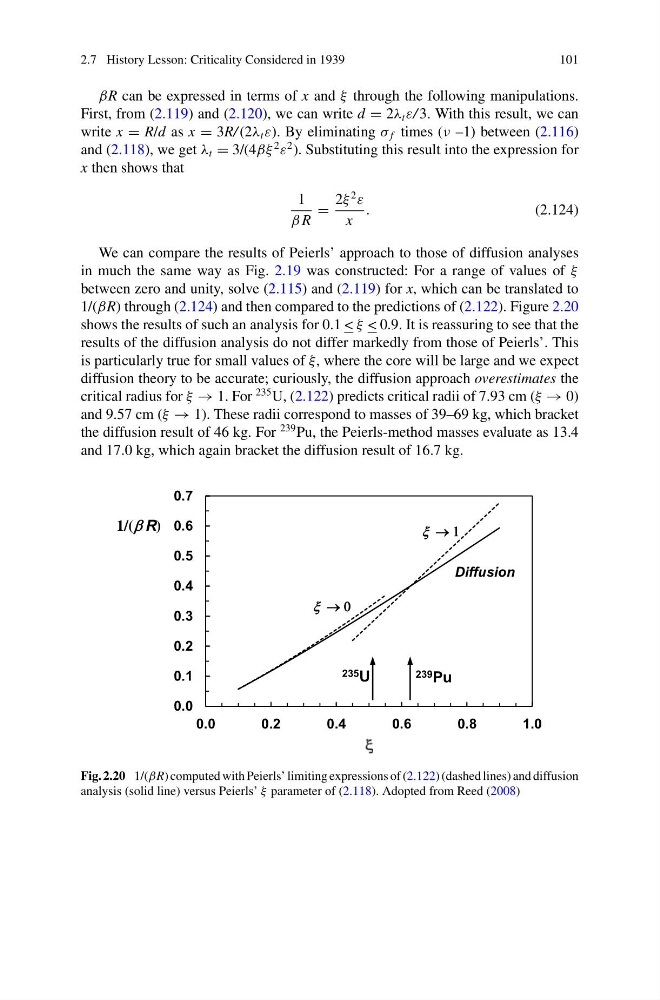
1/(βR) through (2.124) and then compared to the predictions of (2.122). Figure 2.20
shows the results of such an analysis for 0.1 < ξ < 0.9. It is reassuring to see that the
results of the diffusion analysis do not differ markedly from those of Peierls’. This
is particularly true for small values of ξ, where the core will be large and we expect
diffusion theory to be accurate; curiously, the diffusion approach overestimates the
critical radius for ξ → 1. For
235 U, (2.122) predicts critical radii of 7.93 cm (ξ → 0)
and 9.57 cm (ξ → 1). These radii correspond to masses of 39–69 kg, which bracket
the diffusion result of 46 kg. For
239 Pu, the Peierls-method masses evaluate as 13.4
and 17.0 kg, which again bracket the diffusion result of 16.7 kg.
0.0
0.1
0.2
0.3
0.4
0.5
0.6
0.7
0.0
0.2
0.4
0.6
0.8
1.0
235 U
239 Pu
Diffusion
1/( R)
Fig. 2.20 1/(βR) computed with Peierls’ limiting expressions of (2.122) (dashed lines) and diffusion
analysis (solid line) versus Peierls’ ξ parameter of (2.118). Adopted from Reed (2008)
101
βR can be expressed in terms of x and ξ through the following manipulations.
First, from (2.119) and (2.120), we can write d = 2λ t ε/ 3. With this result, we can
write x = R/d as x = 3R/ (2λ t ε). By eliminating σ f times (ν –1) between (2.116)
and (2.118), we get λ t = 3/(4βξ
2
ε
2 ). Substituting this result into the expression for
x then shows that
1
β R
=
2ξ
2
ε
x
.
(2.124)
We can compare the results of Peierls’ approach to those of diffusion analyses
in much the same way as Fig. 2.19 was constructed: For a range of values of ξ
between zero and unity, solve (2.115) and (2.119) for x, which can be translated to
1/(βR) through (2.124) and then compared to the predictions of (2.122). Figure 2.20
shows the results of such an analysis for 0.1 < ξ < 0.9. It is reassuring to see that the
results of the diffusion analysis do not differ markedly from those of Peierls’. This
is particularly true for small values of ξ, where the core will be large and we expect
diffusion theory to be accurate; curiously, the diffusion approach overestimates the
critical radius for ξ → 1. For
235 U, (2.122) predicts critical radii of 7.93 cm (ξ → 0)
and 9.57 cm (ξ → 1). These radii correspond to masses of 39–69 kg, which bracket
the diffusion result of 46 kg. For
239 Pu, the Peierls-method masses evaluate as 13.4
and 17.0 kg, which again bracket the diffusion result of 16.7 kg.
0.0
0.1
0.2
0.3
0.4
0.5
0.6
0.7
0.0
0.2
0.4
0.6
0.8
1.0
235 U
239 Pu
Diffusion
1/( R)
Fig. 2.20 1/(βR) computed with Peierls’ limiting expressions of (2.122) (dashed lines) and diffusion
analysis (solid line) versus Peierls’ ξ parameter of (2.118). Adopted from Reed (2008)