

102
2 Critical Mass, Efficiency, and Yield
2.8 Criticality and Yield: Approximate Methods
The approximate methods described in the following subsections vary from
extremely straightforward algebraic ones to more sophisticated treatments involving
integration and numerical root-finding. These are not intended to replace the more
rigourous analyses of previous sections, but rather to provide some “back of the
envelope” techniques for making quick estimates and for showing how quantities
depend on the fundamental parameters involved.
2.8.1 Bare Critical Mass: Simplified Boundary Condition
In Sect. 2.2, the neutron-flux boundary condition (2.29) resulted in a transcendental
equation, (2.30), for the criticality condition. A simpler result can be had by relaxing
the boundary condition to assume that the density of neutrons drops to zero at the
edge of the core: N(R C ) = 0. This results in an overestimate of the critical radius
because the demand of no neutron density is too pessimistic in that it corresponds
to not permitting any loss of neutrons from the core, but has the advantage of not
requiring any numerical root-finding. In this case, the solution for the neutron density,
(2.28), will satisfy the boundary condition when x = π, which means, via (2.26), that
R C = xd = π d. Assuming threshold criticality with α = 0, this gives, with (2.25)
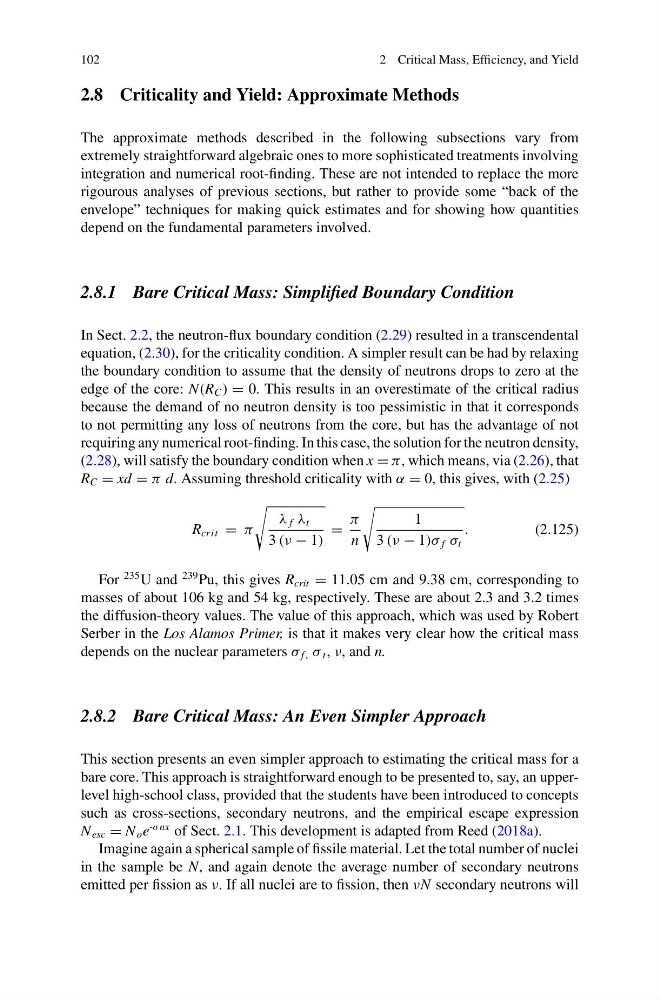
R crit = π
λ f λ t
3 (ν − 1)
=
π
n
1
3 (ν − 1)σ f σ t
.
(2.125)
For
235 U and
239 Pu, this gives R crit = 11.05 cm and 9.38 cm, corresponding to
masses of about 106 kg and 54 kg, respectively. These are about 2.3 and 3.2 times
the diffusion-theory values. The value of this approach, which was used by Robert
Serber in the Los Alamos Primer, is that it makes very clear how the critical mass
depends on the nuclear parameters σ f , σ t , ν, and n.
2.8.2 Bare Critical Mass: An Even Simpler Approach
This section presents an even simpler approach to estimating the critical mass for a
bare core. This approach is straightforward enough to be presented to, say, an upperlevel high-school class, provided that the students have been introduced to concepts
such as cross-sections, secondary neutrons, and the empirical escape expression
N esc = N o e
-σ nx of Sect. 2.1. This development is adapted from Reed (2018a).
Imagine again a spherical sample of fissile material. Let the total number of nuclei
in the sample be N, and again denote the average number of secondary neutrons
emitted per fission as ν. If all nuclei are to fission, then νN secondary neutrons will
2 Critical Mass, Efficiency, and Yield
2.8 Criticality and Yield: Approximate Methods
The approximate methods described in the following subsections vary from
extremely straightforward algebraic ones to more sophisticated treatments involving
integration and numerical root-finding. These are not intended to replace the more
rigourous analyses of previous sections, but rather to provide some “back of the
envelope” techniques for making quick estimates and for showing how quantities
depend on the fundamental parameters involved.
2.8.1 Bare Critical Mass: Simplified Boundary Condition
In Sect. 2.2, the neutron-flux boundary condition (2.29) resulted in a transcendental
equation, (2.30), for the criticality condition. A simpler result can be had by relaxing
the boundary condition to assume that the density of neutrons drops to zero at the
edge of the core: N(R C ) = 0. This results in an overestimate of the critical radius
because the demand of no neutron density is too pessimistic in that it corresponds
to not permitting any loss of neutrons from the core, but has the advantage of not
requiring any numerical root-finding. In this case, the solution for the neutron density,
(2.28), will satisfy the boundary condition when x = π, which means, via (2.26), that
R C = xd = π d. Assuming threshold criticality with α = 0, this gives, with (2.25)
R crit = π
λ f λ t
3 (ν − 1)
=
π
n
1
3 (ν − 1)σ f σ t
.
(2.125)
For
235 U and
239 Pu, this gives R crit = 11.05 cm and 9.38 cm, corresponding to
masses of about 106 kg and 54 kg, respectively. These are about 2.3 and 3.2 times
the diffusion-theory values. The value of this approach, which was used by Robert
Serber in the Los Alamos Primer, is that it makes very clear how the critical mass
depends on the nuclear parameters σ f , σ t , ν, and n.
2.8.2 Bare Critical Mass: An Even Simpler Approach
This section presents an even simpler approach to estimating the critical mass for a
bare core. This approach is straightforward enough to be presented to, say, an upperlevel high-school class, provided that the students have been introduced to concepts
such as cross-sections, secondary neutrons, and the empirical escape expression
N esc = N o e
-σ nx of Sect. 2.1. This development is adapted from Reed (2018a).
Imagine again a spherical sample of fissile material. Let the total number of nuclei
in the sample be N, and again denote the average number of secondary neutrons
emitted per fission as ν. If all nuclei are to fission, then νN secondary neutrons will