

100
2 Critical Mass, Efficiency, and Yield
0
1
2
3
4
5
6
7
0.2
0.4
0.6
0.8
R
crit /
trans
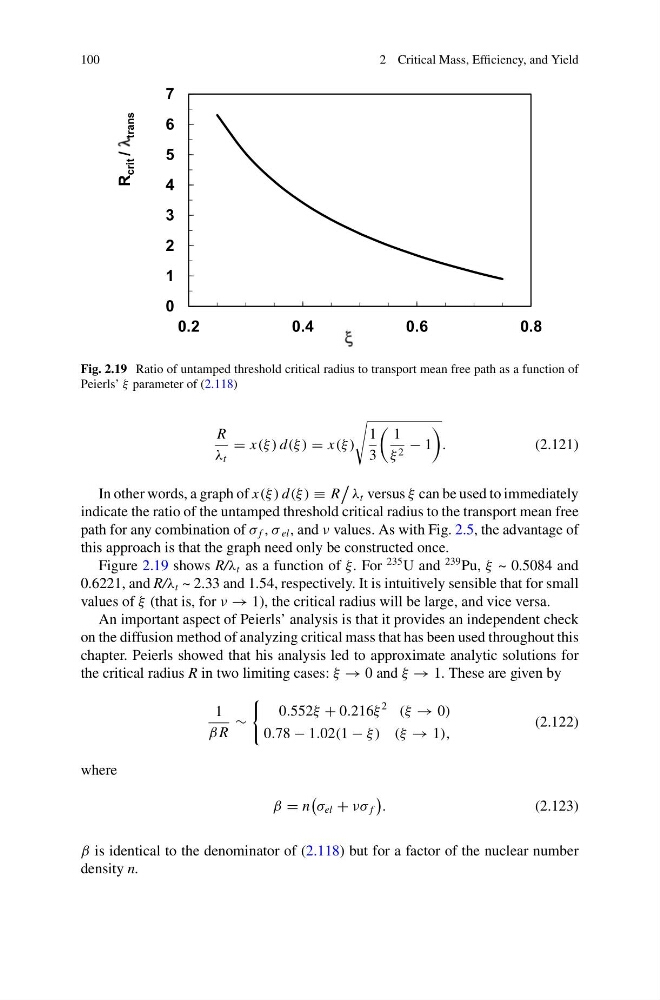
Fig. 2.19 Ratio of untamped threshold critical radius to transport mean free path as a function of
Peierls’ ξ parameter of (2.118)
R
λ t
= x(ξ ) d(ξ ) = x(ξ )
1
3
1
ξ 2 − 1
.
(2.121)
In other words, a graph of x(ξ ) d(ξ ) ≡ R
λ t versus ξ can be used to immediately
indicate the ratio of the untamped threshold critical radius to the transport mean free
path for any combination of σ f , σ el , and ν values. As with Fig. 2.5, the advantage of
this approach is that the graph need only be constructed once.
Figure 2.19 shows R/λ t as a function of ξ. For
235 U and
239 Pu, ξ ~ 0.5084 and
0.6221, and R/λ t ~ 2.33 and 1.54, respectively. It is intuitively sensible that for small
values of ξ (that is, for ν → 1), the critical radius will be large, and vice versa.
An important aspect of Peierls’ analysis is that it provides an independent check
on the diffusion method of analyzing critical mass that has been used throughout this
chapter. Peierls showed that his analysis led to approximate analytic solutions for
the critical radius R in two limiting cases: ξ → 0 and ξ → 1. These are given by
1
β R
∼
0.552ξ + 0.216ξ
2
(ξ → 0)
0.78 − 1.02(1 − ξ ) (ξ → 1),
(2.122)
where
β = n
σ el + νσ f
.
(2.123)
β is identical to the denominator of (2.118) but for a factor of the nuclear number
density n.
2 Critical Mass, Efficiency, and Yield
0
1
2
3
4
5
6
7
0.2
0.4
0.6
0.8
R
crit /
trans
Fig. 2.19 Ratio of untamped threshold critical radius to transport mean free path as a function of
Peierls’ ξ parameter of (2.118)
R
λ t
= x(ξ ) d(ξ ) = x(ξ )
1
3
1
ξ 2 − 1
.
(2.121)
In other words, a graph of x(ξ ) d(ξ ) ≡ R
λ t versus ξ can be used to immediately
indicate the ratio of the untamped threshold critical radius to the transport mean free
path for any combination of σ f , σ el , and ν values. As with Fig. 2.5, the advantage of
this approach is that the graph need only be constructed once.
Figure 2.19 shows R/λ t as a function of ξ. For
235 U and
239 Pu, ξ ~ 0.5084 and
0.6221, and R/λ t ~ 2.33 and 1.54, respectively. It is intuitively sensible that for small
values of ξ (that is, for ν → 1), the critical radius will be large, and vice versa.
An important aspect of Peierls’ analysis is that it provides an independent check
on the diffusion method of analyzing critical mass that has been used throughout this
chapter. Peierls showed that his analysis led to approximate analytic solutions for
the critical radius R in two limiting cases: ξ → 0 and ξ → 1. These are given by
1
β R
∼
0.552ξ + 0.216ξ
2
(ξ → 0)
0.78 − 1.02(1 − ξ ) (ξ → 1),
(2.122)
where
β = n
σ el + νσ f
.
(2.123)
β is identical to the denominator of (2.118) but for a factor of the nuclear number
density n.