

2.7 History Lesson: Criticality Considered in 1939
99
with
ε =
1
2
3λ f
λ t (ν − 1)
=
1
2
3σ t
σ f (ν − 1)
.
(2.116)
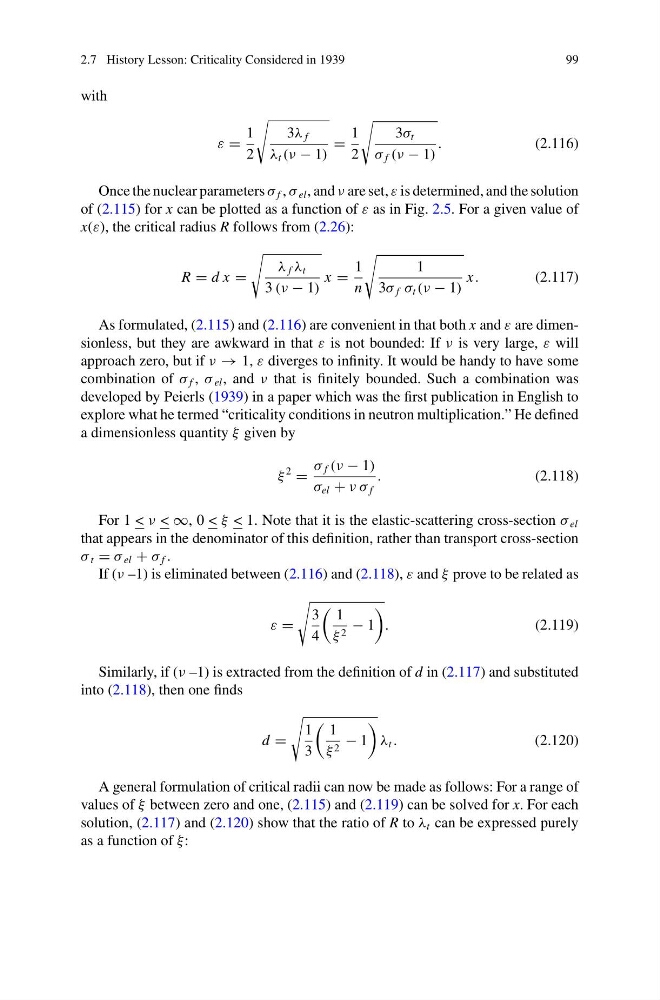
Once the nuclear parameters σ f , σ el , and ν are set, ε is determined, and the solution
of (2.115) for x can be plotted as a function of ε as in Fig. 2.5. For a given value of
x(ε), the critical radius R follows from (2.26):
R = d x =
λ f λ t
3 (ν − 1)
x =
1
n
1
3σ f σ t (ν − 1)
x.
(2.117)
As formulated, (2.115) and (2.116) are convenient in that both x and ε are dimensionless, but they are awkward in that ε is not bounded: If ν is very large, ε will
approach zero, but if ν → 1, ε diverges to infinity. It would be handy to have some
combination of σ f , σ el , and ν that is finitely bounded. Such a combination was
developed by Peierls (1939) in a paper which was the first publication in English to
explore what he termed “criticality conditions in neutron multiplication.” He defined
a dimensionless quantity ξ given by
ξ
2
=
σ f (ν − 1)
σ el + ν σ f
.
(2.118)
For 1 < ν < ∞, 0 < ξ < 1. Note that it is the elastic-scattering cross-section σ el
that appears in the denominator of this definition, rather than transport cross-section
σ t = σ el + σ f .
If (ν –1) is eliminated between (2.116) and (2.118), ε and ξ prove to be related as
ε =
3
4
1
ξ 2 − 1
.
(2.119)
Similarly, if (ν –1) is extracted from the definition of d in (2.117) and substituted
into (2.118), then one finds
d =
1
3
1
ξ 2 − 1
λ t .
(2.120)
A general formulation of critical radii can now be made as follows: For a range of
values of ξ between zero and one, (2.115) and (2.119) can be solved for x. For each
solution, (2.117) and (2.120) show that the ratio of R to λ t can be expressed purely
as a function of ξ:
99
with
ε =
1
2
3λ f
λ t (ν − 1)
=
1
2
3σ t
σ f (ν − 1)
.
(2.116)
Once the nuclear parameters σ f , σ el , and ν are set, ε is determined, and the solution
of (2.115) for x can be plotted as a function of ε as in Fig. 2.5. For a given value of
x(ε), the critical radius R follows from (2.26):
R = d x =
λ f λ t
3 (ν − 1)
x =
1
n
1
3σ f σ t (ν − 1)
x.
(2.117)
As formulated, (2.115) and (2.116) are convenient in that both x and ε are dimensionless, but they are awkward in that ε is not bounded: If ν is very large, ε will
approach zero, but if ν → 1, ε diverges to infinity. It would be handy to have some
combination of σ f , σ el , and ν that is finitely bounded. Such a combination was
developed by Peierls (1939) in a paper which was the first publication in English to
explore what he termed “criticality conditions in neutron multiplication.” He defined
a dimensionless quantity ξ given by
ξ
2
=
σ f (ν − 1)
σ el + ν σ f
.
(2.118)
For 1 < ν < ∞, 0 < ξ < 1. Note that it is the elastic-scattering cross-section σ el
that appears in the denominator of this definition, rather than transport cross-section
σ t = σ el + σ f .
If (ν –1) is eliminated between (2.116) and (2.118), ε and ξ prove to be related as
ε =
3
4
1
ξ 2 − 1
.
(2.119)
Similarly, if (ν –1) is extracted from the definition of d in (2.117) and substituted
into (2.118), then one finds
d =
1
3
1
ξ 2 − 1
λ t .
(2.120)
A general formulation of critical radii can now be made as follows: For a range of
values of ξ between zero and one, (2.115) and (2.119) can be solved for x. For each
solution, (2.117) and (2.120) show that the ratio of R to λ t can be expressed purely
as a function of ξ: