

2.5 Estimating Yield—Analytic
93
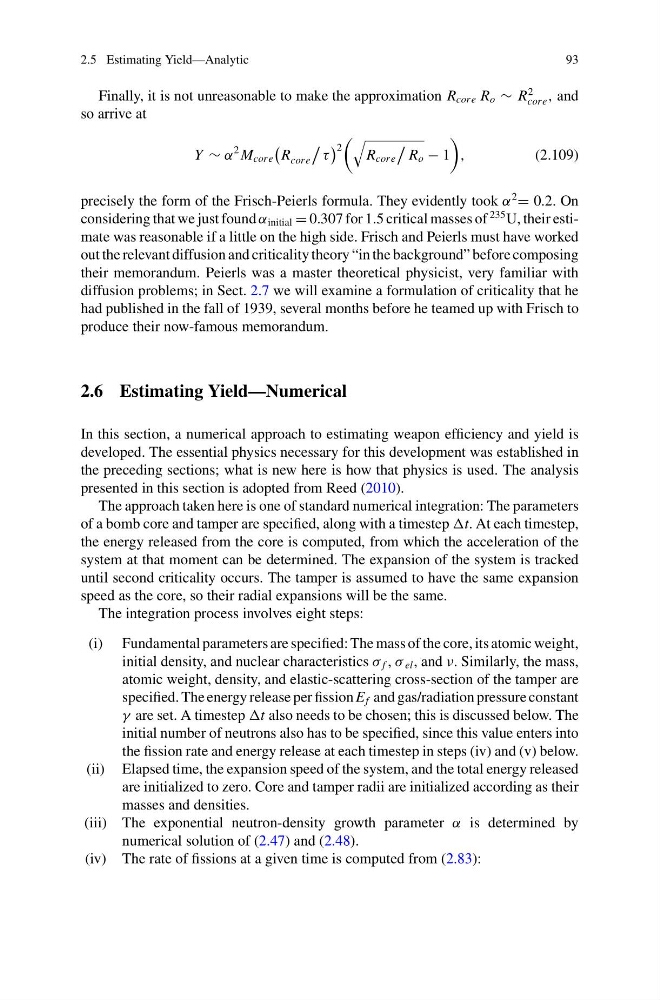
Finally, it is not unreasonable to make the approximation R core R o ∼ R
2
core , and
so arrive at
Y ∼ α
2 M core
R core
τ
2
R core
R o − 1
,
(2.109)
precisely the form of the Frisch-Peierls formula. They evidently took α
2
= 0.2. On
considering that we just found α initial = 0.307 for 1.5 critical masses of
235 U, their estimate was reasonable if a little on the high side. Frisch and Peierls must have worked
out the relevant diffusion and criticality theory “in the background” before composing
their memorandum. Peierls was a master theoretical physicist, very familiar with
diffusion problems; in Sect. 2.7 we will examine a formulation of criticality that he
had published in the fall of 1939, several months before he teamed up with Frisch to
produce their now-famous memorandum.
2.6 Estimating Yield—Numerical
In this section, a numerical approach to estimating weapon efficiency and yield is
developed. The essential physics necessary for this development was established in
the preceding sections; what is new here is how that physics is used. The analysis
presented in this section is adopted from Reed (2010).
The approach taken here is one of standard numerical integration: The parameters
of a bomb core and tamper are specified, along with a timestep t. At each timestep,
the energy released from the core is computed, from which the acceleration of the
system at that moment can be determined. The expansion of the system is tracked
until second criticality occurs. The tamper is assumed to have the same expansion
speed as the core, so their radial expansions will be the same.
The integration process involves eight steps:
(i) Fundamental parameters are specified: The mass of the core, its atomic weight,
initial density, and nuclear characteristics σ f , σ el , and ν. Similarly, the mass,
atomic weight, density, and elastic-scattering cross-section of the tamper are
specified. The energy release per fission E f and gas/radiation pressure constant
γ are set. A timestep t also needs to be chosen; this is discussed below. The
initial number of neutrons also has to be specified, since this value enters into
the fission rate and energy release at each timestep in steps (iv) and (v) below.
(ii) Elapsed time, the expansion speed of the system, and the total energy released
are initialized to zero. Core and tamper radii are initialized according as their
masses and densities.
(iii) The exponential neutron-density growth parameter α is determined by
numerical solution of (2.47) and (2.48).
(iv) The rate of fissions at a given time is computed from (2.83):
93
Finally, it is not unreasonable to make the approximation R core R o ∼ R
2
core , and
so arrive at
Y ∼ α
2 M core
R core
τ
2
R core
R o − 1
,
(2.109)
precisely the form of the Frisch-Peierls formula. They evidently took α
2
= 0.2. On
considering that we just found α initial = 0.307 for 1.5 critical masses of
235 U, their estimate was reasonable if a little on the high side. Frisch and Peierls must have worked
out the relevant diffusion and criticality theory “in the background” before composing
their memorandum. Peierls was a master theoretical physicist, very familiar with
diffusion problems; in Sect. 2.7 we will examine a formulation of criticality that he
had published in the fall of 1939, several months before he teamed up with Frisch to
produce their now-famous memorandum.
2.6 Estimating Yield—Numerical
In this section, a numerical approach to estimating weapon efficiency and yield is
developed. The essential physics necessary for this development was established in
the preceding sections; what is new here is how that physics is used. The analysis
presented in this section is adopted from Reed (2010).
The approach taken here is one of standard numerical integration: The parameters
of a bomb core and tamper are specified, along with a timestep t. At each timestep,
the energy released from the core is computed, from which the acceleration of the
system at that moment can be determined. The expansion of the system is tracked
until second criticality occurs. The tamper is assumed to have the same expansion
speed as the core, so their radial expansions will be the same.
The integration process involves eight steps:
(i) Fundamental parameters are specified: The mass of the core, its atomic weight,
initial density, and nuclear characteristics σ f , σ el , and ν. Similarly, the mass,
atomic weight, density, and elastic-scattering cross-section of the tamper are
specified. The energy release per fission E f and gas/radiation pressure constant
γ are set. A timestep t also needs to be chosen; this is discussed below. The
initial number of neutrons also has to be specified, since this value enters into
the fission rate and energy release at each timestep in steps (iv) and (v) below.
(ii) Elapsed time, the expansion speed of the system, and the total energy released
are initialized to zero. Core and tamper radii are initialized according as their
masses and densities.
(iii) The exponential neutron-density growth parameter α is determined by
numerical solution of (2.47) and (2.48).
(iv) The rate of fissions at a given time is computed from (2.83):