

92
2 Critical Mass, Efficiency, and Yield
utilizing fission; the title of their memo was “On the construction of a “super-bomb”,
based on a nuclear chain reaction in uranium.” Their work was remarkably prescient:
They discussed how a chain reaction could not happen in ordinary uranium; raised
the possibility of bringing together two subcritical pieces of pure
235 U to create a
supercritical mass; discussed how neutrons in cosmic radiation could be used to
trigger the device; described how
235 U could be isolated by diffusion; and remarked
that such a device would create significant radioactive fallout. Copies of the memorandum can be found in many online sites; a printed copy appears in Serber (1992).
Readers are warned, however, that many reprintings contain various typographical
errors. A detailed analysis of the physics involved in the memorandum is presented
by Bernstein (2011), who also describes the errors.
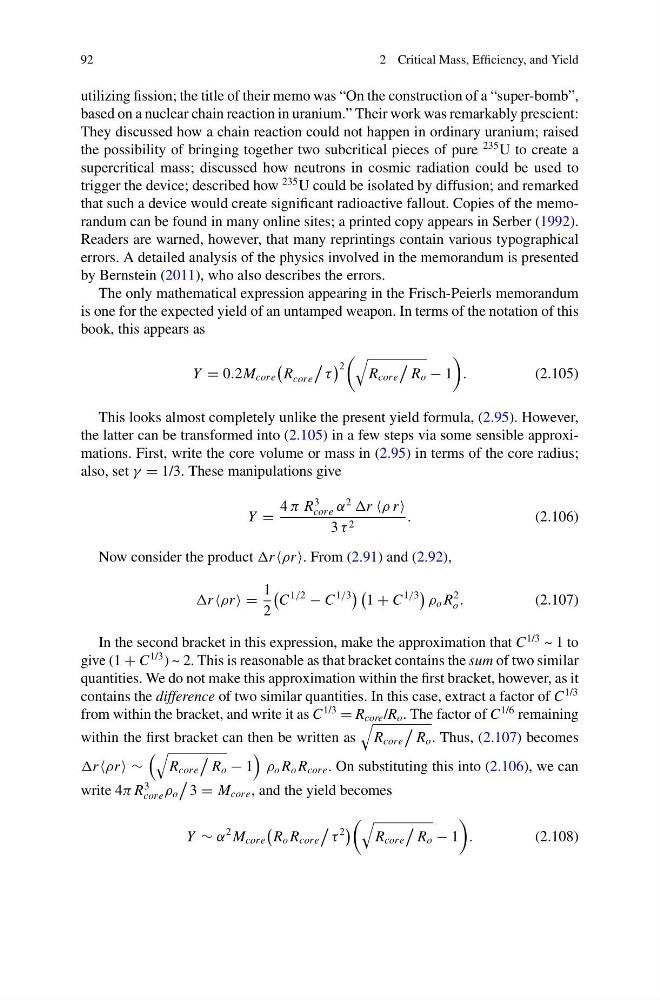
The only mathematical expression appearing in the Frisch-Peierls memorandum
is one for the expected yield of an untamped weapon. In terms of the notation of this
book, this appears as
Y = 0.2M core
R core
τ
2
R core
R o − 1
.
(2.105)
This looks almost completely unlike the present yield formula, (2.95). However,
the latter can be transformed into (2.105) in a few steps via some sensible approximations. First, write the core volume or mass in (2.95) in terms of the core radius;
also, set γ = 1/3. These manipulations give
Y =
4 π R
3
core α
2
r ρ r
3 τ 2
.
(2.106)
Now consider the product r ρr . From (2.91) and (2.92),
r ρr =
1
2
C
1/2
− C
1/3
1 + C
1/3
ρ o R
2
o .
(2.107)
In the second bracket in this expression, make the approximation that C
1/3 ~ 1 to
give (1 + C
1/3 ) ~ 2. This is reasonable as that bracket contains the sum of two similar
quantities. We do not make this approximation within the first bracket, however, as it
contains the difference of two similar quantities. In this case, extract a factor of C
1/3
from within the bracket, and write it as C
1/3
= R core /R o . The factor of C
1/6 remaining
within the first bracket can then be written as
R core
R o . Thus, (2.107) becomes
r ρr ∼
R core
R o − 1
ρ o R o R core . On substituting this into (2.106), we can
write 4π R
3
core ρ o
3 = M core , and the yield becomes
Y ∼ α
2 M core
R o R core
τ
2
R core
R o − 1
.
(2.108)
2 Critical Mass, Efficiency, and Yield
utilizing fission; the title of their memo was “On the construction of a “super-bomb”,
based on a nuclear chain reaction in uranium.” Their work was remarkably prescient:
They discussed how a chain reaction could not happen in ordinary uranium; raised
the possibility of bringing together two subcritical pieces of pure
235 U to create a
supercritical mass; discussed how neutrons in cosmic radiation could be used to
trigger the device; described how
235 U could be isolated by diffusion; and remarked
that such a device would create significant radioactive fallout. Copies of the memorandum can be found in many online sites; a printed copy appears in Serber (1992).
Readers are warned, however, that many reprintings contain various typographical
errors. A detailed analysis of the physics involved in the memorandum is presented
by Bernstein (2011), who also describes the errors.
The only mathematical expression appearing in the Frisch-Peierls memorandum
is one for the expected yield of an untamped weapon. In terms of the notation of this
book, this appears as
Y = 0.2M core
R core
τ
2
R core
R o − 1
.
(2.105)
This looks almost completely unlike the present yield formula, (2.95). However,
the latter can be transformed into (2.105) in a few steps via some sensible approximations. First, write the core volume or mass in (2.95) in terms of the core radius;
also, set γ = 1/3. These manipulations give
Y =
4 π R
3
core α
2
r ρ r
3 τ 2
.
(2.106)
Now consider the product r ρr . From (2.91) and (2.92),
r ρr =
1
2
C
1/2
− C
1/3
1 + C
1/3
ρ o R
2
o .
(2.107)
In the second bracket in this expression, make the approximation that C
1/3 ~ 1 to
give (1 + C
1/3 ) ~ 2. This is reasonable as that bracket contains the sum of two similar
quantities. We do not make this approximation within the first bracket, however, as it
contains the difference of two similar quantities. In this case, extract a factor of C
1/3
from within the bracket, and write it as C
1/3
= R core /R o . The factor of C
1/6 remaining
within the first bracket can then be written as
R core
R o . Thus, (2.107) becomes
r ρr ∼
R core
R o − 1
ρ o R o R core . On substituting this into (2.106), we can
write 4π R
3
core ρ o
3 = M core , and the yield becomes
Y ∼ α
2 M core
R o R core
τ
2
R core
R o − 1
.
(2.108)