

94
2 Critical Mass, Efficiency, and Yield
f issions/sec =
N o V core
τ
e
(α/τ ) t
.
(2.110)
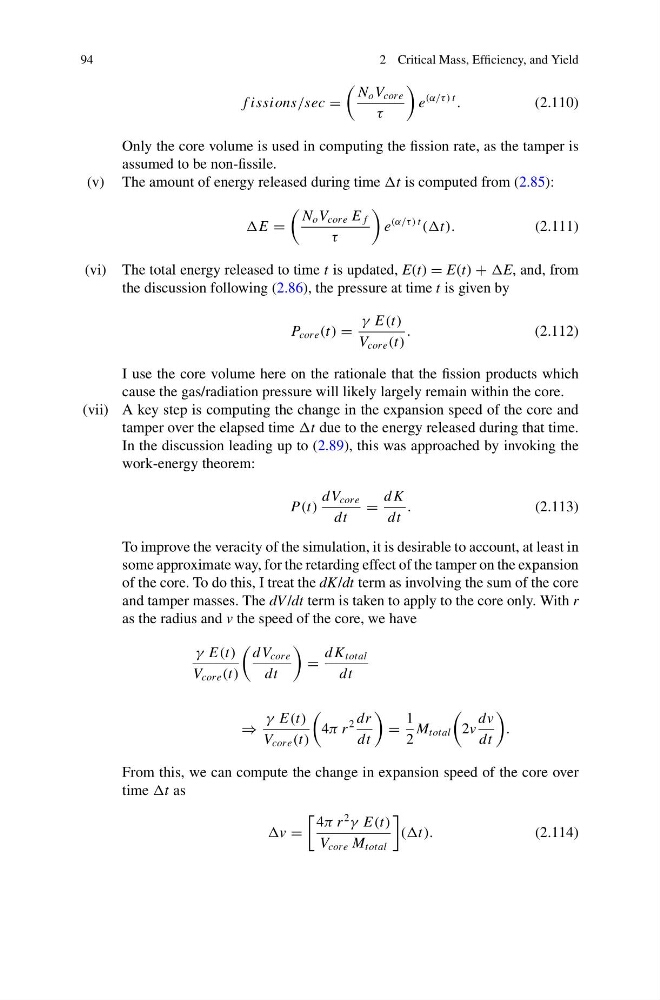
Only the core volume is used in computing the fission rate, as the tamper is
assumed to be non-fissile.
(v) The amount of energy released during time t is computed from (2.85):
E =
N o V core E f
τ
e
(α/τ ) t
(t).
(2.111)
(vi) The total energy released to time t is updated, E(t) = E(t) + E, and, from
the discussion following (2.86), the pressure at time t is given by
P core (t) =
γ E(t)
V core (t)
.
(2.112)
I use the core volume here on the rationale that the fission products which
cause the gas/radiation pressure will likely largely remain within the core.
(vii) A key step is computing the change in the expansion speed of the core and
tamper over the elapsed time t due to the energy released during that time.
In the discussion leading up to (2.89), this was approached by invoking the
work-energy theorem:
P(t)
dV core
dt
=
d K
dt
.
(2.113)
To improve the veracity of the simulation, it is desirable to account, at least in
some approximate way, for the retarding effect of the tamper on the expansion
of the core. To do this, I treat the dK/dt term as involving the sum of the core
and tamper masses. The dV /dt term is taken to apply to the core only. With r
as the radius and v the speed of the core, we have
γ E(t)
V core (t)
dV core
dt
=
d K total
dt
⇒
γ E(t)
V core (t)
4π r
2 dr
dt
=
1
2
M total
2v
dv
dt
.
From this, we can compute the change in expansion speed of the core over
time t as
v =
4π r
2
γ E(t)
V core M total
(t).
(2.114)
2 Critical Mass, Efficiency, and Yield
f issions/sec =
N o V core
τ
e
(α/τ ) t
.
(2.110)
Only the core volume is used in computing the fission rate, as the tamper is
assumed to be non-fissile.
(v) The amount of energy released during time t is computed from (2.85):
E =
N o V core E f
τ
e
(α/τ ) t
(t).
(2.111)
(vi) The total energy released to time t is updated, E(t) = E(t) + E, and, from
the discussion following (2.86), the pressure at time t is given by
P core (t) =
γ E(t)
V core (t)
.
(2.112)
I use the core volume here on the rationale that the fission products which
cause the gas/radiation pressure will likely largely remain within the core.
(vii) A key step is computing the change in the expansion speed of the core and
tamper over the elapsed time t due to the energy released during that time.
In the discussion leading up to (2.89), this was approached by invoking the
work-energy theorem:
P(t)
dV core
dt
=
d K
dt
.
(2.113)
To improve the veracity of the simulation, it is desirable to account, at least in
some approximate way, for the retarding effect of the tamper on the expansion
of the core. To do this, I treat the dK/dt term as involving the sum of the core
and tamper masses. The dV /dt term is taken to apply to the core only. With r
as the radius and v the speed of the core, we have
γ E(t)
V core (t)
dV core
dt
=
d K total
dt
⇒
γ E(t)
V core (t)
4π r
2 dr
dt
=
1
2
M total
2v
dv
dt
.
From this, we can compute the change in expansion speed of the core over
time t as
v =
4π r
2
γ E(t)
V core M total
(t).
(2.114)