

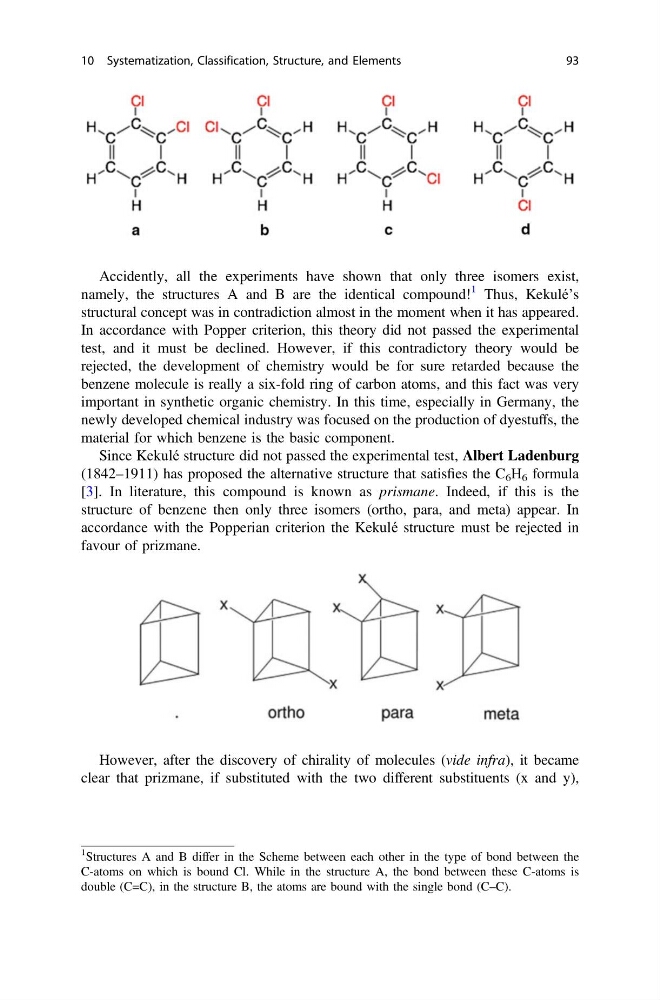
Accidently, all the experiments have shown that only three isomers exist,
namely, the structures A and B are the identical compound!
1 Thus, Kekulé’s
structural concept was in contradiction almost in the moment when it has appeared.
In accordance with Popper criterion, this theory did not passed the experimental
test, and it must be declined. However, if this contradictory theory would be
rejected, the development of chemistry would be for sure retarded because the
benzene molecule is really a six-fold ring of carbon atoms, and this fact was very
important in synthetic organic chemistry. In this time, especially in Germany, the
newly developed chemical industry was focused on the production of dyestuffs, the
material for which benzene is the basic component.
Since Kekulé structure did not passed the experimental test, Albert Ladenburg
(1842–1911) has proposed the alternative structure that satisfies the C 6 H 6 formula
[3]. In literature, this compound is known as prismane. Indeed, if this is the
structure of benzene then only three isomers (ortho, para, and meta) appear. In
accordance with the Popperian criterion the Kekulé structure must be rejected in
favour of prizmane.
However, after the discovery of chirality of molecules (vide infra), it became
clear that prizmane, if substituted with the two different substituents (x and y),
1
Structures A and B differ in the Scheme between each other in the type of bond between the
C-atoms on which is bound Cl. While in the structure A, the bond between these C-atoms is
double (C=C), in the structure B, the atoms are bound with the single bond (C–C).
10 Systematization, Classification, Structure, and Elements
93
namely, the structures A and B are the identical compound!
1 Thus, Kekulé’s
structural concept was in contradiction almost in the moment when it has appeared.
In accordance with Popper criterion, this theory did not passed the experimental
test, and it must be declined. However, if this contradictory theory would be
rejected, the development of chemistry would be for sure retarded because the
benzene molecule is really a six-fold ring of carbon atoms, and this fact was very
important in synthetic organic chemistry. In this time, especially in Germany, the
newly developed chemical industry was focused on the production of dyestuffs, the
material for which benzene is the basic component.
Since Kekulé structure did not passed the experimental test, Albert Ladenburg
(1842–1911) has proposed the alternative structure that satisfies the C 6 H 6 formula
[3]. In literature, this compound is known as prismane. Indeed, if this is the
structure of benzene then only three isomers (ortho, para, and meta) appear. In
accordance with the Popperian criterion the Kekulé structure must be rejected in
favour of prizmane.
However, after the discovery of chirality of molecules (vide infra), it became
clear that prizmane, if substituted with the two different substituents (x and y),
1
Structures A and B differ in the Scheme between each other in the type of bond between the
C-atoms on which is bound Cl. While in the structure A, the bond between these C-atoms is
double (C=C), in the structure B, the atoms are bound with the single bond (C–C).
10 Systematization, Classification, Structure, and Elements
93