

In modern notation this structure is described with a six-fold ring with the
alternating single and double bonds:
Kekulé ring structure, published in 1856, has been an important step in the
extension of the structural theory. However, although elegant, this structural model
was questionable because of its discrepancy with the experimental observations [2].
The problem has appeared with the representation of the structures of benzene
derivates obtained by substitution of two hydrogen atoms with other atoms or
groups, for instance with chlorine. By replacement of two hydrogen atoms with two
chlorine atoms we get dichlorobenzene. Starting from the Kekulé structure of
benzene, we could expect four different isomers of dichlorobenzene, A, B, C i D:
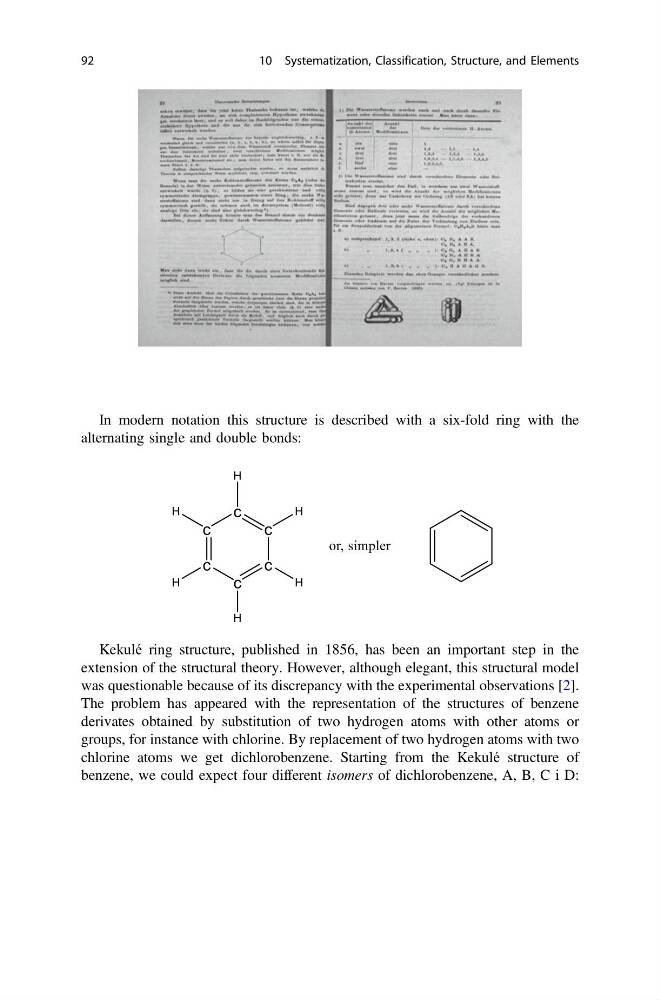
Facsimile from the dissertation of August Kekulé about the structure of benzene
92
10 Systematization, Classification, Structure, and Elements
alternating single and double bonds:
Kekulé ring structure, published in 1856, has been an important step in the
extension of the structural theory. However, although elegant, this structural model
was questionable because of its discrepancy with the experimental observations [2].
The problem has appeared with the representation of the structures of benzene
derivates obtained by substitution of two hydrogen atoms with other atoms or
groups, for instance with chlorine. By replacement of two hydrogen atoms with two
chlorine atoms we get dichlorobenzene. Starting from the Kekulé structure of
benzene, we could expect four different isomers of dichlorobenzene, A, B, C i D:
Facsimile from the dissertation of August Kekulé about the structure of benzene
92
10 Systematization, Classification, Structure, and Elements