

a way that it never falls in contradiction. Thus, science became more and more a
sort of the “organized scepticism”, rather than a method for searching the final truth.
Although, at first sight, Gödel theorem seems pessimistic and discouraging, in fact,
the incompleteness of science is the main force that stimulate its development.
Let remember my first lecture where I have exposed two approaches in the
validation of the quality of science. By the principle of induction advocated by
representatives of the Vienna circle, especially by Wittgenstein, theory must be
provable. The opposite approach proposed by Popper requires that a good theory
must be refutable, i.e. it must assume the test that can reject it. By using this Popper
principle strictly, and keeping in the mind Gödel’s theorem, we are getting into
natural conclusion that almost all the theories should be rejected because none of
them, in accordance with the incompleteness theorem, can pass its own tests. What
would remain of science?
The structural theory, used as a conceptual system developed in chemistry,
represents good model for the demonstration of this Gödel-Popper discrepancy.
Application of the structural theory based on the principle of valence came across
unsolvable contradictions. By studying the structure of the benzene molecule with
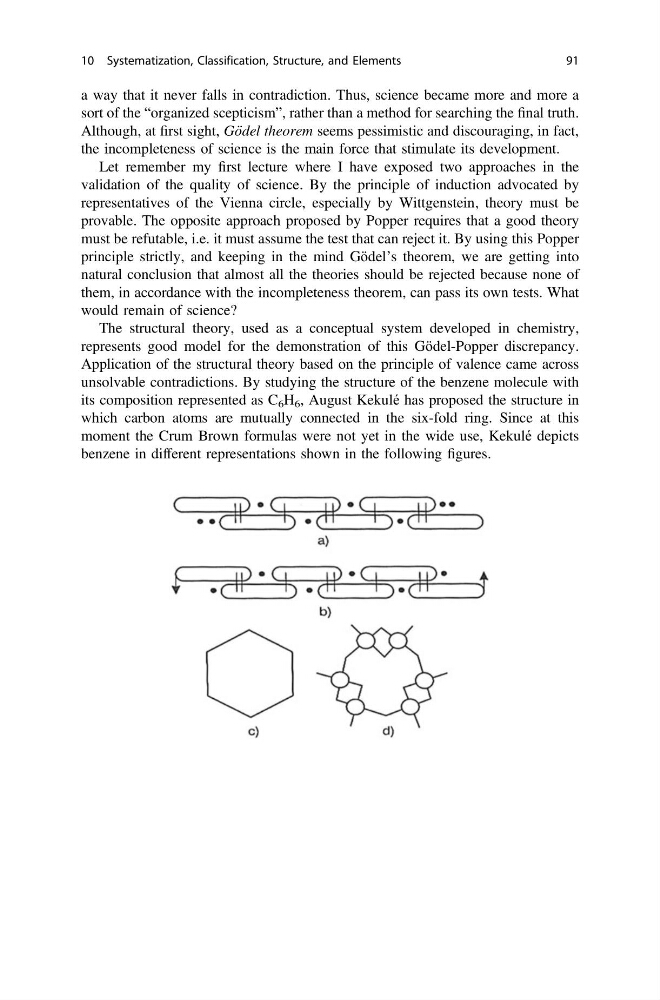
its composition represented as C 6 H 6 , August Kekulé has proposed the structure in
which carbon atoms are mutually connected in the six-fold ring. Since at this
moment the Crum Brown formulas were not yet in the wide use, Kekulé depicts
benzene in different representations shown in the following figures.
Representations of the constitution of benzene molecule in different works of August
Kekulé
10 Systematization, Classification, Structure, and Elements
91
sort of the “organized scepticism”, rather than a method for searching the final truth.
Although, at first sight, Gödel theorem seems pessimistic and discouraging, in fact,
the incompleteness of science is the main force that stimulate its development.
Let remember my first lecture where I have exposed two approaches in the
validation of the quality of science. By the principle of induction advocated by
representatives of the Vienna circle, especially by Wittgenstein, theory must be
provable. The opposite approach proposed by Popper requires that a good theory
must be refutable, i.e. it must assume the test that can reject it. By using this Popper
principle strictly, and keeping in the mind Gödel’s theorem, we are getting into
natural conclusion that almost all the theories should be rejected because none of
them, in accordance with the incompleteness theorem, can pass its own tests. What
would remain of science?
The structural theory, used as a conceptual system developed in chemistry,
represents good model for the demonstration of this Gödel-Popper discrepancy.
Application of the structural theory based on the principle of valence came across
unsolvable contradictions. By studying the structure of the benzene molecule with
its composition represented as C 6 H 6 , August Kekulé has proposed the structure in
which carbon atoms are mutually connected in the six-fold ring. Since at this
moment the Crum Brown formulas were not yet in the wide use, Kekulé depicts
benzene in different representations shown in the following figures.
Representations of the constitution of benzene molecule in different works of August
Kekulé
10 Systematization, Classification, Structure, and Elements
91