

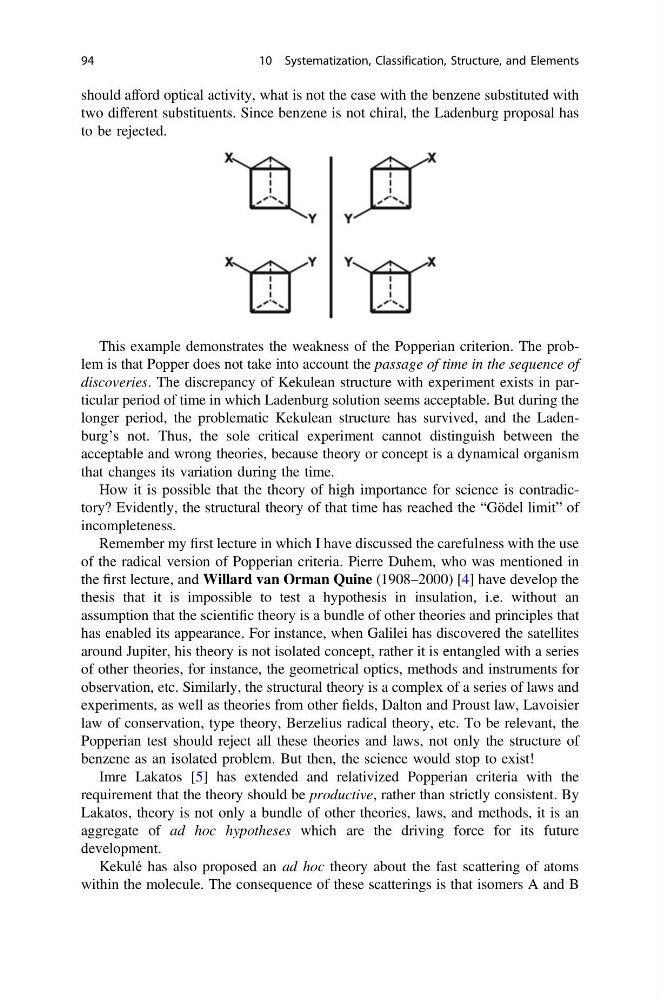
should afford optical activity, what is not the case with the benzene substituted with
two different substituents. Since benzene is not chiral, the Ladenburg proposal has
to be rejected.
This example demonstrates the weakness of the Popperian criterion. The problem is that Popper does not take into account the passage of time in the sequence of
discoveries. The discrepancy of Kekulean structure with experiment exists in particular period of time in which Ladenburg solution seems acceptable. But during the
longer period, the problematic Kekulean structure has survived, and the Ladenburg’s not. Thus, the sole critical experiment cannot distinguish between the
acceptable and wrong theories, because theory or concept is a dynamical organism
that changes its variation during the time.
How it is possible that the theory of high importance for science is contradictory? Evidently, the structural theory of that time has reached the “Gödel limit” of
incompleteness.
Remember my first lecture in which I have discussed the carefulness with the use
of the radical version of Popperian criteria. Pierre Duhem, who was mentioned in
the first lecture, and Willard van Orman Quine (1908–2000) [4] have develop the
thesis that it is impossible to test a hypothesis in insulation, i.e. without an
assumption that the scientific theory is a bundle of other theories and principles that
has enabled its appearance. For instance, when Galilei has discovered the satellites
around Jupiter, his theory is not isolated concept, rather it is entangled with a series
of other theories, for instance, the geometrical optics, methods and instruments for
observation, etc. Similarly, the structural theory is a complex of a series of laws and
experiments, as well as theories from other fields, Dalton and Proust law, Lavoisier
law of conservation, type theory, Berzelius radical theory, etc. To be relevant, the
Popperian test should reject all these theories and laws, not only the structure of
benzene as an isolated problem. But then, the science would stop to exist!
Imre Lakatos [5] has extended and relativized Popperian criteria with the
requirement that the theory should be productive, rather than strictly consistent. By
Lakatos, theory is not only a bundle of other theories, laws, and methods, it is an
aggregate of ad hoc hypotheses which are the driving force for its future
development.
Kekulé has also proposed an ad hoc theory about the fast scattering of atoms
within the molecule. The consequence of these scatterings is that isomers A and B
94
10 Systematization, Classification, Structure, and Elements
two different substituents. Since benzene is not chiral, the Ladenburg proposal has
to be rejected.
This example demonstrates the weakness of the Popperian criterion. The problem is that Popper does not take into account the passage of time in the sequence of
discoveries. The discrepancy of Kekulean structure with experiment exists in particular period of time in which Ladenburg solution seems acceptable. But during the
longer period, the problematic Kekulean structure has survived, and the Ladenburg’s not. Thus, the sole critical experiment cannot distinguish between the
acceptable and wrong theories, because theory or concept is a dynamical organism
that changes its variation during the time.
How it is possible that the theory of high importance for science is contradictory? Evidently, the structural theory of that time has reached the “Gödel limit” of
incompleteness.
Remember my first lecture in which I have discussed the carefulness with the use
of the radical version of Popperian criteria. Pierre Duhem, who was mentioned in
the first lecture, and Willard van Orman Quine (1908–2000) [4] have develop the
thesis that it is impossible to test a hypothesis in insulation, i.e. without an
assumption that the scientific theory is a bundle of other theories and principles that
has enabled its appearance. For instance, when Galilei has discovered the satellites
around Jupiter, his theory is not isolated concept, rather it is entangled with a series
of other theories, for instance, the geometrical optics, methods and instruments for
observation, etc. Similarly, the structural theory is a complex of a series of laws and
experiments, as well as theories from other fields, Dalton and Proust law, Lavoisier
law of conservation, type theory, Berzelius radical theory, etc. To be relevant, the
Popperian test should reject all these theories and laws, not only the structure of
benzene as an isolated problem. But then, the science would stop to exist!
Imre Lakatos [5] has extended and relativized Popperian criteria with the
requirement that the theory should be productive, rather than strictly consistent. By
Lakatos, theory is not only a bundle of other theories, laws, and methods, it is an
aggregate of ad hoc hypotheses which are the driving force for its future
development.
Kekulé has also proposed an ad hoc theory about the fast scattering of atoms
within the molecule. The consequence of these scatterings is that isomers A and B
94
10 Systematization, Classification, Structure, and Elements