

are in very fast interconversion. However, Kekulé did not proposed extra argumentation for this hypothesis.
For the final solution of this contradiction about the structure of benzene we have
to wait a half of century. But this solution will appear as a new paradigm, not only
in chemistry, but also in the general science.
Now let me discuss some other conceptual solutions around structural theory,
which are results of thinking in analogies. Basic idea of structural theory is that
molecules can be decomposed in smaller repetitive fragments. Good example are
Berzelius theory of radicals. Within this theory Berzelius has proposed new method
of classifications of simple hydrocarbons—the homologous series. Simple hydrocarbons and their molecules can be classified in homologous series if all have
elemental composition that satisfy formula C n H 2n+2 , if n is an integer. Ethane has
composition C 2 H 6 , what is in agreement with this formula if n = 2. From this
regularity, it follows that all these molecules can be composed from identical simple
fragments.
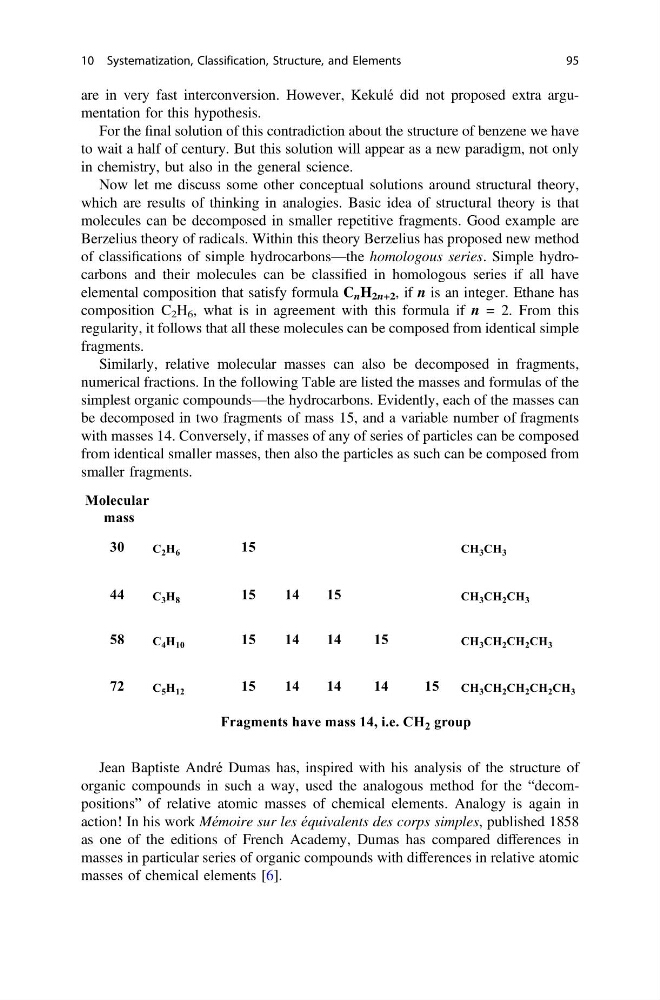
Similarly, relative molecular masses can also be decomposed in fragments,
numerical fractions. In the following Table are listed the masses and formulas of the
simplest organic compounds—the hydrocarbons. Evidently, each of the masses can
be decomposed in two fragments of mass 15, and a variable number of fragments
with masses 14. Conversely, if masses of any of series of particles can be composed
from identical smaller masses, then also the particles as such can be composed from
smaller fragments.
Jean Baptiste André Dumas has, inspired with his analysis of the structure of
organic compounds in such a way, used the analogous method for the “decompositions” of relative atomic masses of chemical elements. Analogy is again in
action! In his work Mémoire sur les équivalents des corps simples, published 1858
as one of the editions of French Academy, Dumas has compared differences in
masses in particular series of organic compounds with differences in relative atomic
masses of chemical elements [6].
10 Systematization, Classification, Structure, and Elements
95
For the final solution of this contradiction about the structure of benzene we have
to wait a half of century. But this solution will appear as a new paradigm, not only
in chemistry, but also in the general science.
Now let me discuss some other conceptual solutions around structural theory,
which are results of thinking in analogies. Basic idea of structural theory is that
molecules can be decomposed in smaller repetitive fragments. Good example are
Berzelius theory of radicals. Within this theory Berzelius has proposed new method
of classifications of simple hydrocarbons—the homologous series. Simple hydrocarbons and their molecules can be classified in homologous series if all have
elemental composition that satisfy formula C n H 2n+2 , if n is an integer. Ethane has
composition C 2 H 6 , what is in agreement with this formula if n = 2. From this
regularity, it follows that all these molecules can be composed from identical simple
fragments.
Similarly, relative molecular masses can also be decomposed in fragments,
numerical fractions. In the following Table are listed the masses and formulas of the
simplest organic compounds—the hydrocarbons. Evidently, each of the masses can
be decomposed in two fragments of mass 15, and a variable number of fragments
with masses 14. Conversely, if masses of any of series of particles can be composed
from identical smaller masses, then also the particles as such can be composed from
smaller fragments.
Jean Baptiste André Dumas has, inspired with his analysis of the structure of
organic compounds in such a way, used the analogous method for the “decompositions” of relative atomic masses of chemical elements. Analogy is again in
action! In his work Mémoire sur les équivalents des corps simples, published 1858
as one of the editions of French Academy, Dumas has compared differences in
masses in particular series of organic compounds with differences in relative atomic
masses of chemical elements [6].
10 Systematization, Classification, Structure, and Elements
95