

Morphology of crystals as a basis for the determination of analogy was too
narrow. For the establishment of the unequivocal reference for analogy, the
appearance of new paradigm was essential. If the criterion for analogy cannot be
determined by the immediate observation of properties of the substance, perhaps the
better approach can be found in focusing on the changes of substances, i.e. on
chemical reactions.
But, before disputing the ways through which the concept about the structure can
emerge from the systematic investigation and classifications of chemical reactions,
we have to look back on another important discovery, which has provided a new
light on the question of chemical affinity, and the problem of mutual binding of
atoms.
By the invention of the first battery, and discovery of the electrical current,
Alessandro Volta (1745–1827) has initiated new field of chemistry—the electrochemistry. Volta has stimulated the development of methods by which chemical
changes can be triggered by application of electrical current. By electrolysis of
water, Volta has, again after Lavoisier, demonstrated that water consists from
oxygen and hydrogen, the gases that are produced on the different electrical poles,
hydrogen on negative, and oxygen on the positive pole. This experimental approach
has appeared as new chemical method, chemists started to electrolyse all available
substances. Humphry Davy (1778–1829) has electrolyzed the melts of salts at high
temperature, and he succeeded to isolate a series of new chemical elements, metals
sodium, potassium, calcium, strontium, and magnesium. All these metals have
emerged on the negative electric pole (i.e. the negative electrode), the same as it
was the case with hydrogen. Oppositely, non-metals have always developed on the
positively charged electrode. Chemical affinity, or we could call it already the
chemical bond, is by its nature an electrical phenomenon! Clearly, atoms of metals
can combine with atoms of non-metals because their electrical nature is, as it
follows from the electrolysis, opposite. This is one of the origins of the first theory
about chemical bond, the chemical dualism: only atoms of different elements can be
bound to each other! Berzelius, who had performed a series of electrochemical
experiments, has insisted on this dualistic view.
However, preparation of series of chemical compounds, especially organic, has
provided the facts that were not explainable within the dualistic point of view. Jean
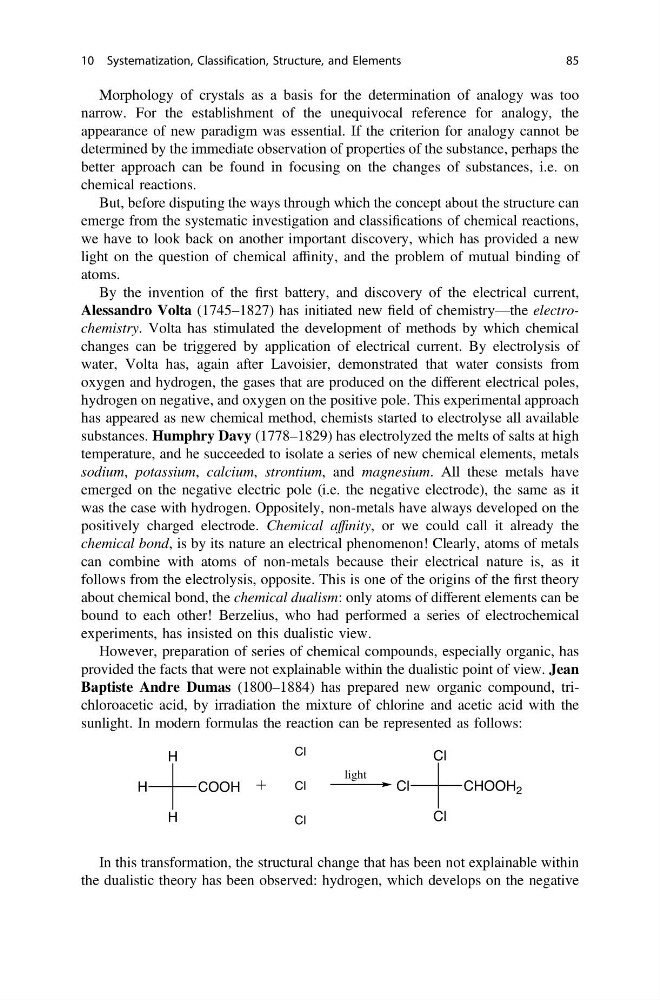
Baptiste Andre Dumas (1800–1884) has prepared new organic compound, trichloroacetic acid, by irradiation the mixture of chlorine and acetic acid with the
sunlight. In modern formulas the reaction can be represented as follows:
In this transformation, the structural change that has been not explainable within
the dualistic theory has been observed: hydrogen, which develops on the negative
10 Systematization, Classification, Structure, and Elements
85
narrow. For the establishment of the unequivocal reference for analogy, the
appearance of new paradigm was essential. If the criterion for analogy cannot be
determined by the immediate observation of properties of the substance, perhaps the
better approach can be found in focusing on the changes of substances, i.e. on
chemical reactions.
But, before disputing the ways through which the concept about the structure can
emerge from the systematic investigation and classifications of chemical reactions,
we have to look back on another important discovery, which has provided a new
light on the question of chemical affinity, and the problem of mutual binding of
atoms.
By the invention of the first battery, and discovery of the electrical current,
Alessandro Volta (1745–1827) has initiated new field of chemistry—the electrochemistry. Volta has stimulated the development of methods by which chemical
changes can be triggered by application of electrical current. By electrolysis of
water, Volta has, again after Lavoisier, demonstrated that water consists from
oxygen and hydrogen, the gases that are produced on the different electrical poles,
hydrogen on negative, and oxygen on the positive pole. This experimental approach
has appeared as new chemical method, chemists started to electrolyse all available
substances. Humphry Davy (1778–1829) has electrolyzed the melts of salts at high
temperature, and he succeeded to isolate a series of new chemical elements, metals
sodium, potassium, calcium, strontium, and magnesium. All these metals have
emerged on the negative electric pole (i.e. the negative electrode), the same as it
was the case with hydrogen. Oppositely, non-metals have always developed on the
positively charged electrode. Chemical affinity, or we could call it already the
chemical bond, is by its nature an electrical phenomenon! Clearly, atoms of metals
can combine with atoms of non-metals because their electrical nature is, as it
follows from the electrolysis, opposite. This is one of the origins of the first theory
about chemical bond, the chemical dualism: only atoms of different elements can be
bound to each other! Berzelius, who had performed a series of electrochemical
experiments, has insisted on this dualistic view.
However, preparation of series of chemical compounds, especially organic, has
provided the facts that were not explainable within the dualistic point of view. Jean
Baptiste Andre Dumas (1800–1884) has prepared new organic compound, trichloroacetic acid, by irradiation the mixture of chlorine and acetic acid with the
sunlight. In modern formulas the reaction can be represented as follows:
In this transformation, the structural change that has been not explainable within
the dualistic theory has been observed: hydrogen, which develops on the negative
10 Systematization, Classification, Structure, and Elements
85