

Chemical elemental contents of a compound, its composition, is in this way
represented by exact symbolism—the chemical formula. Justus Liebig (1803–
1873) has changed this symbolism in such a way that the numerical label of number
of atoms became bottom index: H 2 O or CH 4 . Some chemical books and textbooks
published in the first decade of 20th century still have Berzelius symbols. Soon I
will explain that chemical formulas are not only iconic labels for particular compounds, rather, they have much broader informative contents about the substances.
Similarly, chemical nomenclature developed in the Lavoisier’s circle was not only a
collection of names and symbols.
Besides the contents, i.e. substances and transformations, the chemical conceptual system is complemented with special language (nomenclature), and special
script (formulas). This epistemology of contents, language, and script has its origins already in the beginning of chemical history—in protochemistry, as it has been
discussed in the 3rd lecture represented in this book.
By systematic determination of composition of organic compounds, Berzelius
has observed that some weight ratios of carbon and hydrogen (some ratios of the
numbers of carbon and hydrogen atoms) appear repeatedly, for instance compositions CH 3 , or C 2 H 5 , or C 6 H 5 . It seemed as organic compounds are merely the
combinations of these groups of atoms. As an example, the composition C 2 H 6
seems to be composed from two groups of CH 3 , or C 7 H 8 is a combination of one
group C 6 H 5 , and one CH 3 . Berzelius was convinced that these groups are stable,
and that in organic compounds they play the same role as chemical elements play in
the inorganic compounds. For these groups, Berzelius has used the term radicals.
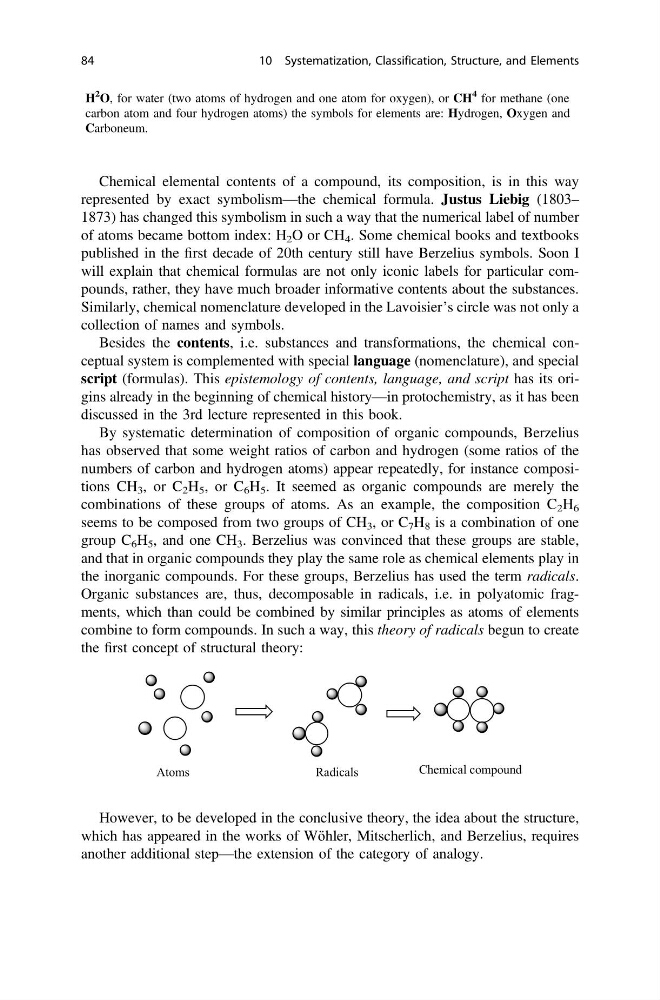
Organic substances are, thus, decomposable in radicals, i.e. in polyatomic fragments, which than could be combined by similar principles as atoms of elements
combine to form compounds. In such a way, this theory of radicals begun to create
the first concept of structural theory:
Atoms
Radicals
Chemical compound
However, to be developed in the conclusive theory, the idea about the structure,
which has appeared in the works of Wöhler, Mitscherlich, and Berzelius, requires
another additional step—the extension of the category of analogy.
H
2
O, for water (two atoms of hydrogen and one atom for oxygen), or CH
4 for methane (one
carbon atom and four hydrogen atoms) the symbols for elements are: Hydrogen, Oxygen and
Carboneum.
84
10 Systematization, Classification, Structure, and Elements
represented by exact symbolism—the chemical formula. Justus Liebig (1803–
1873) has changed this symbolism in such a way that the numerical label of number
of atoms became bottom index: H 2 O or CH 4 . Some chemical books and textbooks
published in the first decade of 20th century still have Berzelius symbols. Soon I
will explain that chemical formulas are not only iconic labels for particular compounds, rather, they have much broader informative contents about the substances.
Similarly, chemical nomenclature developed in the Lavoisier’s circle was not only a
collection of names and symbols.
Besides the contents, i.e. substances and transformations, the chemical conceptual system is complemented with special language (nomenclature), and special
script (formulas). This epistemology of contents, language, and script has its origins already in the beginning of chemical history—in protochemistry, as it has been
discussed in the 3rd lecture represented in this book.
By systematic determination of composition of organic compounds, Berzelius
has observed that some weight ratios of carbon and hydrogen (some ratios of the
numbers of carbon and hydrogen atoms) appear repeatedly, for instance compositions CH 3 , or C 2 H 5 , or C 6 H 5 . It seemed as organic compounds are merely the
combinations of these groups of atoms. As an example, the composition C 2 H 6
seems to be composed from two groups of CH 3 , or C 7 H 8 is a combination of one
group C 6 H 5 , and one CH 3 . Berzelius was convinced that these groups are stable,
and that in organic compounds they play the same role as chemical elements play in
the inorganic compounds. For these groups, Berzelius has used the term radicals.
Organic substances are, thus, decomposable in radicals, i.e. in polyatomic fragments, which than could be combined by similar principles as atoms of elements
combine to form compounds. In such a way, this theory of radicals begun to create
the first concept of structural theory:
Atoms
Radicals
Chemical compound
However, to be developed in the conclusive theory, the idea about the structure,
which has appeared in the works of Wöhler, Mitscherlich, and Berzelius, requires
another additional step—the extension of the category of analogy.
H
2
O, for water (two atoms of hydrogen and one atom for oxygen), or CH
4 for methane (one
carbon atom and four hydrogen atoms) the symbols for elements are: Hydrogen, Oxygen and
Carboneum.
84
10 Systematization, Classification, Structure, and Elements