

electrode, is in this reaction replaced with chlorine, for which it is known that
appears on the positive electrode. Thus, elements, their atoms, with the opposite
electrical nature are mutually substituted. Consequences of this discovery are
far-reaching. First, since this is the discovery of a new type of chemical reaction, the
substitution, the chemical theory has introduced new way of classification, classification by the type of reaction. Chemical classification became
“two-dimensional”, in one direction is the classification of substances, and in
another direction is classification by type of reaction, similarly as I have been
anticipated in discussions about the Newton’s elective affinity (in the fifth lecture of
this book). The second consequence is the possibility that the substitution reaction
can be extended in more general concept. In the simplest case, in hydrogen chloride, any of these two elements, hydrogen or chlorine, respectively, can in principle
be substituted with any atom of different elements. For instance, hydrogen is
replaced with sodium, and chlorine with bromine:
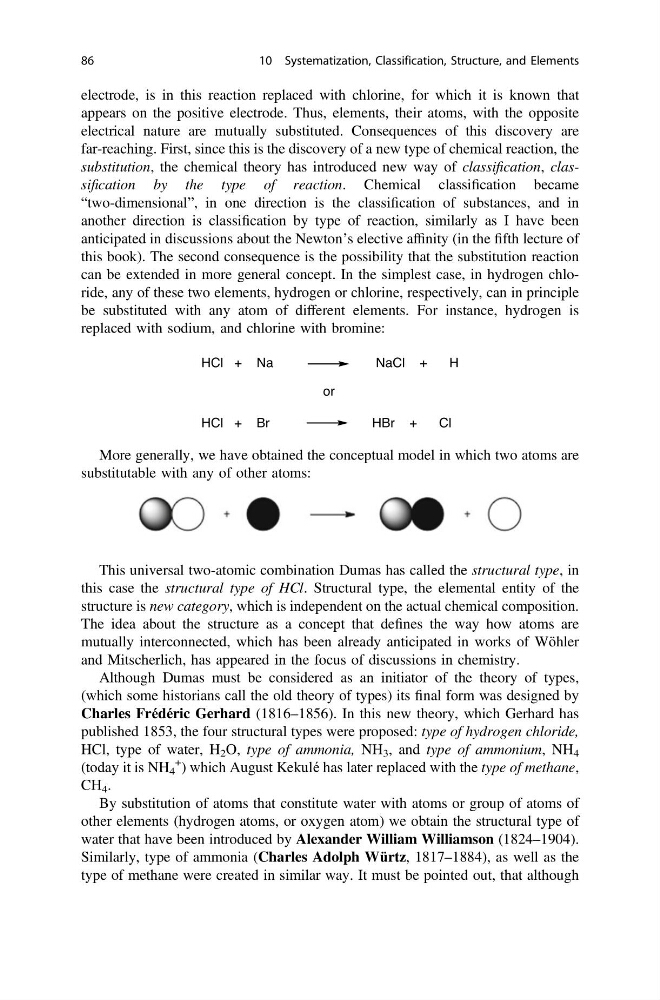
More generally, we have obtained the conceptual model in which two atoms are
substitutable with any of other atoms:
This universal two-atomic combination Dumas has called the structural type, in
this case the structural type of HCl. Structural type, the elemental entity of the
structure is new category, which is independent on the actual chemical composition.
The idea about the structure as a concept that defines the way how atoms are
mutually interconnected, which has been already anticipated in works of Wöhler
and Mitscherlich, has appeared in the focus of discussions in chemistry.
Although Dumas must be considered as an initiator of the theory of types,
(which some historians call the old theory of types) its final form was designed by
Charles Frédéric Gerhard (1816–1856). In this new theory, which Gerhard has
published 1853, the four structural types were proposed: type of hydrogen chloride,
HCl, type of water, H 2 O, type of ammonia, NH 3 , and type of ammonium, NH 4
(today it is NH 4
+
) which August Kekulé has later replaced with the type of methane,
CH 4 .
By substitution of atoms that constitute water with atoms or group of atoms of
other elements (hydrogen atoms, or oxygen atom) we obtain the structural type of
water that have been introduced by Alexander William Williamson (1824–1904).
Similarly, type of ammonia (Charles Adolph Würtz, 1817–1884), as well as the
type of methane were created in similar way. It must be pointed out, that although
86
10 Systematization, Classification, Structure, and Elements
appears on the positive electrode. Thus, elements, their atoms, with the opposite
electrical nature are mutually substituted. Consequences of this discovery are
far-reaching. First, since this is the discovery of a new type of chemical reaction, the
substitution, the chemical theory has introduced new way of classification, classification by the type of reaction. Chemical classification became
“two-dimensional”, in one direction is the classification of substances, and in
another direction is classification by type of reaction, similarly as I have been
anticipated in discussions about the Newton’s elective affinity (in the fifth lecture of
this book). The second consequence is the possibility that the substitution reaction
can be extended in more general concept. In the simplest case, in hydrogen chloride, any of these two elements, hydrogen or chlorine, respectively, can in principle
be substituted with any atom of different elements. For instance, hydrogen is
replaced with sodium, and chlorine with bromine:
More generally, we have obtained the conceptual model in which two atoms are
substitutable with any of other atoms:
This universal two-atomic combination Dumas has called the structural type, in
this case the structural type of HCl. Structural type, the elemental entity of the
structure is new category, which is independent on the actual chemical composition.
The idea about the structure as a concept that defines the way how atoms are
mutually interconnected, which has been already anticipated in works of Wöhler
and Mitscherlich, has appeared in the focus of discussions in chemistry.
Although Dumas must be considered as an initiator of the theory of types,
(which some historians call the old theory of types) its final form was designed by
Charles Frédéric Gerhard (1816–1856). In this new theory, which Gerhard has
published 1853, the four structural types were proposed: type of hydrogen chloride,
HCl, type of water, H 2 O, type of ammonia, NH 3 , and type of ammonium, NH 4
(today it is NH 4
+
) which August Kekulé has later replaced with the type of methane,
CH 4 .
By substitution of atoms that constitute water with atoms or group of atoms of
other elements (hydrogen atoms, or oxygen atom) we obtain the structural type of
water that have been introduced by Alexander William Williamson (1824–1904).
Similarly, type of ammonia (Charles Adolph Würtz, 1817–1884), as well as the
type of methane were created in similar way. It must be pointed out, that although
86
10 Systematization, Classification, Structure, and Elements