

by proposing that, besides the three “normal” double bonds, the molecule possesses
also three incomplete valences:
Since in the Lewis theory, the chemical bond is described with electron pairs
between the two interconnected atoms, the mobility of double bonds should be
replaced with mobilities of electrons. In this picture, electron pairs can move within
the molecule, but they can also be exchanged between two reacting molecules.
Lewis electronic theory affords in this way the possibility of its extension, from the
explanation of molecular structure to the explanation of changes of this structure
during chemical reaction. Mobility of electron pairs has occurred to be a starting
point of the concept of reaction mechanisms, which was later developed by
Robinson and Ingold, and which became one of the pillars of modern chemistry.
Robinson has unified Thiele’s concept about shifts of double bonds with the
Lewis’s electron pairs theory in the hypothesis about the “ease relocation of electrons in unsaturated systems”. As the constitution of molecule is in chemical formulas represented with bonding lines, which are symbols for electron pairs,
chemical reaction is in analogous way represented with arrows as labels for shifts of
electron pairs [12]. In the literature, these are known as the “Robinson arrows”.
In addition, Robinson has used this concept for the explanation of the structure
of benzene. If Thiele’s incomplete valences are replaced with electron pairs, then
the double and the single bonds in the benzene molecule cannot be distinguished:
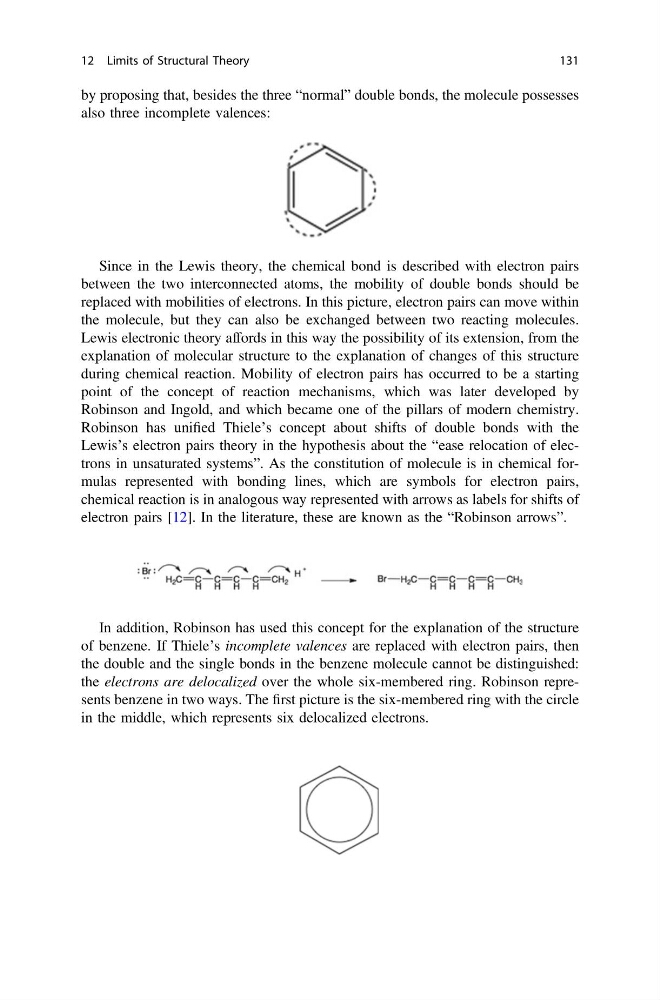
the electrons are delocalized over the whole six-membered ring. Robinson represents benzene in two ways. The first picture is the six-membered ring with the circle
in the middle, which represents six delocalized electrons.
12 Limits of Structural Theory
131
also three incomplete valences:
Since in the Lewis theory, the chemical bond is described with electron pairs
between the two interconnected atoms, the mobility of double bonds should be
replaced with mobilities of electrons. In this picture, electron pairs can move within
the molecule, but they can also be exchanged between two reacting molecules.
Lewis electronic theory affords in this way the possibility of its extension, from the
explanation of molecular structure to the explanation of changes of this structure
during chemical reaction. Mobility of electron pairs has occurred to be a starting
point of the concept of reaction mechanisms, which was later developed by
Robinson and Ingold, and which became one of the pillars of modern chemistry.
Robinson has unified Thiele’s concept about shifts of double bonds with the
Lewis’s electron pairs theory in the hypothesis about the “ease relocation of electrons in unsaturated systems”. As the constitution of molecule is in chemical formulas represented with bonding lines, which are symbols for electron pairs,
chemical reaction is in analogous way represented with arrows as labels for shifts of
electron pairs [12]. In the literature, these are known as the “Robinson arrows”.
In addition, Robinson has used this concept for the explanation of the structure
of benzene. If Thiele’s incomplete valences are replaced with electron pairs, then
the double and the single bonds in the benzene molecule cannot be distinguished:
the electrons are delocalized over the whole six-membered ring. Robinson represents benzene in two ways. The first picture is the six-membered ring with the circle
in the middle, which represents six delocalized electrons.
12 Limits of Structural Theory
131