

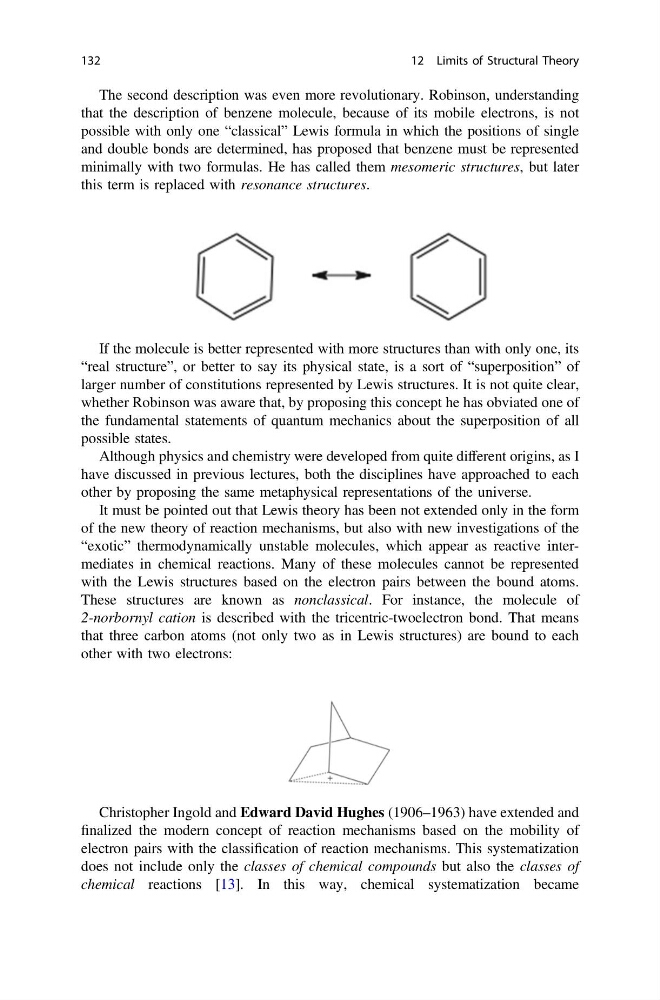
The second description was even more revolutionary. Robinson, understanding
that the description of benzene molecule, because of its mobile electrons, is not
possible with only one “classical” Lewis formula in which the positions of single
and double bonds are determined, has proposed that benzene must be represented
minimally with two formulas. He has called them mesomeric structures, but later
this term is replaced with resonance structures.
If the molecule is better represented with more structures than with only one, its
“real structure”, or better to say its physical state, is a sort of “superposition” of
larger number of constitutions represented by Lewis structures. It is not quite clear,
whether Robinson was aware that, by proposing this concept he has obviated one of
the fundamental statements of quantum mechanics about the superposition of all
possible states.
Although physics and chemistry were developed from quite different origins, as I
have discussed in previous lectures, both the disciplines have approached to each
other by proposing the same metaphysical representations of the universe.
It must be pointed out that Lewis theory has been not extended only in the form
of the new theory of reaction mechanisms, but also with new investigations of the
“exotic” thermodynamically unstable molecules, which appear as reactive intermediates in chemical reactions. Many of these molecules cannot be represented
with the Lewis structures based on the electron pairs between the bound atoms.
These structures are known as nonclassical. For instance, the molecule of
2-norbornyl cation is described with the tricentric-twoelectron bond. That means
that three carbon atoms (not only two as in Lewis structures) are bound to each
other with two electrons:
Christopher Ingold and Edward David Hughes (1906–1963) have extended and
finalized the modern concept of reaction mechanisms based on the mobility of
electron pairs with the classification of reaction mechanisms. This systematization
does not include only the classes of chemical compounds but also the classes of
chemical reactions [13]. In this way, chemical systematization became
132
12 Limits of Structural Theory
that the description of benzene molecule, because of its mobile electrons, is not
possible with only one “classical” Lewis formula in which the positions of single
and double bonds are determined, has proposed that benzene must be represented
minimally with two formulas. He has called them mesomeric structures, but later
this term is replaced with resonance structures.
If the molecule is better represented with more structures than with only one, its
“real structure”, or better to say its physical state, is a sort of “superposition” of
larger number of constitutions represented by Lewis structures. It is not quite clear,
whether Robinson was aware that, by proposing this concept he has obviated one of
the fundamental statements of quantum mechanics about the superposition of all
possible states.
Although physics and chemistry were developed from quite different origins, as I
have discussed in previous lectures, both the disciplines have approached to each
other by proposing the same metaphysical representations of the universe.
It must be pointed out that Lewis theory has been not extended only in the form
of the new theory of reaction mechanisms, but also with new investigations of the
“exotic” thermodynamically unstable molecules, which appear as reactive intermediates in chemical reactions. Many of these molecules cannot be represented
with the Lewis structures based on the electron pairs between the bound atoms.
These structures are known as nonclassical. For instance, the molecule of
2-norbornyl cation is described with the tricentric-twoelectron bond. That means
that three carbon atoms (not only two as in Lewis structures) are bound to each
other with two electrons:
Christopher Ingold and Edward David Hughes (1906–1963) have extended and
finalized the modern concept of reaction mechanisms based on the mobility of
electron pairs with the classification of reaction mechanisms. This systematization
does not include only the classes of chemical compounds but also the classes of
chemical reactions [13]. In this way, chemical systematization became
132
12 Limits of Structural Theory