

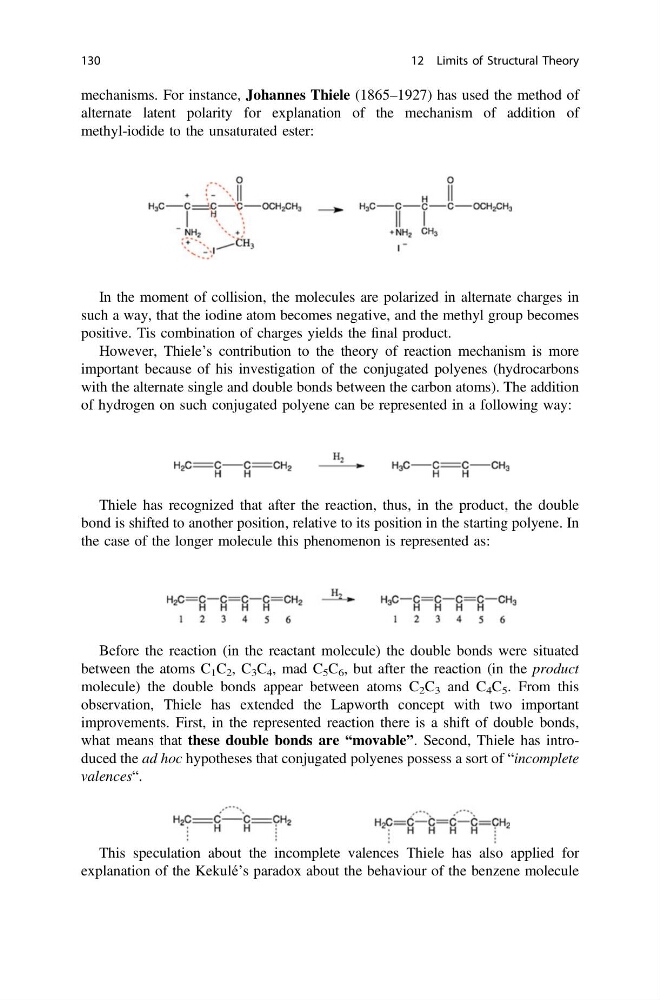
mechanisms. For instance, Johannes Thiele (1865–1927) has used the method of
alternate latent polarity for explanation of the mechanism of addition of
methyl-iodide to the unsaturated ester:
In the moment of collision, the molecules are polarized in alternate charges in
such a way, that the iodine atom becomes negative, and the methyl group becomes
positive. Tis combination of charges yields the final product.
However, Thiele’s contribution to the theory of reaction mechanism is more
important because of his investigation of the conjugated polyenes (hydrocarbons
with the alternate single and double bonds between the carbon atoms). The addition
of hydrogen on such conjugated polyene can be represented in a following way:
Thiele has recognized that after the reaction, thus, in the product, the double
bond is shifted to another position, relative to its position in the starting polyene. In
the case of the longer molecule this phenomenon is represented as:
Before the reaction (in the reactant molecule) the double bonds were situated
between the atoms C 1 C 2 , C 3 C 4 , mad C 5 C 6 , but after the reaction (in the product
molecule) the double bonds appear between atoms C 2 C 3 and C 4 C 5 . From this
observation, Thiele has extended the Lapworth concept with two important
improvements. First, in the represented reaction there is a shift of double bonds,
what means that these double bonds are “movable”. Second, Thiele has introduced the ad hoc hypotheses that conjugated polyenes possess a sort of “incomplete
valences“.
This speculation about the incomplete valences Thiele has also applied for
explanation of the Kekulé’s paradox about the behaviour of the benzene molecule
130
12 Limits of Structural Theory
alternate latent polarity for explanation of the mechanism of addition of
methyl-iodide to the unsaturated ester:
In the moment of collision, the molecules are polarized in alternate charges in
such a way, that the iodine atom becomes negative, and the methyl group becomes
positive. Tis combination of charges yields the final product.
However, Thiele’s contribution to the theory of reaction mechanism is more
important because of his investigation of the conjugated polyenes (hydrocarbons
with the alternate single and double bonds between the carbon atoms). The addition
of hydrogen on such conjugated polyene can be represented in a following way:
Thiele has recognized that after the reaction, thus, in the product, the double
bond is shifted to another position, relative to its position in the starting polyene. In
the case of the longer molecule this phenomenon is represented as:
Before the reaction (in the reactant molecule) the double bonds were situated
between the atoms C 1 C 2 , C 3 C 4 , mad C 5 C 6 , but after the reaction (in the product
molecule) the double bonds appear between atoms C 2 C 3 and C 4 C 5 . From this
observation, Thiele has extended the Lapworth concept with two important
improvements. First, in the represented reaction there is a shift of double bonds,
what means that these double bonds are “movable”. Second, Thiele has introduced the ad hoc hypotheses that conjugated polyenes possess a sort of “incomplete
valences“.
This speculation about the incomplete valences Thiele has also applied for
explanation of the Kekulé’s paradox about the behaviour of the benzene molecule
130
12 Limits of Structural Theory