

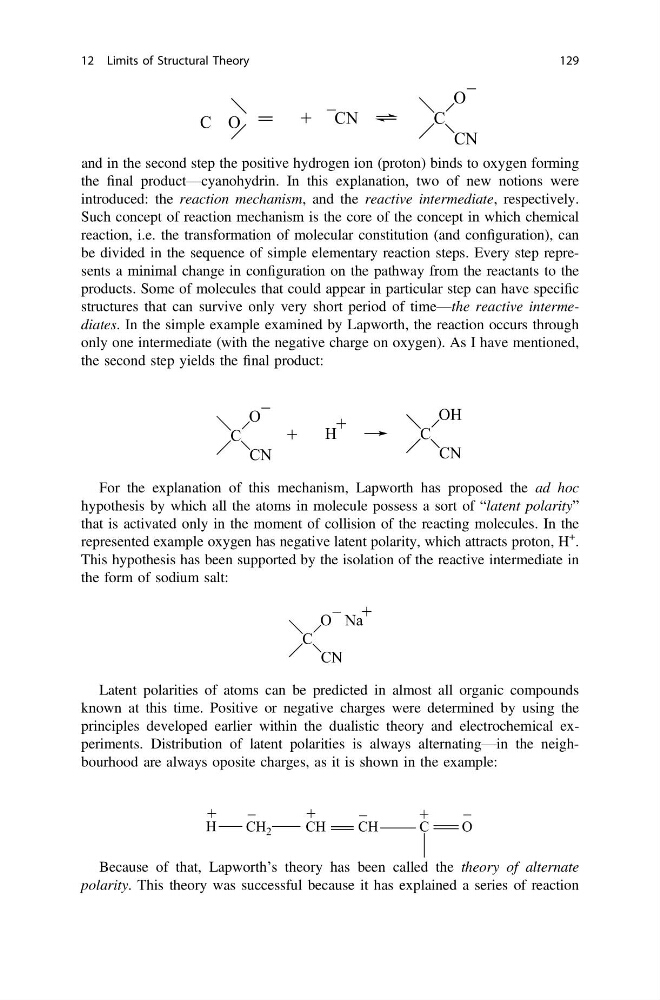
and in the second step the positive hydrogen ion (proton) binds to oxygen forming
the final product—cyanohydrin. In this explanation, two of new notions were
introduced: the reaction mechanism, and the reactive intermediate, respectively.
Such concept of reaction mechanism is the core of the concept in which chemical
reaction, i.e. the transformation of molecular constitution (and configuration), can
be divided in the sequence of simple elementary reaction steps. Every step represents a minimal change in configuration on the pathway from the reactants to the
products. Some of molecules that could appear in particular step can have specific
structures that can survive only very short period of time—the reactive intermediates. In the simple example examined by Lapworth, the reaction occurs through
only one intermediate (with the negative charge on oxygen). As I have mentioned,
the second step yields the final product:
For the explanation of this mechanism, Lapworth has proposed the ad hoc
hypothesis by which all the atoms in molecule possess a sort of “latent polarity”
that is activated only in the moment of collision of the reacting molecules. In the
represented example oxygen has negative latent polarity, which attracts proton, H
+
.
This hypothesis has been supported by the isolation of the reactive intermediate in
the form of sodium salt:
Latent polarities of atoms can be predicted in almost all organic compounds
known at this time. Positive or negative charges were determined by using the
principles developed earlier within the dualistic theory and electrochemical experiments. Distribution of latent polarities is always alternating—in the neighbourhood are always oposite charges, as it is shown in the example:
Because of that, Lapworth’s theory has been called the theory of alternate
polarity. This theory was successful because it has explained a series of reaction
12 Limits of Structural Theory
129
the final product—cyanohydrin. In this explanation, two of new notions were
introduced: the reaction mechanism, and the reactive intermediate, respectively.
Such concept of reaction mechanism is the core of the concept in which chemical
reaction, i.e. the transformation of molecular constitution (and configuration), can
be divided in the sequence of simple elementary reaction steps. Every step represents a minimal change in configuration on the pathway from the reactants to the
products. Some of molecules that could appear in particular step can have specific
structures that can survive only very short period of time—the reactive intermediates. In the simple example examined by Lapworth, the reaction occurs through
only one intermediate (with the negative charge on oxygen). As I have mentioned,
the second step yields the final product:
For the explanation of this mechanism, Lapworth has proposed the ad hoc
hypothesis by which all the atoms in molecule possess a sort of “latent polarity”
that is activated only in the moment of collision of the reacting molecules. In the
represented example oxygen has negative latent polarity, which attracts proton, H
+
.
This hypothesis has been supported by the isolation of the reactive intermediate in
the form of sodium salt:
Latent polarities of atoms can be predicted in almost all organic compounds
known at this time. Positive or negative charges were determined by using the
principles developed earlier within the dualistic theory and electrochemical experiments. Distribution of latent polarities is always alternating—in the neighbourhood are always oposite charges, as it is shown in the example:
Because of that, Lapworth’s theory has been called the theory of alternate
polarity. This theory was successful because it has explained a series of reaction
12 Limits of Structural Theory
129