

Although Lewis concept, as well as the later developed model of resonance,
form the basis for unequivocal use of the structures for the classification of organic
compounds and understanding chemical changes, it was still insufficient for the
explanation of the nature of chemical bond. For the detailed description of the
nature of electron in molecules, it is necessary to use quantum mechanics, the
theory that represents electrons as either waves, or particles, depending on the
selection of the experiment. The new scientific and philosophical paradigm has
appeared: the observer and the observed are not more separated but coupled to
each other!
However, in spite to the introduction of quantum mechanics in the explanation
of chemical bond, Lewis concept was abandoned. Still, it has remained one of the
basic models in chemistry. Christopher Kelk Ingold (1893–1970) and Robert
Robinson (1886–1975) have created the idea that, perhaps, not only the molecular
structures, but also chemical reactions, which are in principle merely the changes of
these structures, could be represented by using Lewis electron pairs. If chemical
bonds, which define constitution and configuration of molecule are electron pairs,
then chemical reaction regarded as breaking and formation of chemical bond can be
represented just by shifting electron pairs from one to another position in the
molecule. Ingold and Robinson have named this model the theory of reaction
mechanisms.
The historical way to this theory was not the straight line. Rather, the concept of
reaction mechanism was created through a series of phases. The mechanistic theory
has its origin already at the time of the first, “nonelectronic”, structural concept.
Close to the end of the 19th century, Arthur Lapworth (1872–1941) tried for the
first time to describe chemical reaction starting from the structural theory. As the
model for his theory, Lapworth has studied the reaction of addition of cyanide ion
to carbonyl group in benzaldehyde. The basic experimental method that Lapworth
has used was chemical kinetics, i.e. the investigation of the rate of chemical reaction. By patient measuring the rates of addition of cyanide ion to the carbonyl
group, Lapworth has concluded that this reaction occurs in two steps. The first step
yields the short-living unstable ion with the negative charge on the oxygen atom,
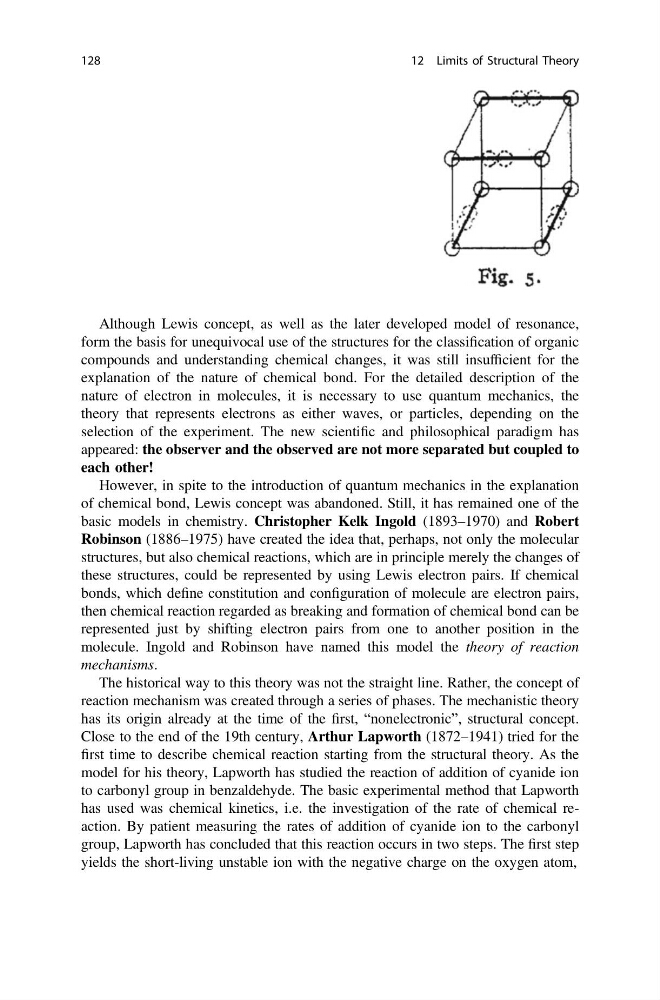
Figure from Lewis work
about the tetrahedral
distributions of electron
pairs in the molecule of
methane
128
12 Limits of Structural Theory
form the basis for unequivocal use of the structures for the classification of organic
compounds and understanding chemical changes, it was still insufficient for the
explanation of the nature of chemical bond. For the detailed description of the
nature of electron in molecules, it is necessary to use quantum mechanics, the
theory that represents electrons as either waves, or particles, depending on the
selection of the experiment. The new scientific and philosophical paradigm has
appeared: the observer and the observed are not more separated but coupled to
each other!
However, in spite to the introduction of quantum mechanics in the explanation
of chemical bond, Lewis concept was abandoned. Still, it has remained one of the
basic models in chemistry. Christopher Kelk Ingold (1893–1970) and Robert
Robinson (1886–1975) have created the idea that, perhaps, not only the molecular
structures, but also chemical reactions, which are in principle merely the changes of
these structures, could be represented by using Lewis electron pairs. If chemical
bonds, which define constitution and configuration of molecule are electron pairs,
then chemical reaction regarded as breaking and formation of chemical bond can be
represented just by shifting electron pairs from one to another position in the
molecule. Ingold and Robinson have named this model the theory of reaction
mechanisms.
The historical way to this theory was not the straight line. Rather, the concept of
reaction mechanism was created through a series of phases. The mechanistic theory
has its origin already at the time of the first, “nonelectronic”, structural concept.
Close to the end of the 19th century, Arthur Lapworth (1872–1941) tried for the
first time to describe chemical reaction starting from the structural theory. As the
model for his theory, Lapworth has studied the reaction of addition of cyanide ion
to carbonyl group in benzaldehyde. The basic experimental method that Lapworth
has used was chemical kinetics, i.e. the investigation of the rate of chemical reaction. By patient measuring the rates of addition of cyanide ion to the carbonyl
group, Lapworth has concluded that this reaction occurs in two steps. The first step
yields the short-living unstable ion with the negative charge on the oxygen atom,
Figure from Lewis work
about the tetrahedral
distributions of electron
pairs in the molecule of
methane
128
12 Limits of Structural Theory