

Just this concept of electron pairs, especially of lone pairs, will have fundamental
importance for the successive development of the theory of reaction mechanisms.
Starting with its own idea about electrons as entities without their identity, Lewis
understand that electrons could from that reason be formally redistributed in the
molecule by changing their role of bonding, or nonbonding electron pairs. Evidently, electrons are not only without their identity (i.e., the secondary identity, in
accordance with my previous lectures) but also without the defined position in
molecule—they are delocalized. This concept of delocalization can be clearly
recognized from the Lewis original papers. The real, physical electronic structure of
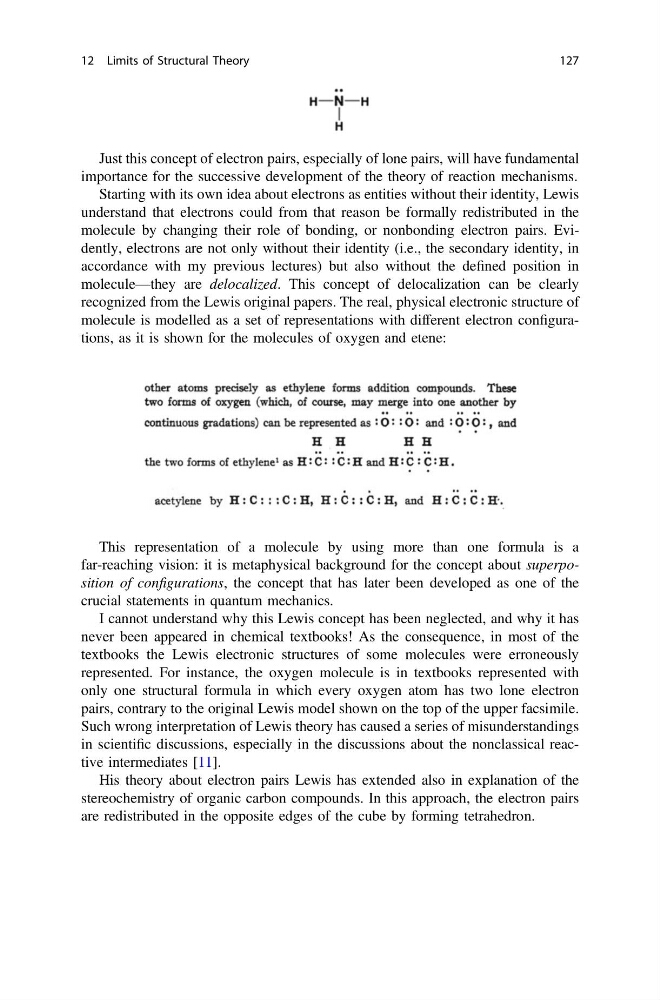
molecule is modelled as a set of representations with different electron configurations, as it is shown for the molecules of oxygen and etene:
This representation of a molecule by using more than one formula is a
far-reaching vision: it is metaphysical background for the concept about superposition of configurations, the concept that has later been developed as one of the
crucial statements in quantum mechanics.
I cannot understand why this Lewis concept has been neglected, and why it has
never been appeared in chemical textbooks! As the consequence, in most of the
textbooks the Lewis electronic structures of some molecules were erroneously
represented. For instance, the oxygen molecule is in textbooks represented with
only one structural formula in which every oxygen atom has two lone electron
pairs, contrary to the original Lewis model shown on the top of the upper facsimile.
Such wrong interpretation of Lewis theory has caused a series of misunderstandings
in scientific discussions, especially in the discussions about the nonclassical reactive intermediates [11].
His theory about electron pairs Lewis has extended also in explanation of the
stereochemistry of organic carbon compounds. In this approach, the electron pairs
are redistributed in the opposite edges of the cube by forming tetrahedron.
12 Limits of Structural Theory
127
importance for the successive development of the theory of reaction mechanisms.
Starting with its own idea about electrons as entities without their identity, Lewis
understand that electrons could from that reason be formally redistributed in the
molecule by changing their role of bonding, or nonbonding electron pairs. Evidently, electrons are not only without their identity (i.e., the secondary identity, in
accordance with my previous lectures) but also without the defined position in
molecule—they are delocalized. This concept of delocalization can be clearly
recognized from the Lewis original papers. The real, physical electronic structure of
molecule is modelled as a set of representations with different electron configurations, as it is shown for the molecules of oxygen and etene:
This representation of a molecule by using more than one formula is a
far-reaching vision: it is metaphysical background for the concept about superposition of configurations, the concept that has later been developed as one of the
crucial statements in quantum mechanics.
I cannot understand why this Lewis concept has been neglected, and why it has
never been appeared in chemical textbooks! As the consequence, in most of the
textbooks the Lewis electronic structures of some molecules were erroneously
represented. For instance, the oxygen molecule is in textbooks represented with
only one structural formula in which every oxygen atom has two lone electron
pairs, contrary to the original Lewis model shown on the top of the upper facsimile.
Such wrong interpretation of Lewis theory has caused a series of misunderstandings
in scientific discussions, especially in the discussions about the nonclassical reactive intermediates [11].
His theory about electron pairs Lewis has extended also in explanation of the
stereochemistry of organic carbon compounds. In this approach, the electron pairs
are redistributed in the opposite edges of the cube by forming tetrahedron.
12 Limits of Structural Theory
127