

identical atoms in spite to the fact that between them do not extst the difference in
electric polarity, the problem that origins already from the dualistic concept of
Berzelius. Since magnetons, as Parson calls electrons-magnets, can in the vicinity
of atomic nucleus be distributed in several configurations, the molecules can possess different shapes and symmetries. Evidently inspired with the octet rule, Parson
has proposed that the best combination can be obtained with eight magnetons.
Irving Langmuir (1881–1957) has also studied the relationship between the octet
rule and electronic structure, but with the special focus on the symmetry, the category
that will later appear as one of basic concepts in quantum mechanics. Langmuir has
represented eight electrons symmetrically distributed on the vertices of the geometrical solid cube. In his picture, electrons are in atoms divided in shells (similarly as in
the Bohr’s model), and these shells differ between each other by symmetry: each shell
is characterized with its particular distribution of electrons that their position form the
geometrical solid with various number of planes, or axes of symmetry [10]. Since, by
Bohr, electron shells differ in energy of their electrons, Langmuir propose the idea
about the close relationship between energy and symmetry, the theoretical model that
will be in details developed within quantum mechanics.
Such model about eight electrons in vertices of cube has been accepted by
Lewis, who has refined this concept by pairing electrons in four electron pairs.
Lewis emphasis on the electron pair instead of the electron octet was a consequence
of the investigation of the electron structure of helium, which, in contrast to other
noble gases, possesses only two electrons.
By Lewis, the electron pair which forms chemical bond is necessary condition
for the accomplishing the electronic octet. Taking into account Parson-Langmuir
ideas about cubic symmetry, Lewis has proposed representation of the electronic
structure of molecules as interlinking of cubes in which electrons are situated in
vertices. Atoms of chemical elements which have less than eight outer (valence)
electrons are modelled with cubes with so many empty vertices how many electrons
they miss to fulfil the octet, as it is clearly shown in original Lewis drafts about the
electron structures of some atoms.
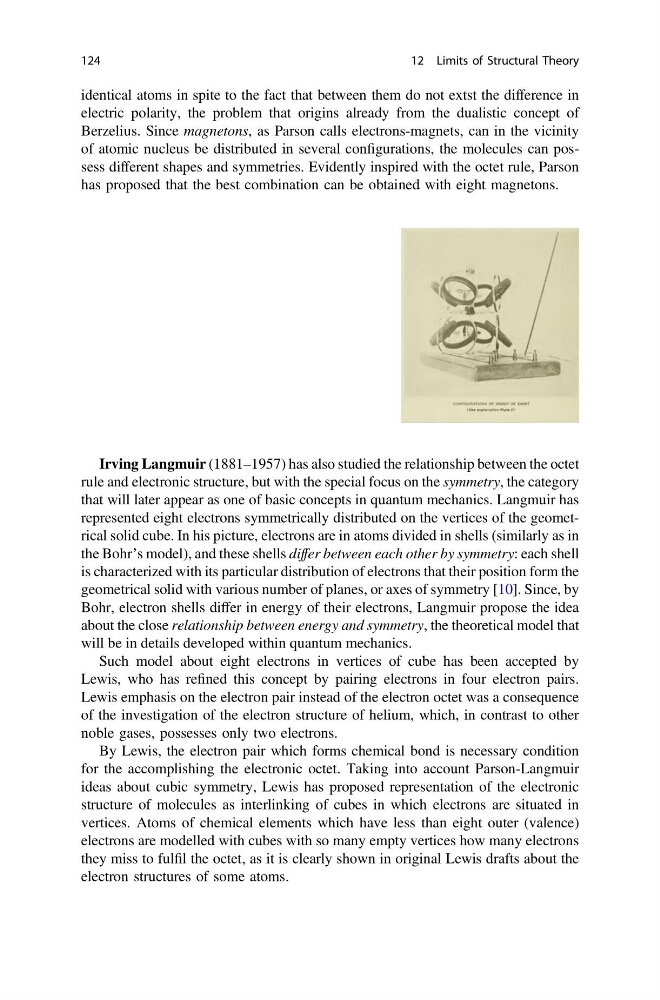
Photo of the model from
Parsons book, which
demonstrates the optimal
space configuration of
eight magnetons (electrons
which behave as magnets)
124
12 Limits of Structural Theory
electric polarity, the problem that origins already from the dualistic concept of
Berzelius. Since magnetons, as Parson calls electrons-magnets, can in the vicinity
of atomic nucleus be distributed in several configurations, the molecules can possess different shapes and symmetries. Evidently inspired with the octet rule, Parson
has proposed that the best combination can be obtained with eight magnetons.
Irving Langmuir (1881–1957) has also studied the relationship between the octet
rule and electronic structure, but with the special focus on the symmetry, the category
that will later appear as one of basic concepts in quantum mechanics. Langmuir has
represented eight electrons symmetrically distributed on the vertices of the geometrical solid cube. In his picture, electrons are in atoms divided in shells (similarly as in
the Bohr’s model), and these shells differ between each other by symmetry: each shell
is characterized with its particular distribution of electrons that their position form the
geometrical solid with various number of planes, or axes of symmetry [10]. Since, by
Bohr, electron shells differ in energy of their electrons, Langmuir propose the idea
about the close relationship between energy and symmetry, the theoretical model that
will be in details developed within quantum mechanics.
Such model about eight electrons in vertices of cube has been accepted by
Lewis, who has refined this concept by pairing electrons in four electron pairs.
Lewis emphasis on the electron pair instead of the electron octet was a consequence
of the investigation of the electron structure of helium, which, in contrast to other
noble gases, possesses only two electrons.
By Lewis, the electron pair which forms chemical bond is necessary condition
for the accomplishing the electronic octet. Taking into account Parson-Langmuir
ideas about cubic symmetry, Lewis has proposed representation of the electronic
structure of molecules as interlinking of cubes in which electrons are situated in
vertices. Atoms of chemical elements which have less than eight outer (valence)
electrons are modelled with cubes with so many empty vertices how many electrons
they miss to fulfil the octet, as it is clearly shown in original Lewis drafts about the
electron structures of some atoms.
Photo of the model from
Parsons book, which
demonstrates the optimal
space configuration of
eight magnetons (electrons
which behave as magnets)
124
12 Limits of Structural Theory