

outer electrons can be eight. Walther Ludwig Julius Kossel (1888–1956) has in
Annalen der Physik in the same year (1916) published the discussion in which the
octet rule (regarded as eight outer, say, valence electrons) is explained within the
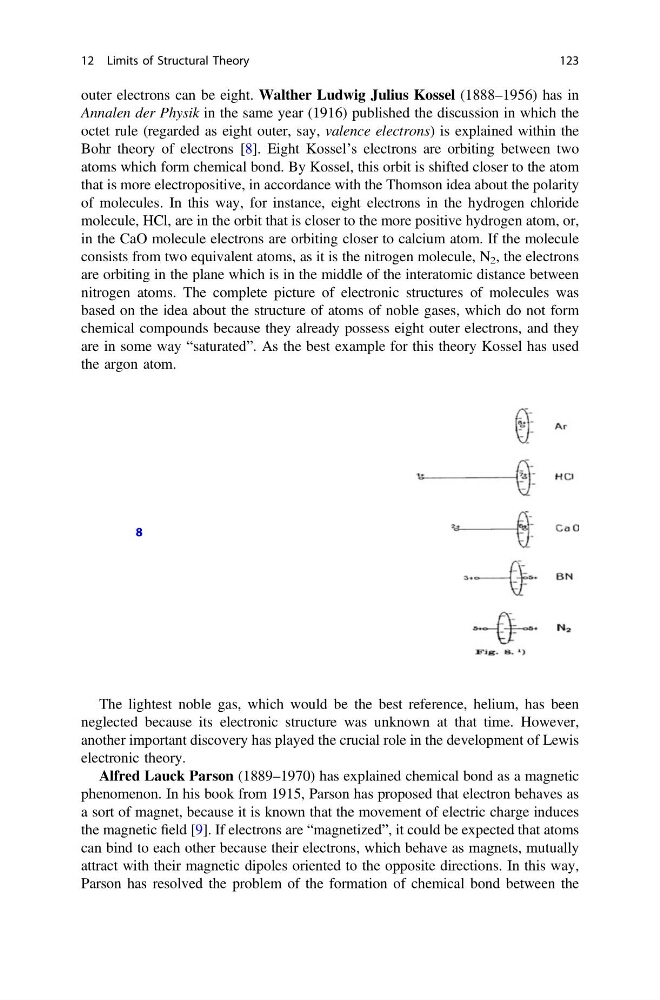
Bohr theory of electrons [8]. Eight Kossel’s electrons are orbiting between two
atoms which form chemical bond. By Kossel, this orbit is shifted closer to the atom
that is more electropositive, in accordance with the Thomson idea about the polarity
of molecules. In this way, for instance, eight electrons in the hydrogen chloride
molecule, HCl, are in the orbit that is closer to the more positive hydrogen atom, or,
in the CaO molecule electrons are orbiting closer to calcium atom. If the molecule
consists from two equivalent atoms, as it is the nitrogen molecule, N 2 , the electrons
are orbiting in the plane which is in the middle of the interatomic distance between
nitrogen atoms. The complete picture of electronic structures of molecules was
based on the idea about the structure of atoms of noble gases, which do not form
chemical compounds because they already possess eight outer electrons, and they
are in some way “saturated”. As the best example for this theory Kossel has used
the argon atom.
The lightest noble gas, which would be the best reference, helium, has been
neglected because its electronic structure was unknown at that time. However,
another important discovery has played the crucial role in the development of Lewis
electronic theory.
Alfred Lauck Parson (1889–1970) has explained chemical bond as a magnetic
phenomenon. In his book from 1915, Parson has proposed that electron behaves as
a sort of magnet, because it is known that the movement of electric charge induces
the magnetic field [9]. If electrons are “magnetized”, it could be expected that atoms
can bind to each other because their electrons, which behave as magnets, mutually
attract with their magnetic dipoles oriented to the opposite directions. In this way,
Parson has resolved the problem of the formation of chemical bond between the
Facsimile from the work of
Walther Ludwig Julius
Kossel about the electron
structure of molecules.
Eight electrons are
orbiting in the plane close
to the atomic nucleus of
more electropositive
element [8] (Kossel 1916)
12 Limits of Structural Theory
123
Annalen der Physik in the same year (1916) published the discussion in which the
octet rule (regarded as eight outer, say, valence electrons) is explained within the
Bohr theory of electrons [8]. Eight Kossel’s electrons are orbiting between two
atoms which form chemical bond. By Kossel, this orbit is shifted closer to the atom
that is more electropositive, in accordance with the Thomson idea about the polarity
of molecules. In this way, for instance, eight electrons in the hydrogen chloride
molecule, HCl, are in the orbit that is closer to the more positive hydrogen atom, or,
in the CaO molecule electrons are orbiting closer to calcium atom. If the molecule
consists from two equivalent atoms, as it is the nitrogen molecule, N 2 , the electrons
are orbiting in the plane which is in the middle of the interatomic distance between
nitrogen atoms. The complete picture of electronic structures of molecules was
based on the idea about the structure of atoms of noble gases, which do not form
chemical compounds because they already possess eight outer electrons, and they
are in some way “saturated”. As the best example for this theory Kossel has used
the argon atom.
The lightest noble gas, which would be the best reference, helium, has been
neglected because its electronic structure was unknown at that time. However,
another important discovery has played the crucial role in the development of Lewis
electronic theory.
Alfred Lauck Parson (1889–1970) has explained chemical bond as a magnetic
phenomenon. In his book from 1915, Parson has proposed that electron behaves as
a sort of magnet, because it is known that the movement of electric charge induces
the magnetic field [9]. If electrons are “magnetized”, it could be expected that atoms
can bind to each other because their electrons, which behave as magnets, mutually
attract with their magnetic dipoles oriented to the opposite directions. In this way,
Parson has resolved the problem of the formation of chemical bond between the
Facsimile from the work of
Walther Ludwig Julius
Kossel about the electron
structure of molecules.
Eight electrons are
orbiting in the plane close
to the atomic nucleus of
more electropositive
element [8] (Kossel 1916)
12 Limits of Structural Theory
123