

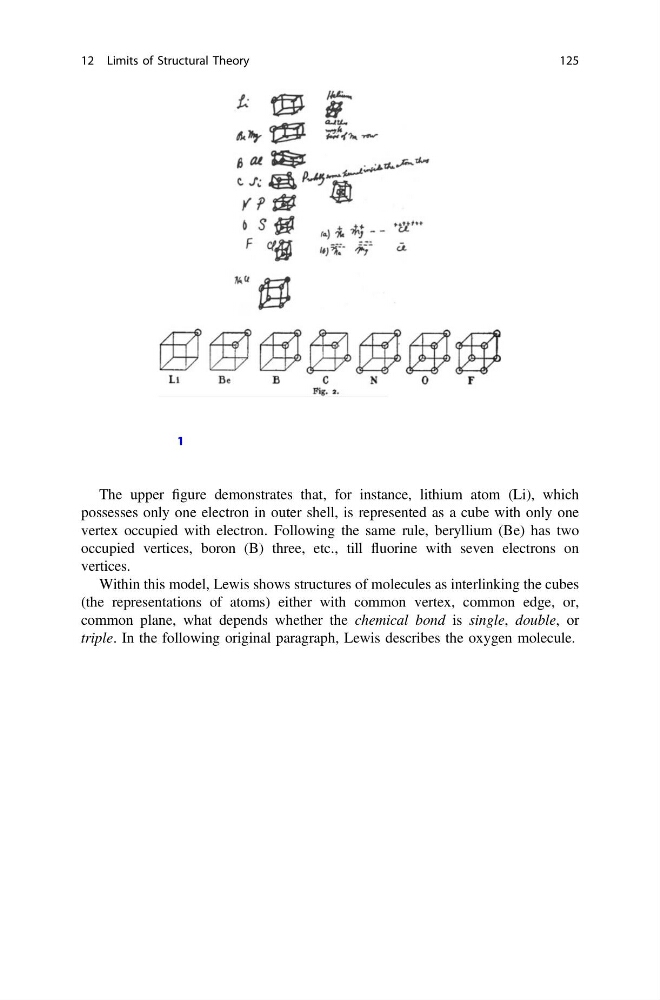
The upper figure demonstrates that, for instance, lithium atom (Li), which
possesses only one electron in outer shell, is represented as a cube with only one
vertex occupied with electron. Following the same rule, beryllium (Be) has two
occupied vertices, boron (B) three, etc., till fluorine with seven electrons on
vertices.
Within this model, Lewis shows structures of molecules as interlinking the cubes
(the representations of atoms) either with common vertex, common edge, or,
common plane, what depends whether the chemical bond is single, double, or
triple. In the following original paragraph, Lewis describes the oxygen molecule.
Facsimile of Lewis representations of distribution of electrons in vertices of cube for
different atoms [1] (Lewis 1916)
12 Limits of Structural Theory
125
possesses only one electron in outer shell, is represented as a cube with only one
vertex occupied with electron. Following the same rule, beryllium (Be) has two
occupied vertices, boron (B) three, etc., till fluorine with seven electrons on
vertices.
Within this model, Lewis shows structures of molecules as interlinking the cubes
(the representations of atoms) either with common vertex, common edge, or,
common plane, what depends whether the chemical bond is single, double, or
triple. In the following original paragraph, Lewis describes the oxygen molecule.
Facsimile of Lewis representations of distribution of electrons in vertices of cube for
different atoms [1] (Lewis 1916)
12 Limits of Structural Theory
125