

152
R. Barrett and P. P. Delsanto
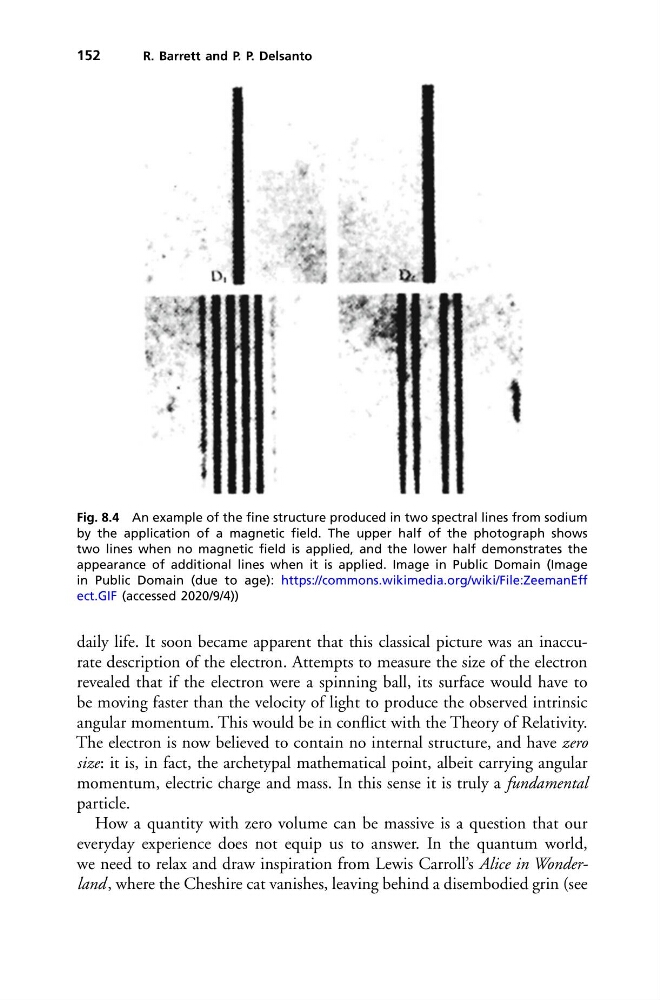
Fig. 8.4 An example of the fine structure produced in two spectral lines from sodium
by the application of a magnetic field. The upper half of the photograph shows
two lines when no magnetic field is applied, and the lower half demonstrates the
appearance of additional lines when it is applied. Image in Public Domain (Image
in Public Domain (due to age): https://commons.wikimedia.org/wiki/File:ZeemanEff
ect.GIF (accessed 2020/9/4))
daily life. It soon became apparent that this classical picture was an inaccurate description of the electron. Attempts to measure the size of the electron
revealed that if the electron were a spinning ball, its surface would have to
be moving faster than the velocity of light to produce the observed intrinsic
angular momentum. This would be in conflict with the Theory of Relativity.
The electron is now believed to contain no internal structure, and have zero
size: it is, in fact, the archetypal mathematical point, albeit carrying angular
momentum, electric charge and mass. In this sense it is truly a fundamental
particle.
How a quantity with zero volume can be massive is a question that our
everyday experience does not equip us to answer. In the quantum world,
we need to relax and draw inspiration from Lewis Carroll’s Alice in Wonderland , where the Cheshire cat vanishes, leaving behind a disembodied grin (see
R. Barrett and P. P. Delsanto
Fig. 8.4 An example of the fine structure produced in two spectral lines from sodium
by the application of a magnetic field. The upper half of the photograph shows
two lines when no magnetic field is applied, and the lower half demonstrates the
appearance of additional lines when it is applied. Image in Public Domain (Image
in Public Domain (due to age): https://commons.wikimedia.org/wiki/File:ZeemanEff
ect.GIF (accessed 2020/9/4))
daily life. It soon became apparent that this classical picture was an inaccurate description of the electron. Attempts to measure the size of the electron
revealed that if the electron were a spinning ball, its surface would have to
be moving faster than the velocity of light to produce the observed intrinsic
angular momentum. This would be in conflict with the Theory of Relativity.
The electron is now believed to contain no internal structure, and have zero
size: it is, in fact, the archetypal mathematical point, albeit carrying angular
momentum, electric charge and mass. In this sense it is truly a fundamental
particle.
How a quantity with zero volume can be massive is a question that our
everyday experience does not equip us to answer. In the quantum world,
we need to relax and draw inspiration from Lewis Carroll’s Alice in Wonderland , where the Cheshire cat vanishes, leaving behind a disembodied grin (see