

8 The Most Accurate Theory in Physics
151
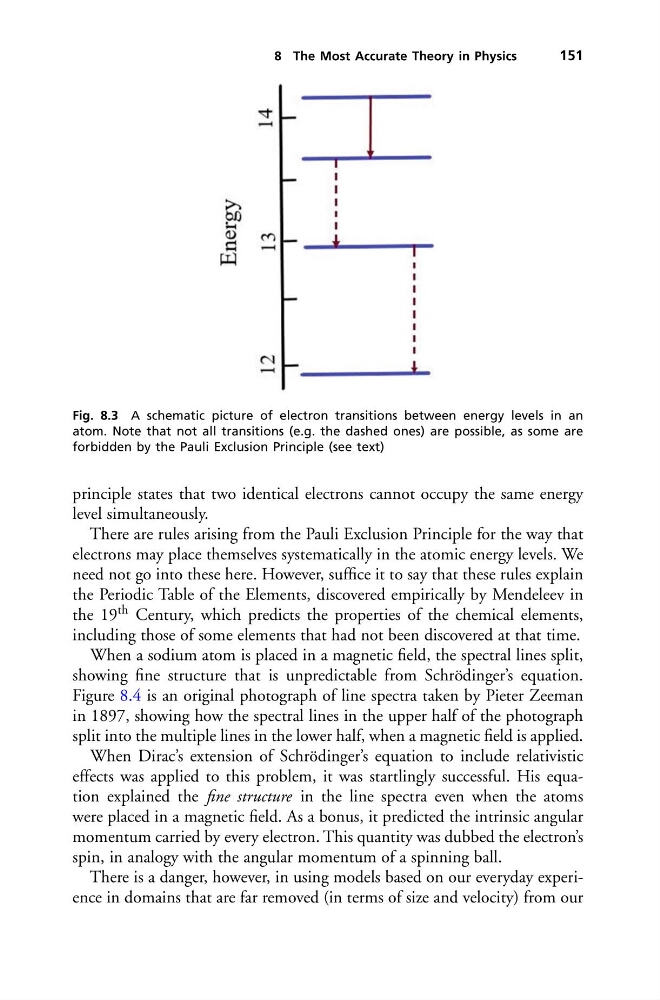
Fig. 8.3 A schematic picture of electron transitions between energy levels in an
atom. Note that not all transitions (e.g. the dashed ones) are possible, as some are
forbidden by the Pauli Exclusion Principle (see text)
principle states that two identical electrons cannot occupy the same energy
level simultaneously.
There are rules arising from the Pauli Exclusion Principle for the way that
electrons may place themselves systematically in the atomic energy levels. We
need not go into these here. However, suffice it to say that these rules explain
the Periodic Table of the Elements, discovered empirically by Mendeleev in
the 19 th Century, which predicts the properties of the chemical elements,
including those of some elements that had not been discovered at that time.
When a sodium atom is placed in a magnetic field, the spectral lines split,
showing fine structure that is unpredictable from Schrödinger’s equation.
Figure 8.4 is an original photograph of line spectra taken by Pieter Zeeman
in 1897, showing how the spectral lines in the upper half of the photograph
split into the multiple lines in the lower half, when a magnetic field is applied.
When Dirac’s extension of Schrödinger’s equation to include relativistic
effects was applied to this problem, it was startlingly successful. His equation explained the fine structure in the line spectra even when the atoms
were placed in a magnetic field. As a bonus, it predicted the intrinsic angular
momentum carried by every electron. This quantity was dubbed the electron’s
spin, in analogy with the angular momentum of a spinning ball.
There is a danger, however, in using models based on our everyday experience in domains that are far removed (in terms of size and velocity) from our
151
Fig. 8.3 A schematic picture of electron transitions between energy levels in an
atom. Note that not all transitions (e.g. the dashed ones) are possible, as some are
forbidden by the Pauli Exclusion Principle (see text)
principle states that two identical electrons cannot occupy the same energy
level simultaneously.
There are rules arising from the Pauli Exclusion Principle for the way that
electrons may place themselves systematically in the atomic energy levels. We
need not go into these here. However, suffice it to say that these rules explain
the Periodic Table of the Elements, discovered empirically by Mendeleev in
the 19 th Century, which predicts the properties of the chemical elements,
including those of some elements that had not been discovered at that time.
When a sodium atom is placed in a magnetic field, the spectral lines split,
showing fine structure that is unpredictable from Schrödinger’s equation.
Figure 8.4 is an original photograph of line spectra taken by Pieter Zeeman
in 1897, showing how the spectral lines in the upper half of the photograph
split into the multiple lines in the lower half, when a magnetic field is applied.
When Dirac’s extension of Schrödinger’s equation to include relativistic
effects was applied to this problem, it was startlingly successful. His equation explained the fine structure in the line spectra even when the atoms
were placed in a magnetic field. As a bonus, it predicted the intrinsic angular
momentum carried by every electron. This quantity was dubbed the electron’s
spin, in analogy with the angular momentum of a spinning ball.
There is a danger, however, in using models based on our everyday experience in domains that are far removed (in terms of size and velocity) from our