

150
R. Barrett and P. P. Delsanto
banner of electromagnetism, and became one of the bedrocks of what is now
known as classical physics.
We now turn our attention to a phenomenon known as the line spectra of
atoms, whose explanation provided some of the most convincing evidence
for the veracity of Quantum Mechanics. In the non-relativistic Quantum
Mechanics of Schrödinger, the energies of the electrons in the cloud
surrounding the nucleus of an atom may only have certain particular values,
or energy levels. The value of the energy in these levels is obtained from
the solution of the fundamental equation of QM, the Schrödinger Equation. Electromagnetic radiation is emitted in the form of discrete frequencies,
when electrons transition from a higher to a lower energy state. This is
quite different from the predictions of classical physics, where a spectrum
continuous across all frequencies, is expected.
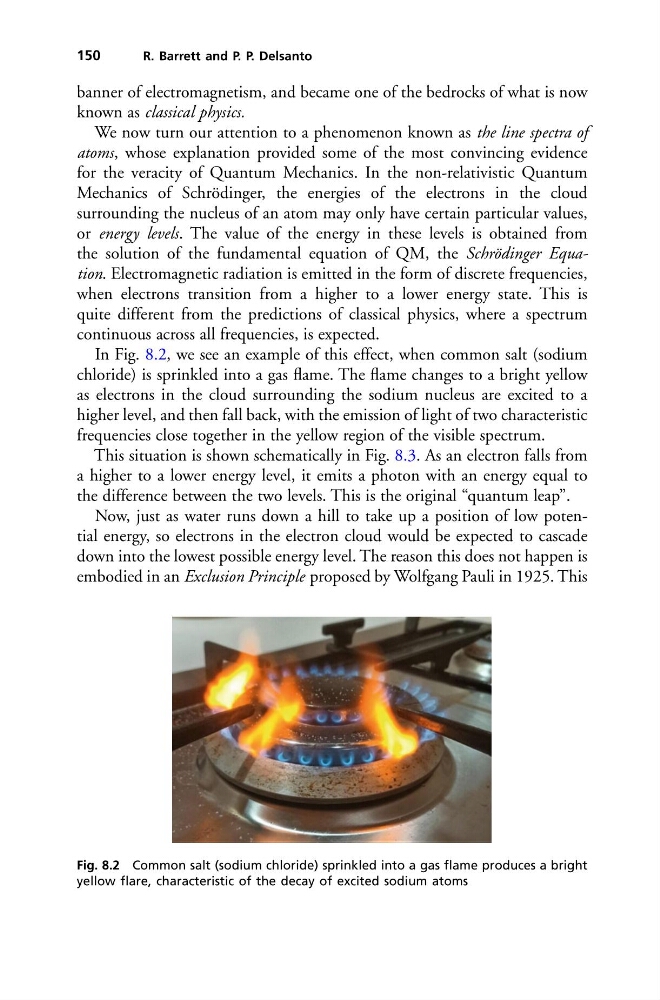
In Fig. 8.2, we see an example of this effect, when common salt (sodium
chloride) is sprinkled into a gas flame. The flame changes to a bright yellow
as electrons in the cloud surrounding the sodium nucleus are excited to a
higher level, and then fall back, with the emission of light of two characteristic
frequencies close together in the yellow region of the visible spectrum.
This situation is shown schematically in Fig. 8.3. As an electron falls from
a higher to a lower energy level, it emits a photon with an energy equal to
the difference between the two levels. This is the original “quantum leap”.
Now, just as water runs down a hill to take up a position of low potential energy, so electrons in the electron cloud would be expected to cascade
down into the lowest possible energy level. The reason this does not happen is
embodied in an Exclusion Principle proposed by Wolfgang Pauli in 1925. This
Fig. 8.2 Common salt (sodium chloride) sprinkled into a gas flame produces a bright
yellow flare, characteristic of the decay of excited sodium atoms
R. Barrett and P. P. Delsanto
banner of electromagnetism, and became one of the bedrocks of what is now
known as classical physics.
We now turn our attention to a phenomenon known as the line spectra of
atoms, whose explanation provided some of the most convincing evidence
for the veracity of Quantum Mechanics. In the non-relativistic Quantum
Mechanics of Schrödinger, the energies of the electrons in the cloud
surrounding the nucleus of an atom may only have certain particular values,
or energy levels. The value of the energy in these levels is obtained from
the solution of the fundamental equation of QM, the Schrödinger Equation. Electromagnetic radiation is emitted in the form of discrete frequencies,
when electrons transition from a higher to a lower energy state. This is
quite different from the predictions of classical physics, where a spectrum
continuous across all frequencies, is expected.
In Fig. 8.2, we see an example of this effect, when common salt (sodium
chloride) is sprinkled into a gas flame. The flame changes to a bright yellow
as electrons in the cloud surrounding the sodium nucleus are excited to a
higher level, and then fall back, with the emission of light of two characteristic
frequencies close together in the yellow region of the visible spectrum.
This situation is shown schematically in Fig. 8.3. As an electron falls from
a higher to a lower energy level, it emits a photon with an energy equal to
the difference between the two levels. This is the original “quantum leap”.
Now, just as water runs down a hill to take up a position of low potential energy, so electrons in the electron cloud would be expected to cascade
down into the lowest possible energy level. The reason this does not happen is
embodied in an Exclusion Principle proposed by Wolfgang Pauli in 1925. This
Fig. 8.2 Common salt (sodium chloride) sprinkled into a gas flame produces a bright
yellow flare, characteristic of the decay of excited sodium atoms