

130
R. Barrett and P. P. Delsanto
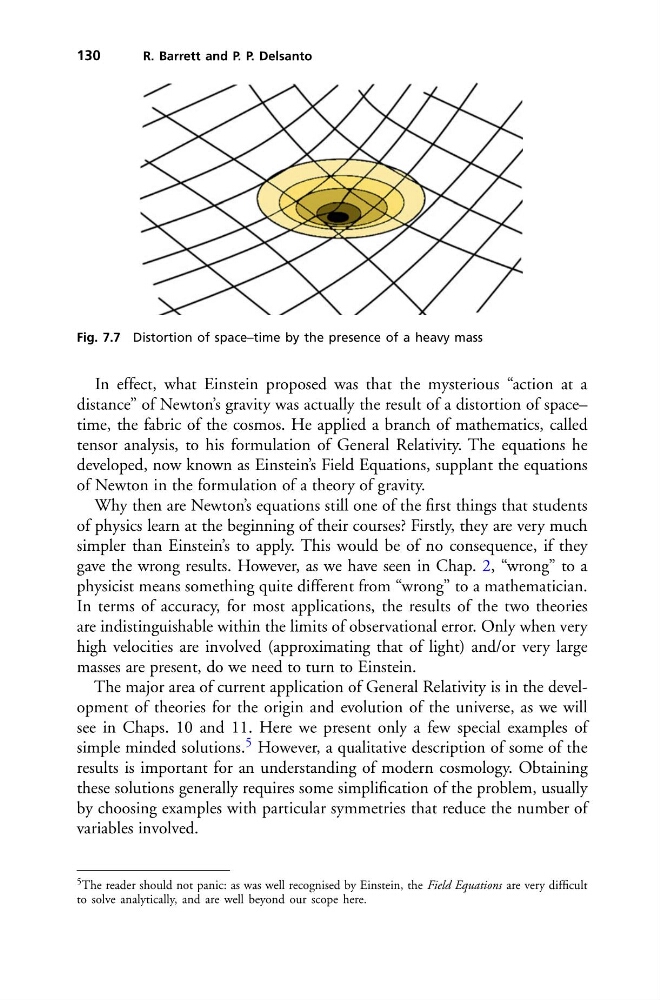
Fig. 7.7 Distortion of space–time by the presence of a heavy mass
In effect, what Einstein proposed was that the mysterious “action at a
distance” of Newton’s gravity was actually the result of a distortion of space–
time, the fabric of the cosmos. He applied a branch of mathematics, called
tensor analysis, to his formulation of General Relativity. The equations he
developed, now known as Einstein’s Field Equations, supplant the equations
of Newton in the formulation of a theory of gravity.
Why then are Newton’s equations still one of the first things that students
of physics learn at the beginning of their courses? Firstly, they are very much
simpler than Einstein’s to apply. This would be of no consequence, if they
gave the wrong results. However, as we have seen in Chap. 2, “wrong” to a
physicist means something quite different from “wrong” to a mathematician.
In terms of accuracy, for most applications, the results of the two theories
are indistinguishable within the limits of observational error. Only when very
high velocities are involved (approximating that of light) and/or very large
masses are present, do we need to turn to Einstein.
The major area of current application of General Relativity is in the development of theories for the origin and evolution of the universe, as we will
see in Chaps. 10 and 11. Here we present only a few special examples of
simple minded solutions. 5 However, a qualitative description of some of the
results is important for an understanding of modern cosmology. Obtaining
these solutions generally requires some simplification of the problem, usually
by choosing examples with particular symmetries that reduce the number of
variables involved.
5 The reader should not panic: as was well recognised by Einstein, the Field Equations are very difficult
to solve analytically, and are well beyond our scope here.
R. Barrett and P. P. Delsanto
Fig. 7.7 Distortion of space–time by the presence of a heavy mass
In effect, what Einstein proposed was that the mysterious “action at a
distance” of Newton’s gravity was actually the result of a distortion of space–
time, the fabric of the cosmos. He applied a branch of mathematics, called
tensor analysis, to his formulation of General Relativity. The equations he
developed, now known as Einstein’s Field Equations, supplant the equations
of Newton in the formulation of a theory of gravity.
Why then are Newton’s equations still one of the first things that students
of physics learn at the beginning of their courses? Firstly, they are very much
simpler than Einstein’s to apply. This would be of no consequence, if they
gave the wrong results. However, as we have seen in Chap. 2, “wrong” to a
physicist means something quite different from “wrong” to a mathematician.
In terms of accuracy, for most applications, the results of the two theories
are indistinguishable within the limits of observational error. Only when very
high velocities are involved (approximating that of light) and/or very large
masses are present, do we need to turn to Einstein.
The major area of current application of General Relativity is in the development of theories for the origin and evolution of the universe, as we will
see in Chaps. 10 and 11. Here we present only a few special examples of
simple minded solutions. 5 However, a qualitative description of some of the
results is important for an understanding of modern cosmology. Obtaining
these solutions generally requires some simplification of the problem, usually
by choosing examples with particular symmetries that reduce the number of
variables involved.
5 The reader should not panic: as was well recognised by Einstein, the Field Equations are very difficult
to solve analytically, and are well beyond our scope here.