

7 General Relativity
131
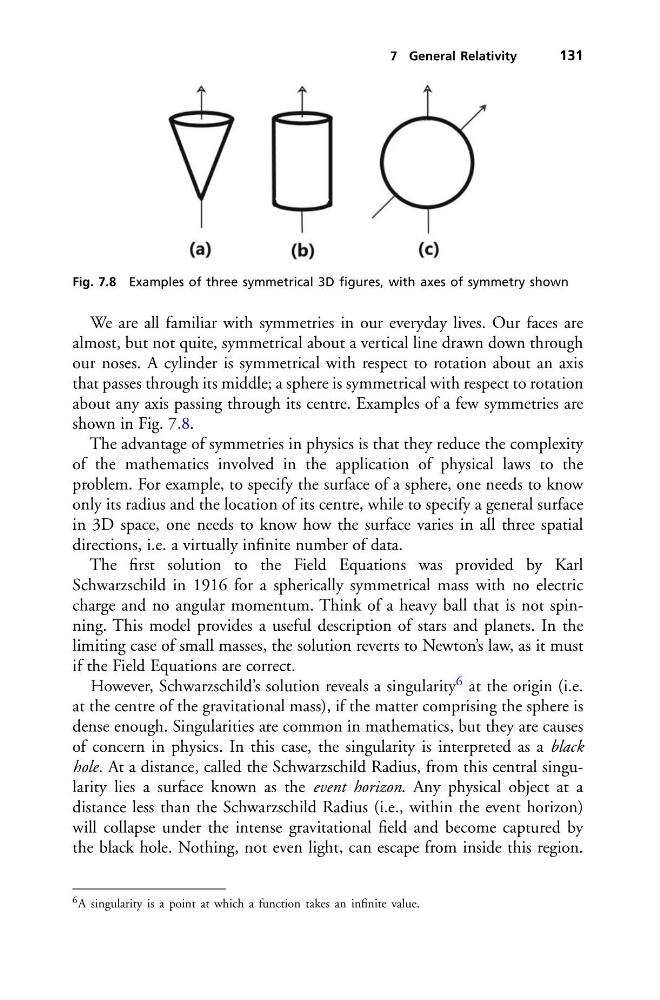
Fig. 7.8 Examples of three symmetrical 3D figures, with axes of symmetry shown
We are all familiar with symmetries in our everyday lives. Our faces are
almost, but not quite, symmetrical about a vertical line drawn down through
our noses. A cylinder is symmetrical with respect to rotation about an axis
that passes through its middle; a sphere is symmetrical with respect to rotation
about any axis passing through its centre. Examples of a few symmetries are
shown in Fig. 7.8.
The advantage of symmetries in physics is that they reduce the complexity
of the mathematics involved in the application of physical laws to the
problem. For example, to specify the surface of a sphere, one needs to know
only its radius and the location of its centre, while to specify a general surface
in 3D space, one needs to know how the surface varies in all three spatial
directions, i.e. a virtually infinite number of data.
The first solution to the Field Equations was provided by Karl
Schwarzschild in 1916 for a spherically symmetrical mass with no electric
charge and no angular momentum. Think of a heavy ball that is not spinning. This model provides a useful description of stars and planets. In the
limiting case of small masses, the solution reverts to Newton’s law, as it must
if the Field Equations are correct.
However, Schwarzschild’s solution reveals a singularity 6 at the origin (i.e.
at the centre of the gravitational mass), if the matter comprising the sphere is
dense enough. Singularities are common in mathematics, but they are causes
of concern in physics. In this case, the singularity is interpreted as a black
hole. At a distance, called the Schwarzschild Radius, from this central singularity lies a surface known as the event horizon. Any physical object at a
distance less than the Schwarzschild Radius (i.e., within the event horizon)
will collapse under the intense gravitational field and become captured by
the black hole. Nothing, not even light, can escape from inside this region.
6 A singularity is a point at which a function takes an infinite value.
131
Fig. 7.8 Examples of three symmetrical 3D figures, with axes of symmetry shown
We are all familiar with symmetries in our everyday lives. Our faces are
almost, but not quite, symmetrical about a vertical line drawn down through
our noses. A cylinder is symmetrical with respect to rotation about an axis
that passes through its middle; a sphere is symmetrical with respect to rotation
about any axis passing through its centre. Examples of a few symmetries are
shown in Fig. 7.8.
The advantage of symmetries in physics is that they reduce the complexity
of the mathematics involved in the application of physical laws to the
problem. For example, to specify the surface of a sphere, one needs to know
only its radius and the location of its centre, while to specify a general surface
in 3D space, one needs to know how the surface varies in all three spatial
directions, i.e. a virtually infinite number of data.
The first solution to the Field Equations was provided by Karl
Schwarzschild in 1916 for a spherically symmetrical mass with no electric
charge and no angular momentum. Think of a heavy ball that is not spinning. This model provides a useful description of stars and planets. In the
limiting case of small masses, the solution reverts to Newton’s law, as it must
if the Field Equations are correct.
However, Schwarzschild’s solution reveals a singularity 6 at the origin (i.e.
at the centre of the gravitational mass), if the matter comprising the sphere is
dense enough. Singularities are common in mathematics, but they are causes
of concern in physics. In this case, the singularity is interpreted as a black
hole. At a distance, called the Schwarzschild Radius, from this central singularity lies a surface known as the event horizon. Any physical object at a
distance less than the Schwarzschild Radius (i.e., within the event horizon)
will collapse under the intense gravitational field and become captured by
the black hole. Nothing, not even light, can escape from inside this region.
6 A singularity is a point at which a function takes an infinite value.