

All these data suggest the mechanism depicted in Scheme 12. Complex 51 forms
the alkoxy intermediate I from the alcohol in basic medium. Subsequently, hydride
II is generated through β-hydrogen elimination. This compound delivers its hydride
to the substrates, CO 2 or HCO 3
À , to produce the formato species III. Complex III
releases formate and, upon reaction with an alcohol and a base, regenerates the
alkoxy complex I that restarts the catalytic cycle [94].
2.3 Transfer Hydrogenation in Water
The development of aqueous TH reactions offers economic and environmental
benefits because water is cheap and non-toxic. Research into TH reactions in
water started in the 1980s. Sasson, Blum and co-workers reported on the aqueousorganic biphasic reduction of C¼C and C¼O bonds with phosphine ruthenium and
rhodium complexes in the presence of formate salts as hydrogen donor [95–
97]. Joó’s group reported on the hydrogenation of unsaturated bonds by using
water soluble rhodium and ruthenium complexes bearing sulfonated phosphine
ligands [98–100]. Thereafter, great progress was made in the TH of C¼C and
C¼O and also C¼N bonds. The most widely employed catalysts are half-sandwich
compounds, Cp*Ir complexes playing a remarkable role [101–108]. We collect here
new contributions in this area that have appeared in the last 5 years.
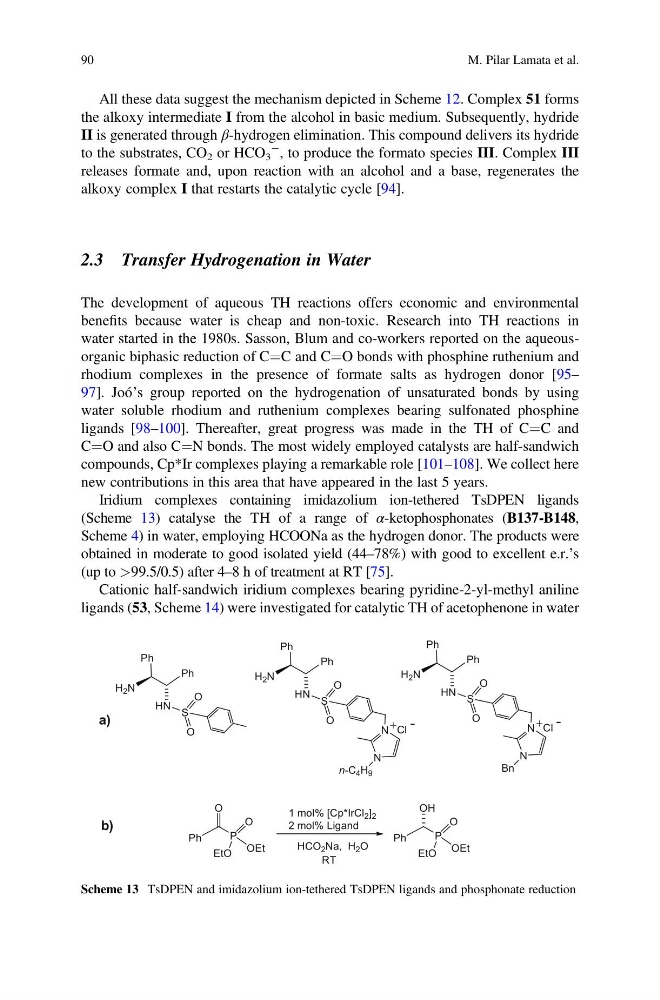
Iridium complexes containing imidazolium ion-tethered TsDPEN ligands
(Scheme 13) catalyse the TH of a range of α-ketophosphonates (B137-B148,
Scheme 4) in water, employing HCOONa as the hydrogen donor. The products were
obtained in moderate to good isolated yield (44–78%) with good to excellent e.r.’s
(up to >99.5/0.5) after 4–8 h of treatment at RT [75].
Cationic half-sandwich iridium complexes bearing pyridine-2-yl-methyl aniline
ligands (53, Scheme 14) were investigated for catalytic TH of acetophenone in water
H 2 N
Ph
Ph
HN S
O
O
H 2 N
Ph
Ph
HN S
O
O
N
N
n-C 4 H 9
+ Cl -
H 2 N
Ph
Ph
HN S
O
O
N
N
Bn
+ Cl -
Ph
P
O
O
EtO OEt
Ph
P
O
OH
EtO OEt
HCO 2 Na, H 2 O
1 mol% [Cp*IrCl 2 ] 2
RT
2 mol% Ligand
a)
b)
Scheme 13 TsDPEN and imidazolium ion-tethered TsDPEN ligands and phosphonate reduction
90
M. Pilar Lamata et al.
the alkoxy intermediate I from the alcohol in basic medium. Subsequently, hydride
II is generated through β-hydrogen elimination. This compound delivers its hydride
to the substrates, CO 2 or HCO 3
À , to produce the formato species III. Complex III
releases formate and, upon reaction with an alcohol and a base, regenerates the
alkoxy complex I that restarts the catalytic cycle [94].
2.3 Transfer Hydrogenation in Water
The development of aqueous TH reactions offers economic and environmental
benefits because water is cheap and non-toxic. Research into TH reactions in
water started in the 1980s. Sasson, Blum and co-workers reported on the aqueousorganic biphasic reduction of C¼C and C¼O bonds with phosphine ruthenium and
rhodium complexes in the presence of formate salts as hydrogen donor [95–
97]. Joó’s group reported on the hydrogenation of unsaturated bonds by using
water soluble rhodium and ruthenium complexes bearing sulfonated phosphine
ligands [98–100]. Thereafter, great progress was made in the TH of C¼C and
C¼O and also C¼N bonds. The most widely employed catalysts are half-sandwich
compounds, Cp*Ir complexes playing a remarkable role [101–108]. We collect here
new contributions in this area that have appeared in the last 5 years.
Iridium complexes containing imidazolium ion-tethered TsDPEN ligands
(Scheme 13) catalyse the TH of a range of α-ketophosphonates (B137-B148,
Scheme 4) in water, employing HCOONa as the hydrogen donor. The products were
obtained in moderate to good isolated yield (44–78%) with good to excellent e.r.’s
(up to >99.5/0.5) after 4–8 h of treatment at RT [75].
Cationic half-sandwich iridium complexes bearing pyridine-2-yl-methyl aniline
ligands (53, Scheme 14) were investigated for catalytic TH of acetophenone in water
H 2 N
Ph
Ph
HN S
O
O
H 2 N
Ph
Ph
HN S
O
O
N
N
n-C 4 H 9
+ Cl -
H 2 N
Ph
Ph
HN S
O
O
N
N
Bn
+ Cl -
Ph
P
O
O
EtO OEt
Ph
P
O
OH
EtO OEt
HCO 2 Na, H 2 O
1 mol% [Cp*IrCl 2 ] 2
RT
2 mol% Ligand
a)
b)
Scheme 13 TsDPEN and imidazolium ion-tethered TsDPEN ligands and phosphonate reduction
90
M. Pilar Lamata et al.