

as a solvent. A HCOOH/HCOONa mixture was used as a hydrogen source. The best
results were obtained with a HCOOH/HCOONa, 7.5/3.5 M ratio, in 2 mL of H 2 O
(pH ¼ 2.60). At 60
C, with a catalyst loading of 0.5 mol%, 95–96% of conversion
was achieved after 4–6 h of reaction [109].
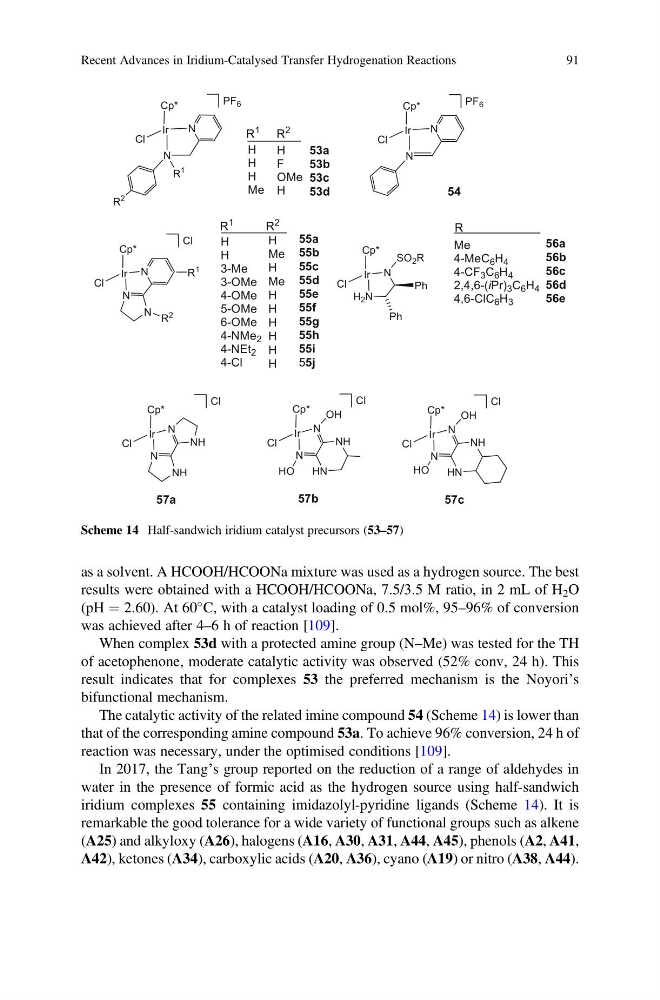
When complex 53d with a protected amine group (N–Me) was tested for the TH
of acetophenone, moderate catalytic activity was observed (52% conv, 24 h). This
result indicates that for complexes 53 the preferred mechanism is the Noyori’s
bifunctional mechanism.
The catalytic activity of the related imine compound 54 (Scheme 14) is lower than
that of the corresponding amine compound 53a. To achieve 96% conversion, 24 h of
reaction was necessary, under the optimised conditions [109].
In 2017, the Tang’s group reported on the reduction of a range of aldehydes in
water in the presence of formic acid as the hydrogen source using half-sandwich
iridium complexes 55 containing imidazolyl-pyridine ligands (Scheme 14). It is
remarkable the good tolerance for a wide variety of functional groups such as alkene
(A25) and alkyloxy (A26), halogens (A16, A30, A31, A44, A45), phenols (A2, A41,
A42), ketones (A34), carboxylic acids (A20, A36), cyano (A19) or nitro (A38, A44).
Cl
Ir
Cp*
N
R
1
R
2
N
R
1
R
2
PF 6
Cl
Ir
Cp*
N
N
PF 6
54
Cl
Ir
Cp*
N
Cl
N
N R
2
R
1
Cl
Ir
Cp*
Ph
SO 2 R
N
H 2 N
Ph
Cl
Ir
Cp*
Cl
N
NH
NH
N
Cl
Ir
Cp*
Cl
N
HO
HN
NH
OH
N
57a
57b
57c
Cl
Ir
Cp*
Cl
N
HO
HN
NH
OH
N
H
F
OMe
H
53a
53b
53c
53d
H
H
H
Me
Me
4-MeC 6 H 4
4-CF 3 C 6 H 4
2,4,6-(iPr) 3 C 6 H 4
4,6-ClC 6 H 3
56a
56b
56c
56d
56e
R
55a
55b
55c
55d
55e
55f
55g
55h
55i
55j
R 1
R 2
H
H
3-Me
3-OMe
4-OMe
5-OMe
6-OMe
4-NMe 2
4-NEt 2
4-Cl
H
Me
H
Me
H
H
H
H
H
H
Scheme 14 Half-sandwich iridium catalyst precursors (53–57)
Recent Advances in Iridium-Catalysed Transfer Hydrogenation Reactions
91
results were obtained with a HCOOH/HCOONa, 7.5/3.5 M ratio, in 2 mL of H 2 O
(pH ¼ 2.60). At 60
C, with a catalyst loading of 0.5 mol%, 95–96% of conversion
was achieved after 4–6 h of reaction [109].
When complex 53d with a protected amine group (N–Me) was tested for the TH
of acetophenone, moderate catalytic activity was observed (52% conv, 24 h). This
result indicates that for complexes 53 the preferred mechanism is the Noyori’s
bifunctional mechanism.
The catalytic activity of the related imine compound 54 (Scheme 14) is lower than
that of the corresponding amine compound 53a. To achieve 96% conversion, 24 h of
reaction was necessary, under the optimised conditions [109].
In 2017, the Tang’s group reported on the reduction of a range of aldehydes in
water in the presence of formic acid as the hydrogen source using half-sandwich
iridium complexes 55 containing imidazolyl-pyridine ligands (Scheme 14). It is
remarkable the good tolerance for a wide variety of functional groups such as alkene
(A25) and alkyloxy (A26), halogens (A16, A30, A31, A44, A45), phenols (A2, A41,
A42), ketones (A34), carboxylic acids (A20, A36), cyano (A19) or nitro (A38, A44).
Cl
Ir
Cp*
N
R
1
R
2
N
R
1
R
2
PF 6
Cl
Ir
Cp*
N
N
PF 6
54
Cl
Ir
Cp*
N
Cl
N
N R
2
R
1
Cl
Ir
Cp*
Ph
SO 2 R
N
H 2 N
Ph
Cl
Ir
Cp*
Cl
N
NH
NH
N
Cl
Ir
Cp*
Cl
N
HO
HN
NH
OH
N
57a
57b
57c
Cl
Ir
Cp*
Cl
N
HO
HN
NH
OH
N
H
F
OMe
H
53a
53b
53c
53d
H
H
H
Me
Me
4-MeC 6 H 4
4-CF 3 C 6 H 4
2,4,6-(iPr) 3 C 6 H 4
4,6-ClC 6 H 3
56a
56b
56c
56d
56e
R
55a
55b
55c
55d
55e
55f
55g
55h
55i
55j
R 1
R 2
H
H
3-Me
3-OMe
4-OMe
5-OMe
6-OMe
4-NMe 2
4-NEt 2
4-Cl
H
Me
H
Me
H
H
H
H
H
H
Scheme 14 Half-sandwich iridium catalyst precursors (53–57)
Recent Advances in Iridium-Catalysed Transfer Hydrogenation Reactions
91