

catalysts are, probably, the most intensively studied ones (for recent reviews, see
Refs. [88–91]). However, the protocols reported so far require, in general, harsh
conditions of temperature and pressure. TH approaches could try to avoid this
problem and allow for the use of renewable hydrogen sources with inherent advantages from a perspective of sustainability. However, reports on TH of CO 2 are
scarce. Most of them involve half-sandwich ruthenium or iridium complexes bearing
strongly electron-donating N-heterocyclic carbene ligands. In 2010, the group of
Peris reported the formation of formic acid from CO 2 in the presence of 2-propanol
as the hydrogen donor. With the iridium catalyst precursor 49 under 50 bar of CO 2 ,
in a 0.5 M KOH solution, a TON of 150 was obtained after 72 h at 110
C [92]. The
same group showed that the sulfonate substituted bis-abnormal carbene complex 50
afforded a TON of 2,700 under 50 bar of CO 2 , in a 0.5 M KOH solution, after 75 h at
200
C [93].
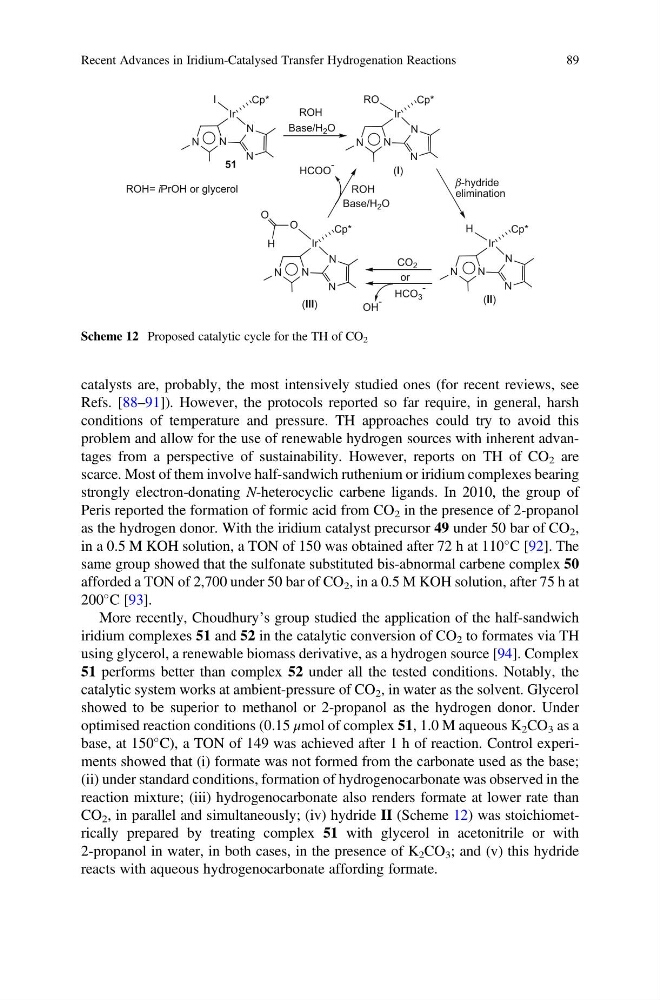
More recently, Choudhury’s group studied the application of the half-sandwich
iridium complexes 51 and 52 in the catalytic conversion of CO 2 to formates via TH
using glycerol, a renewable biomass derivative, as a hydrogen source [94]. Complex
51 performs better than complex 52 under all the tested conditions. Notably, the
catalytic system works at ambient-pressure of CO 2 , in water as the solvent. Glycerol
showed to be superior to methanol or 2-propanol as the hydrogen donor. Under
optimised reaction conditions (0.15 μmol of complex 51, 1.0 M aqueous K 2 CO 3 as a
base, at 150
C), a TON of 149 was achieved after 1 h of reaction. Control experiments showed that (i) formate was not formed from the carbonate used as the base;
(ii) under standard conditions, formation of hydrogenocarbonate was observed in the
reaction mixture; (iii) hydrogenocarbonate also renders formate at lower rate than
CO 2 , in parallel and simultaneously; (iv) hydride II (Scheme 12) was stoichiometrically prepared by treating complex 51 with glycerol in acetonitrile or with
2-propanol in water, in both cases, in the presence of K 2 CO 3 ; and (v) this hydride
reacts with aqueous hydrogenocarbonate affording formate.
Ir
Cp*
N
N
I
N
N
Ir
Cp*
N
N
RO
N
N
Ir
Cp*
N
N
O
N
N
Ir
Cp*
N
N
H
N
N
ROH= iPrOH or glycerol
Base/H 2 O
ROH
Base/H 2 O
HCOO
-
CO 2
HCO 3
-
OH
-
ROH
or
H
O
(I)
(II)
(III)
-hydride
elimination
51
b
Scheme 12 Proposed catalytic cycle for the TH of CO 2
Recent Advances in Iridium-Catalysed Transfer Hydrogenation Reactions
89
Refs. [88–91]). However, the protocols reported so far require, in general, harsh
conditions of temperature and pressure. TH approaches could try to avoid this
problem and allow for the use of renewable hydrogen sources with inherent advantages from a perspective of sustainability. However, reports on TH of CO 2 are
scarce. Most of them involve half-sandwich ruthenium or iridium complexes bearing
strongly electron-donating N-heterocyclic carbene ligands. In 2010, the group of
Peris reported the formation of formic acid from CO 2 in the presence of 2-propanol
as the hydrogen donor. With the iridium catalyst precursor 49 under 50 bar of CO 2 ,
in a 0.5 M KOH solution, a TON of 150 was obtained after 72 h at 110
C [92]. The
same group showed that the sulfonate substituted bis-abnormal carbene complex 50
afforded a TON of 2,700 under 50 bar of CO 2 , in a 0.5 M KOH solution, after 75 h at
200
C [93].
More recently, Choudhury’s group studied the application of the half-sandwich
iridium complexes 51 and 52 in the catalytic conversion of CO 2 to formates via TH
using glycerol, a renewable biomass derivative, as a hydrogen source [94]. Complex
51 performs better than complex 52 under all the tested conditions. Notably, the
catalytic system works at ambient-pressure of CO 2 , in water as the solvent. Glycerol
showed to be superior to methanol or 2-propanol as the hydrogen donor. Under
optimised reaction conditions (0.15 μmol of complex 51, 1.0 M aqueous K 2 CO 3 as a
base, at 150
C), a TON of 149 was achieved after 1 h of reaction. Control experiments showed that (i) formate was not formed from the carbonate used as the base;
(ii) under standard conditions, formation of hydrogenocarbonate was observed in the
reaction mixture; (iii) hydrogenocarbonate also renders formate at lower rate than
CO 2 , in parallel and simultaneously; (iv) hydride II (Scheme 12) was stoichiometrically prepared by treating complex 51 with glycerol in acetonitrile or with
2-propanol in water, in both cases, in the presence of K 2 CO 3 ; and (v) this hydride
reacts with aqueous hydrogenocarbonate affording formate.
Ir
Cp*
N
N
I
N
N
Ir
Cp*
N
N
RO
N
N
Ir
Cp*
N
N
O
N
N
Ir
Cp*
N
N
H
N
N
ROH= iPrOH or glycerol
Base/H 2 O
ROH
Base/H 2 O
HCOO
-
CO 2
HCO 3
-
OH
-
ROH
or
H
O
(I)
(II)
(III)
-hydride
elimination
51
b
Scheme 12 Proposed catalytic cycle for the TH of CO 2
Recent Advances in Iridium-Catalysed Transfer Hydrogenation Reactions
89