

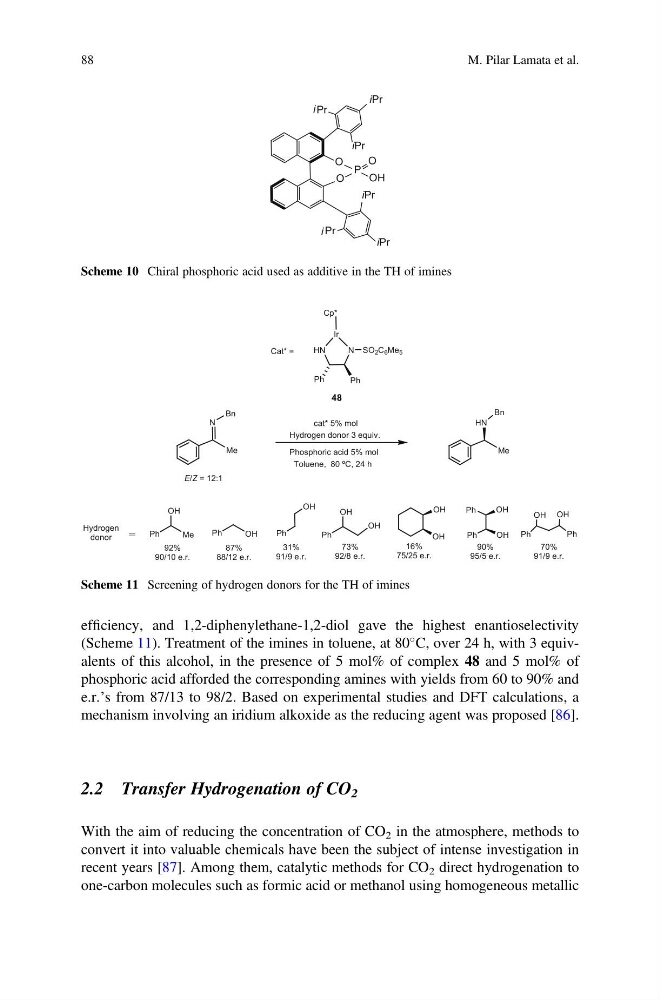
efficiency, and 1,2-diphenylethane-1,2-diol gave the highest enantioselectivity
(Scheme 11). Treatment of the imines in toluene, at 80
C, over 24 h, with 3 equivalents of this alcohol, in the presence of 5 mol% of complex 48 and 5 mol% of
phosphoric acid afforded the corresponding amines with yields from 60 to 90% and
e.r.’s from 87/13 to 98/2. Based on experimental studies and DFT calculations, a
mechanism involving an iridium alkoxide as the reducing agent was proposed [86].
2.2 Transfer Hydrogenation of CO 2
With the aim of reducing the concentration of CO 2 in the atmosphere, methods to
convert it into valuable chemicals have been the subject of intense investigation in
recent years [87]. Among them, catalytic methods for CO 2 direct hydrogenation to
one-carbon molecules such as formic acid or methanol using homogeneous metallic
O
O
P
O
OH
iPr
iPr
Pr
iPr
iPr
Pr
i
i
Scheme 10 Chiral phosphoric acid used as additive in the TH of imines
Cat* =
OH
Me
Ph
OH
Ph
Ph
OH
Ph
OH
OH
OH
OH
Ph
Ph
OH
OH
OH
Ph
OH
Ph
92%
90/10 e.r.
87%
88/12 e.r.
31%
91/9 e.r.
73%
92/8 e.r.
16%
75/25 e.r.
90%
95/5 e.r.
70%
91/9 e.r.
Toluene, 80 ºC, 24 h
HN
Ir
Cp*
N
48
Ph
Ph
SO 2 C 6 Me 5
N
Me
Bn
HN
Me
Bn
E/Z = 12:1
Hydrogen
donor
=
Hydrogen donor 3 equiv.
cat* 5% mol
Phosphoric acid 5% mol
Scheme 11 Screening of hydrogen donors for the TH of imines
88
M. Pilar Lamata et al.
(Scheme 11). Treatment of the imines in toluene, at 80
C, over 24 h, with 3 equivalents of this alcohol, in the presence of 5 mol% of complex 48 and 5 mol% of
phosphoric acid afforded the corresponding amines with yields from 60 to 90% and
e.r.’s from 87/13 to 98/2. Based on experimental studies and DFT calculations, a
mechanism involving an iridium alkoxide as the reducing agent was proposed [86].
2.2 Transfer Hydrogenation of CO 2
With the aim of reducing the concentration of CO 2 in the atmosphere, methods to
convert it into valuable chemicals have been the subject of intense investigation in
recent years [87]. Among them, catalytic methods for CO 2 direct hydrogenation to
one-carbon molecules such as formic acid or methanol using homogeneous metallic
O
O
P
O
OH
iPr
iPr
Pr
iPr
iPr
Pr
i
i
Scheme 10 Chiral phosphoric acid used as additive in the TH of imines
Cat* =
OH
Me
Ph
OH
Ph
Ph
OH
Ph
OH
OH
OH
OH
Ph
Ph
OH
OH
OH
Ph
OH
Ph
92%
90/10 e.r.
87%
88/12 e.r.
31%
91/9 e.r.
73%
92/8 e.r.
16%
75/25 e.r.
90%
95/5 e.r.
70%
91/9 e.r.
Toluene, 80 ºC, 24 h
HN
Ir
Cp*
N
48
Ph
Ph
SO 2 C 6 Me 5
N
Me
Bn
HN
Me
Bn
E/Z = 12:1
Hydrogen
donor
=
Hydrogen donor 3 equiv.
cat* 5% mol
Phosphoric acid 5% mol
Scheme 11 Screening of hydrogen donors for the TH of imines
88
M. Pilar Lamata et al.