

2-propano1 catalysed by [RuCl 2 (PPh 3 ) 3 ] was significantly accelerated upon adding a
catalytic amount of NaOH [9]. Furthermore, in 1995, Noyori and co-workers
reported that η
6 -arene complexes of ruthenium containing the ligand (1S,2S)-(N-ptoluenesulfonyl)-1,2-diphenylethylenediamine [(S,S)-TsDPEN] efficiently catalysed
the TH of aromatic ketones with 2-propanol affording high enantiomeric ratios (e.r.)
[10]. The same group discovered that the TH reaction took place through a new
bifunctional mechanism that involved cooperation between the metal and an NH
moiety of the ligand [11].
These two important findings fuelled an extraordinary flourishing of the TH
reaction which still continues nowadays. On the one hand, the scope of the substrates
to be hydrogenated and that of the hydrogen donors to be used have been extended,
asymmetric versions have been developed and water has been incorporated as one of
the solvents to be taken into account. On the other hand, metals and the class of
compounds employed as catalysts have expanded notably. So, along with complexes
of Ru, Rh and Ir, it has been shown that compounds of Ni [12, 13], Pd [14, 15], Re
[16], Os [17, 18], Pt [19, 20], Au [21, 22], Mo [23, 24], Zn [25, 26], Zr [27, 28] and
Bi [29] also efficiently catalyse the TH of a broad variety of unsaturated substrates.
In particular, in recent years, more abundant, cheap and healthy transition metal such
as Fe [12, 30–39], Co [12, 40, 41] and Mn [42–55] have attracted increasing
attention.
Iridium compounds have played a key role in the development of TH, allowing
for the achievement of important milestones. Among the most important advances
propelled by iridium compounds, it is worth mentioning the TH of linear imines.
Back in 1996, Noyori’s group reported that ruthenium complexes containing (S,S)TsDPEN as a ligand could catalyse the asymmetric TH of cyclic imines with
outstanding enantioselectivities [56]. However, it took until 2010 to have efficient
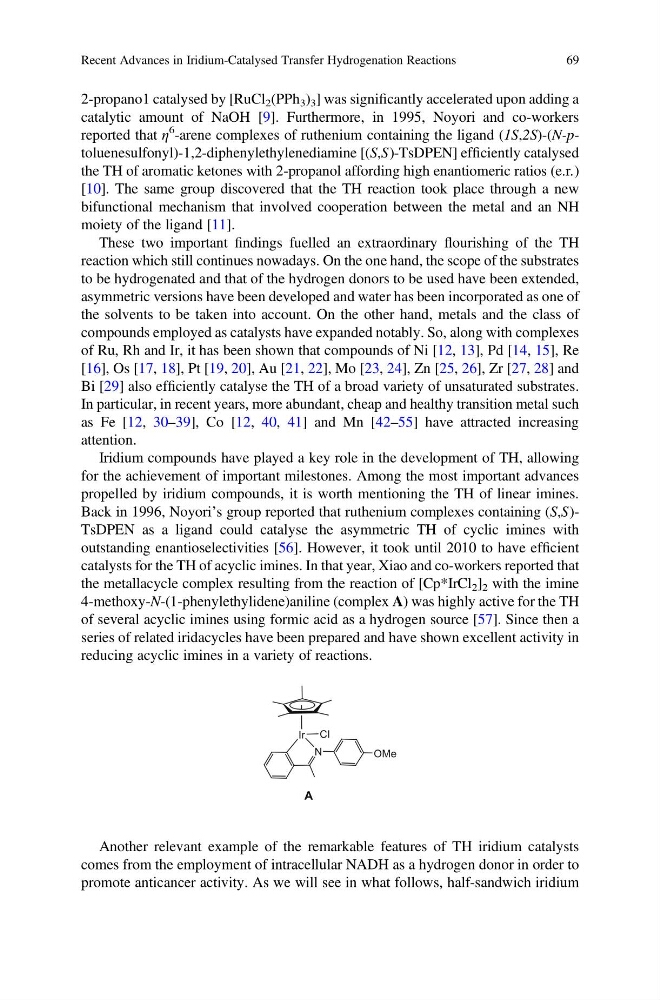
catalysts for the TH of acyclic imines. In that year, Xiao and co-workers reported that
the metallacycle complex resulting from the reaction of [Cp*IrCl 2 ] 2 with the imine
4-methoxy-N-(1-phenylethylidene)aniline (complex A) was highly active for the TH
of several acyclic imines using formic acid as a hydrogen source [57]. Since then a
series of related iridacycles have been prepared and have shown excellent activity in
reducing acyclic imines in a variety of reactions.
Ir Cl
N
OMe
A
Another relevant example of the remarkable features of TH iridium catalysts
comes from the employment of intracellular NADH as a hydrogen donor in order to
promote anticancer activity. As we will see in what follows, half-sandwich iridium
Recent Advances in Iridium-Catalysed Transfer Hydrogenation Reactions
69
catalytic amount of NaOH [9]. Furthermore, in 1995, Noyori and co-workers
reported that η
6 -arene complexes of ruthenium containing the ligand (1S,2S)-(N-ptoluenesulfonyl)-1,2-diphenylethylenediamine [(S,S)-TsDPEN] efficiently catalysed
the TH of aromatic ketones with 2-propanol affording high enantiomeric ratios (e.r.)
[10]. The same group discovered that the TH reaction took place through a new
bifunctional mechanism that involved cooperation between the metal and an NH
moiety of the ligand [11].
These two important findings fuelled an extraordinary flourishing of the TH
reaction which still continues nowadays. On the one hand, the scope of the substrates
to be hydrogenated and that of the hydrogen donors to be used have been extended,
asymmetric versions have been developed and water has been incorporated as one of
the solvents to be taken into account. On the other hand, metals and the class of
compounds employed as catalysts have expanded notably. So, along with complexes
of Ru, Rh and Ir, it has been shown that compounds of Ni [12, 13], Pd [14, 15], Re
[16], Os [17, 18], Pt [19, 20], Au [21, 22], Mo [23, 24], Zn [25, 26], Zr [27, 28] and
Bi [29] also efficiently catalyse the TH of a broad variety of unsaturated substrates.
In particular, in recent years, more abundant, cheap and healthy transition metal such
as Fe [12, 30–39], Co [12, 40, 41] and Mn [42–55] have attracted increasing
attention.
Iridium compounds have played a key role in the development of TH, allowing
for the achievement of important milestones. Among the most important advances
propelled by iridium compounds, it is worth mentioning the TH of linear imines.
Back in 1996, Noyori’s group reported that ruthenium complexes containing (S,S)TsDPEN as a ligand could catalyse the asymmetric TH of cyclic imines with
outstanding enantioselectivities [56]. However, it took until 2010 to have efficient
catalysts for the TH of acyclic imines. In that year, Xiao and co-workers reported that
the metallacycle complex resulting from the reaction of [Cp*IrCl 2 ] 2 with the imine
4-methoxy-N-(1-phenylethylidene)aniline (complex A) was highly active for the TH
of several acyclic imines using formic acid as a hydrogen source [57]. Since then a
series of related iridacycles have been prepared and have shown excellent activity in
reducing acyclic imines in a variety of reactions.
Ir Cl
N
OMe
A
Another relevant example of the remarkable features of TH iridium catalysts
comes from the employment of intracellular NADH as a hydrogen donor in order to
promote anticancer activity. As we will see in what follows, half-sandwich iridium
Recent Advances in Iridium-Catalysed Transfer Hydrogenation Reactions
69