

hydrogenation (TH) reactions. The reduction of carbonyls, imines, alkenes and
alkynes is considered. The TH of unsaturated alkene-carbonyl substrates and heterocycles is particularly studied. Recent results on the reduction of CO 2 are also
included. Special attention is paid to THs performed in aqueous medium as well as to
the development of TH in biological media. The employ of biomass-derived products as reagents or solvents in TH transformations is also reviewed. Finally, the
proposed mechanisms for TH reactions are revised.
Keywords Aldehydes · Alkenes · Alkynes · Biological transfer hydrogenation ·
Carbene complexes · Half-sandwich complexes · Ketones · Mechanisms · NHeterocycles · Pincer complexes · Sustainability · α,β-Unsaturated substrates
1 Introduction
Transfer hydrogenation (TH) reaction refers to the addition of hydrogen to an
unsaturated molecule from a sacrificial hydrogen donor other than H 2 usually with
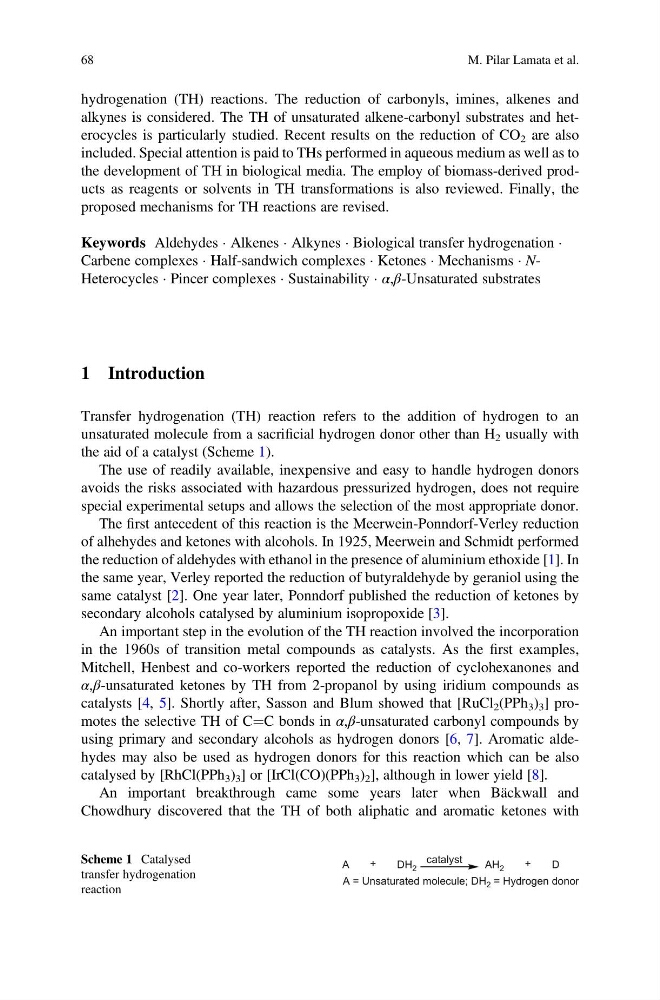
the aid of a catalyst (Scheme 1).
The use of readily available, inexpensive and easy to handle hydrogen donors
avoids the risks associated with hazardous pressurized hydrogen, does not require
special experimental setups and allows the selection of the most appropriate donor.
The first antecedent of this reaction is the Meerwein-Ponndorf-Verley reduction
of alhehydes and ketones with alcohols. In 1925, Meerwein and Schmidt performed
the reduction of aldehydes with ethanol in the presence of aluminium ethoxide [1]. In
the same year, Verley reported the reduction of butyraldehyde by geraniol using the
same catalyst [2]. One year later, Ponndorf published the reduction of ketones by
secondary alcohols catalysed by aluminium isopropoxide [3].
An important step in the evolution of the TH reaction involved the incorporation
in the 1960s of transition metal compounds as catalysts. As the first examples,
Mitchell, Henbest and co-workers reported the reduction of cyclohexanones and
α,β-unsaturated ketones by TH from 2-propanol by using iridium compounds as
catalysts [4, 5]. Shortly after, Sasson and Blum showed that [RuCl 2 (PPh 3 ) 3 ] promotes the selective TH of C¼C bonds in α,β-unsaturated carbonyl compounds by
using primary and secondary alcohols as hydrogen donors [6, 7]. Aromatic aldehydes may also be used as hydrogen donors for this reaction which can be also
catalysed by [RhCl(PPh 3 ) 3 ] or [IrCl(CO)(PPh 3 ) 2 ], although in lower yield [8].
An important breakthrough came some years later when Bäckwall and
Chowdhury discovered that the TH of both aliphatic and aromatic ketones with
A
+
DH 2
AH 2
+
D
catalyst
A = Unsaturated molecule; DH 2 = Hydrogen donor
Scheme 1 Catalysed
transfer hydrogenation
reaction
68
M. Pilar Lamata et al.
alkynes is considered. The TH of unsaturated alkene-carbonyl substrates and heterocycles is particularly studied. Recent results on the reduction of CO 2 are also
included. Special attention is paid to THs performed in aqueous medium as well as to
the development of TH in biological media. The employ of biomass-derived products as reagents or solvents in TH transformations is also reviewed. Finally, the
proposed mechanisms for TH reactions are revised.
Keywords Aldehydes · Alkenes · Alkynes · Biological transfer hydrogenation ·
Carbene complexes · Half-sandwich complexes · Ketones · Mechanisms · NHeterocycles · Pincer complexes · Sustainability · α,β-Unsaturated substrates
1 Introduction
Transfer hydrogenation (TH) reaction refers to the addition of hydrogen to an
unsaturated molecule from a sacrificial hydrogen donor other than H 2 usually with
the aid of a catalyst (Scheme 1).
The use of readily available, inexpensive and easy to handle hydrogen donors
avoids the risks associated with hazardous pressurized hydrogen, does not require
special experimental setups and allows the selection of the most appropriate donor.
The first antecedent of this reaction is the Meerwein-Ponndorf-Verley reduction
of alhehydes and ketones with alcohols. In 1925, Meerwein and Schmidt performed
the reduction of aldehydes with ethanol in the presence of aluminium ethoxide [1]. In
the same year, Verley reported the reduction of butyraldehyde by geraniol using the
same catalyst [2]. One year later, Ponndorf published the reduction of ketones by
secondary alcohols catalysed by aluminium isopropoxide [3].
An important step in the evolution of the TH reaction involved the incorporation
in the 1960s of transition metal compounds as catalysts. As the first examples,
Mitchell, Henbest and co-workers reported the reduction of cyclohexanones and
α,β-unsaturated ketones by TH from 2-propanol by using iridium compounds as
catalysts [4, 5]. Shortly after, Sasson and Blum showed that [RuCl 2 (PPh 3 ) 3 ] promotes the selective TH of C¼C bonds in α,β-unsaturated carbonyl compounds by
using primary and secondary alcohols as hydrogen donors [6, 7]. Aromatic aldehydes may also be used as hydrogen donors for this reaction which can be also
catalysed by [RhCl(PPh 3 ) 3 ] or [IrCl(CO)(PPh 3 ) 2 ], although in lower yield [8].
An important breakthrough came some years later when Bäckwall and
Chowdhury discovered that the TH of both aliphatic and aromatic ketones with
A
+
DH 2
AH 2
+
D
catalyst
A = Unsaturated molecule; DH 2 = Hydrogen donor
Scheme 1 Catalysed
transfer hydrogenation
reaction
68
M. Pilar Lamata et al.